
The Dates Merchants Should Know
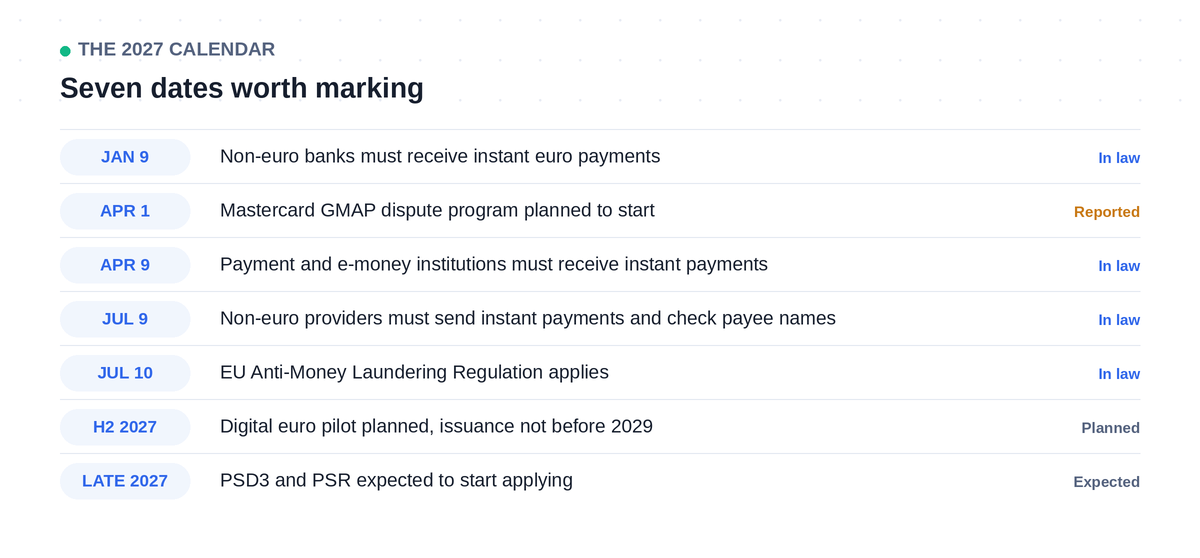
Every year around this time, the "what's coming" articles start. Most of them are vague. The nice thing about 2027 is that several changes already have dates attached, some written into EU law, some still reported or planned. That makes it possible to put a calendar on the wall and plan around it.
This article goes through what we found: instant bank payments, new EU anti-money-laundering rules, a reported change to how Mastercard monitors disputes, the payment services reform known as PSD3 and PSR, and a digital euro pilot. We also say which of these dates are fixed and which are not, because that difference matters when you're planning budgets and teams. If you work with higher-risk merchants, you'll see a few places where the changes land harder than average.
One thing up front. We're a payment company, not a law firm, and a lot of this is still moving. Treat the dates as a starting point and confirm what applies to you with your acquirer or your legal advisor.
Instant bank payments become the default
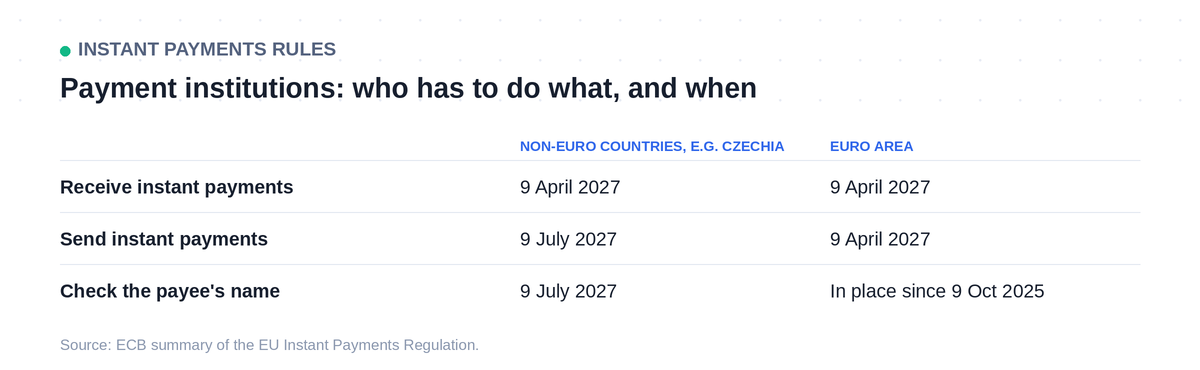
The EU's Instant Payments Regulation has been rolling out in stages. In the euro area, banks had to receive instant euro payments from January 2025 and send them from October 2025, along with a check that the name of the recipient matches the account number. In 2027 it's the turn of two other groups.
For countries outside the euro, including Czechia, banks must be able to receive instant euro payments from January 9, 2027. For payment and e-money institutions, the ECB lists April 9, 2027 as the date to receive instant payments, in euro and non-euro countries alike. Sending instant payments follows for non-euro providers on July 9, 2027, and so does the payee name check. Euro area payment institutions have to both receive and send from April 9, 2027.
What does that mean for a merchant? Mostly it affects money going out. Refunds, payouts to players or sellers, and settlement to you can move faster and around the clock. The name check is the part that will surprise some teams. When someone sends a transfer, the provider checks the recipient's name against the account number and warns if they don't match. That catches honest typos and some fraud. It also means a payout with a slightly different spelling of a name might get flagged, so it's worth testing your own payout flows before the dates arrive.
If you read our recent piece on pay by bank for iGaming, you'll see why this matters there too. Faster, name-checked bank transfers are the rail those payouts run on.
New EU anti-money-laundering rules start on July 10, 2027
The EU's new Anti-Money Laundering Regulation, known as AMLR, applies directly in all 27 member states from July 10, 2027. Until now, a lot of this was set by national laws that implemented EU directives, which is why a company could face slightly different expectations in different countries. A regulation replaces that patchwork with a single rulebook.
From what the published guidance describes, a few things change. Customer due diligence is split into standard, enhanced and simplified levels, with a list of defined cases where enhanced checks are required instead of leaving it entirely to each firm's own judgment. The basic threshold for identifying a beneficial owner stays at 25%, although the European Commission may lower it for high-risk sectors. Crypto-asset service providers authorized under the EU's MiCA rules come fully into scope. And the new EU authority, AMLA, begins directly supervising around 40 large, high-risk financial institutions from January 1, 2028, with the list due at the end of 2027.
That last date falls just outside 2027, but the preparation happens inside it. For most payment companies the rules will still be enforced by national supervisors, with AMLA setting standards and coordinating.
Here's our own reading, and it is our reading, not a quote from the rules. Merchants in sectors that regulators already watch closely, such as gaming, adult content, crypto and lending, should expect to be asked for more documents and clearer explanations of who owns the business and where the money comes from. Having that material ready before the question arrives usually makes onboarding and reviews faster. It is easy to do now and annoying to do under pressure.
Mastercard's reported change to dispute monitoring
This is the one where we need to be most careful. Reports from payment providers say Mastercard plans to replace its current chargeback monitoring with a new program called GMAP, starting April 1, 2027. We could not find the Mastercard document itself, and the details below come from provider guidance that says to confirm them with your acquirer.
As reported, the program would add new categories for merchants and acquirers with high or excessive dispute levels. It would combine fraud and non-fraud disputes into one ratio, so a fraud report counts even when it never turns into a chargeback. And monitoring would move to the submerchant level where possible, instead of looking only at the shared merchant ID. Reported thresholds and fees are specific, but we are not repeating the numbers here, because they are not confirmed.
Why does this matter for you? If you've been watching only your chargebacks, a combined ratio is a different measurement. Payment facilitators and platforms that group many small merchants under one ID would feel the submerchant change most. It also fits a pattern we've seen before. Visa already counts fraud reports and chargebacks together under its VAMP program, and the card networks keep tightening where disputes are concerned. Ask your acquirer directly: which program applies to us, what is our current ratio under it, and what changes in April?
PSD3 and the Payment Services Regulation
The EU's reform of PSD2 has two parts, a new directive called PSD3 and a regulation called PSR. A provisional political agreement was reached in November 2025, and final compromise texts were circulated to member states in April 2026. Formal adoption is expected in 2026. Law firm guidance tells payment firms to expect the new regime to take effect by late 2027, with transition rules for licensing. Dates like these often shift, so we put this one on the calendar as expected, not confirmed.
The pieces that matter to merchants, as law firms summarize them:
- More responsibility on providers for certain scams. Where a payer is tricked into a payment in defined cases, the rules treat the payment as unauthorized and the payer's provider has to reimburse. Providers also have to run risk-based monitoring on transactions.
- Name checks beyond instant payments. The payee name and account number check extends to credit transfers that aren't already covered by the instant payments rules.
- Tougher standards for open banking connections. Banks' interfaces face more detailed performance and uptime requirements, and regulators are told to act without delay when they fall short. That's good news for anyone who wants to offer pay by bank.
- Fraud data sharing. Providers get a clearer legal basis to exchange fraud information with each other, within data protection rules.
Our view: for most merchants these changes will arrive through their provider, not directly. You'll see them as updated contract terms, new authentication steps and slightly different dispute flows. The practical step is to ask your provider in good time what changes for your account and when.
A digital euro pilot, and a long road after it
The digital euro keeps showing up in headlines, so here is where it stands. The Council of the EU agreed its position in December 2025, and the European Parliament adopted its position in July 2026. Negotiations between them were still going in October. The ECB has said it wants to be ready for a first issuance in 2029, but only if the law is completed by the end of 2026.
For 2027, the ECB plans a pilot in the second half of the year, running for about one year. It would use a beta version that is not legal tender, with central bank staff and merchants taking part. The ECB has named 36 payment service providers for the trial. The draft law also proposes a way to limit what merchants pay in fees, but that part is still under negotiation.
So a digital euro in your checkout in 2027 is very unlikely. What's realistic is more news, more pilots and a possible decision about whether merchants will be required to accept it. It's worth following, but it's not something to build around yet.
What this means for high-risk merchants
None of these changes are aimed at high-risk businesses specifically. But several of them hit harder when your business already gets extra attention. Combined dispute ratios are harder to stay under when your category sees more disputes. Stronger AML expectations mean more paperwork for sectors regulators already watch. Faster payouts help players and sellers, and they also give fraudsters less time to be caught, which is why name checks and monitoring are getting stricter at the same time.
The opportunity is that merchants who are organized look better to acquirers, and acquirers choose who they keep during a tightening. A clean file, a clear dispute process and a payout flow that has been tested are all things you control.
A short list for the first half of 2027
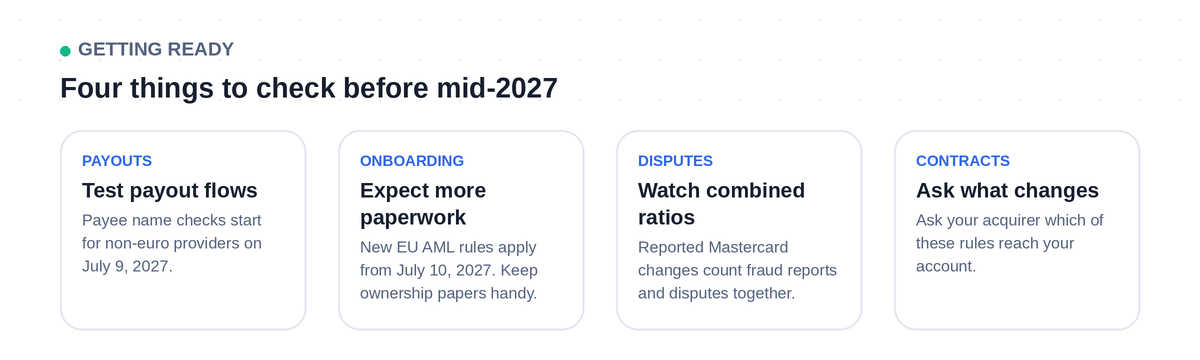
- Ask your provider when instant payouts and payee name checks apply to your account, and test payouts with real names, including unusual spellings.
- Gather your company documents now: ownership structure, who controls the business, and where your funds come from.
- Check your dispute numbers as a combined figure, fraud reports plus chargebacks, divided by sales, and ask your acquirer which program they're measured against.
- If you run a platform or marketplace, ask how disputes will be tracked per submerchant.
- Look at your contract renewal dates. Changes often reach merchants through new terms.
- Pick one person who owns this calendar, so the dates don't get lost.
The short version
2027 is less about one big new thing and more about several smaller deadlines landing close together. Instant payments and name checks arrive in the spring and summer. New AML rules start on July 10. A reported Mastercard dispute program is planned for April. PSD3 and PSR are expected late in the year, and a digital euro pilot runs in the second half. The dates differ in how firm they are, and the sooner you ask the right questions, the less you'll need to scramble.
At MMG Corporation, we work with merchants in higher-risk verticals on payment setups that fit how their business really runs. If you'd like to talk through what these dates mean for your setup, get in touch.
Get in touchThis article was researched and written with the help of AI tools as part of our content process, and reviewed and fact-checked by the MMG team before publication.
Sources
- European Central Bank: Instant Payments Regulation, implementation deadlines
- C9 Group: SEPA Instant 2027 for payment and e-money institutions (non-euro member states)
- Morrison Foerster: PSD3 and the Payment Services Regulation, key developments (April 2026)
- CheckMarble: EU AMLR, what changes in July 2027
- Chargeflow: Mastercard GMAP, 2027 changes (based on provider guidance, details unconfirmed)
- SeamlessChex: Visa VAMP and recurring billing
- EconoTimes: ECB plans 2027 digital euro pilot (October 2026)