
What It Fixes and What It Doesn't
Card payments are the default way players fund a gambling account, and every operator knows the downsides. Issuers decline or block gambling transactions. Disputes come in weeks later. Fees add up. So it's no surprise that "pay by bank" keeps showing up in conversations about what comes next.
Pay by bank, sometimes called open banking payments or account-to-account payments, lets a player approve a transfer straight from their bank app. No card number, no card network in the middle. Some of the claims around it sound almost too good. This article looks at what it genuinely changes for an iGaming operator, and what it doesn't. A quick note on sources: most of what's published about this comes from open banking vendors, so we leave out their big promises and stick to points that hold up across several of them.
How a pay by bank deposit works
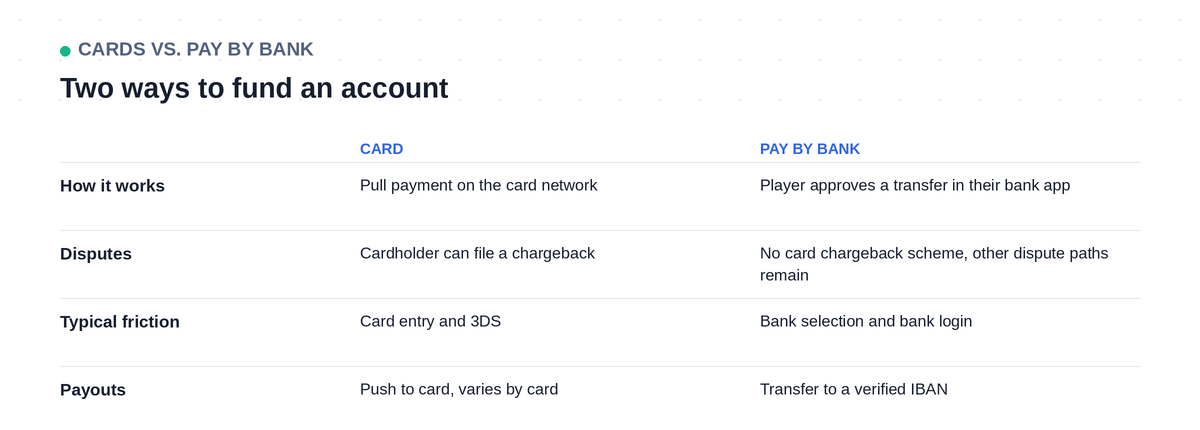
The player picks "pay by bank," chooses their bank, and is sent to their banking app or login to approve a payment for a set amount. When the bank confirms, the operator credits the wallet. Because the player authenticates with their own bank, strong customer authentication is built into the step.
That sounds small, but it shifts a few things. The money moves between bank accounts instead of over card rails. The operator isn't handling card details at all. And the bank, not a card issuer, decides whether the payment goes through.
Why operators are asking about it now
Three pressures push in the same direction. First, card acceptance in gambling is uneven. A player can have money in the bank and still get declined at the cashier, and every decline is a lost deposit. Second, disputes carry a cost beyond the lost amount. Card programs count disputes against a merchant, and acquirers can apply their own limits to gaming, so a rising dispute ratio is a real business problem. Third, players expect to move money quickly, both in and out. A method that settles through the bank and can pay out to the same account looks attractive on all three counts.
None of that makes it a drop-in replacement. It makes it worth a proper look.
What it can fix
Card declines. Many card issuers block or decline gambling transactions. A bank transfer doesn't go through the same issuer decision, so operators often look at it as a second route for players whose cards keep failing. We haven't seen independent numbers on how much approval rates improve, so treat any specific percentage you hear with caution.
Card chargebacks. A pay by bank payment doesn't go through the card networks, so there's no card chargeback scheme. That removes the dispute type that worries gaming operators most: the player who loses and then tells their card issuer the deposit was unauthorized.
Fees. Bank transfers can be cheaper than card processing for some operators. The details depend entirely on the provider and the market, and public sources rarely give real figures, so this one needs a quote, not an assumption.
What it doesn't fix
This is where some of the marketing goes too far. A few vendor pages say chargebacks "don't exist" or fraud is "virtually eliminated" with pay by bank. That's too strong.
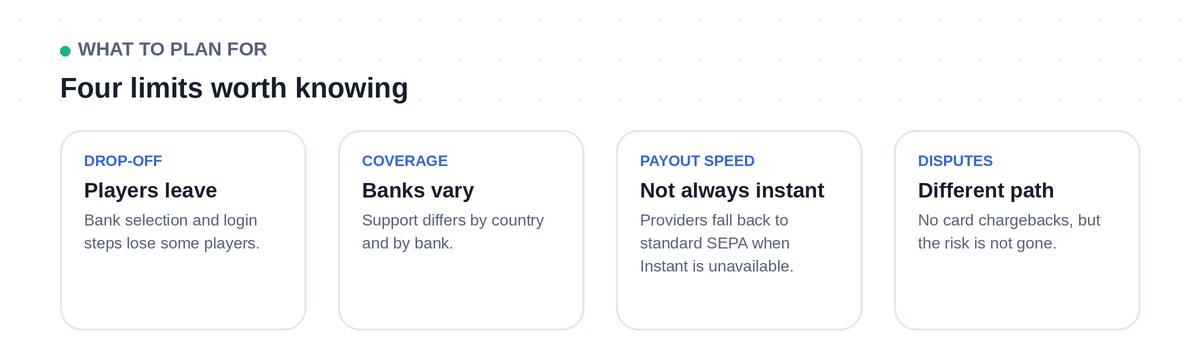
Account-to-account payments follow a different dispute path, not no dispute path. In Europe, payment services rules still give payers rights when a payment wasn't authorized, and banks handle those claims in their own way. If a player's bank account is taken over, the operator can still end up in the middle of a dispute. And the usual gambling problems stay exactly where they were: bonus abuse, multi-accounting, money laundering, and players who regret a deposit. Those are behavior problems, and a different payment rail doesn't remove them.
There are practical limits too.
- Drop-off. Choosing a bank, logging in and approving the payment adds steps. Players can abandon along the way, especially when there's no card fallback.
- Coverage. Bank support varies by country and by bank. Operators have to check that the banks their players actually use are supported in each market they're licensed in.
- Two different stacks. UK open banking and EU rules work separately, so a setup for one market doesn't automatically carry over to the other.
More than a deposit button
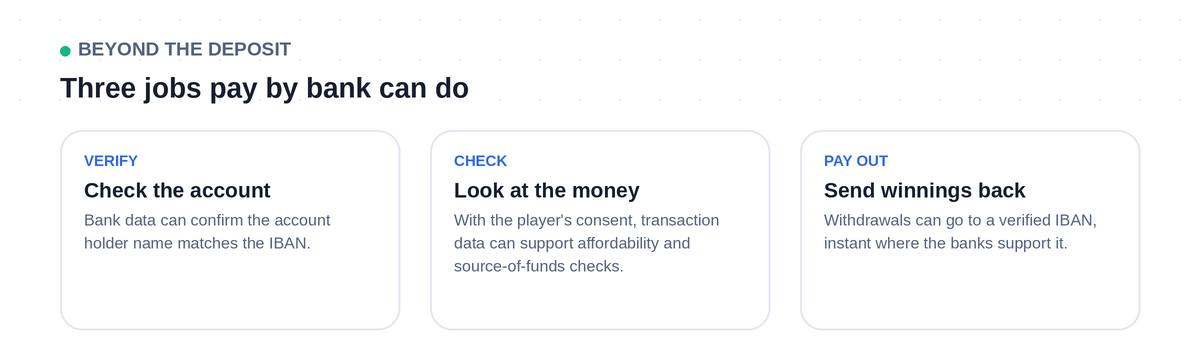
The more interesting uses sit around the payment. With the player's consent, bank connections can return the account holder's name and IBAN, which operators can match against the identity they already verified. That's a handy extra check next to ID documents, not a replacement for them.
Some operators also look at transaction data with consent to support affordability and source-of-funds checks. Regulators in several markets expect checks like these, though the rules differ, and one data source is only one signal among several. It's worth asking your compliance team what actually counts in each market before building a flow around it.
Payouts are the other half
Withdrawals can go back to a verified IBAN, and the idea of near-instant payouts is a big part of the pitch. Where the banks support instant euro transfers, that can work well. Where they don't, providers usually fall back to standard SEPA, which is slower. Licensing conditions can also add holding periods or manual reviews, so the speed players see depends on more than the payment rail. Promise players only what you can deliver in each market.
What it means for your risk team
A bank payment gives the risk team a different kind of signal. Instead of a card number and a billing address, you may get the verified account holder name and the bank the money came from. That can help catch a player funding an account with someone else's money, which is a common pattern in both fraud and money laundering.
It also makes the "pay out to where the money came from" rule easy to follow. If deposits arrive from a verified account, withdrawals can go back to that same account. Mule accounts, where a person receives funds on behalf of someone else, are still a concern, so identity checks stay in place. What changes is where the evidence comes from.
Velocity rules need a second look as well. Limits built around card behavior, such as several small deposits from one card, don't map neatly onto bank transfers. Ask your provider which signals you can see and tune the rules to those, instead of copying the card setup over.
Questions to ask before you add it
- Which banks and countries does the provider cover, and does that match where your players are?
- What happens when a player abandons the flow? Is there a card or wallet fallback on the same screen?
- How are refunds and disputes handled when a player says a payment wasn't theirs?
- Can payouts go out instantly, and in which markets? What are the fallbacks?
- What does your licensing authority say about the data you'd use for affordability or KYC checks?
- What are the real fees, with a quote, not a brochure?
The short version
Pay by bank can take pressure off card declines and remove card chargebacks from part of your volume. It won't remove fraud, bonus abuse or the need for good checks, and it brings its own drop-off and coverage questions. Most operators will end up running it next to cards, not instead of them, so the real question is where it earns its place in your mix.
At MMG Corporation, we work with merchants in higher-risk verticals, including gaming, on payment setups that fit how their business really runs. If you'd like to talk through your payment flow, get in touch.
Get in touchThis article was researched and written with the help of AI tools as part of our content process, and reviewed and fact-checked by the MMG team before publication.