
Where Approvals Really Move
In the first article of this series we looked at the four places where location shows up in payments. One of them gets the least attention from merchants and has probably the most direct link to approval rates: where your payment is processed, and how it gets there.
This article is about two connected topics. Local acquiring is about who handles the payment in which country. Routing is about which path each payment takes. Both are often sold with big promises, and both come with real costs. Let's look at what they do, what they don't do, and how to decide whether either belongs in your setup.
What local acquiring means
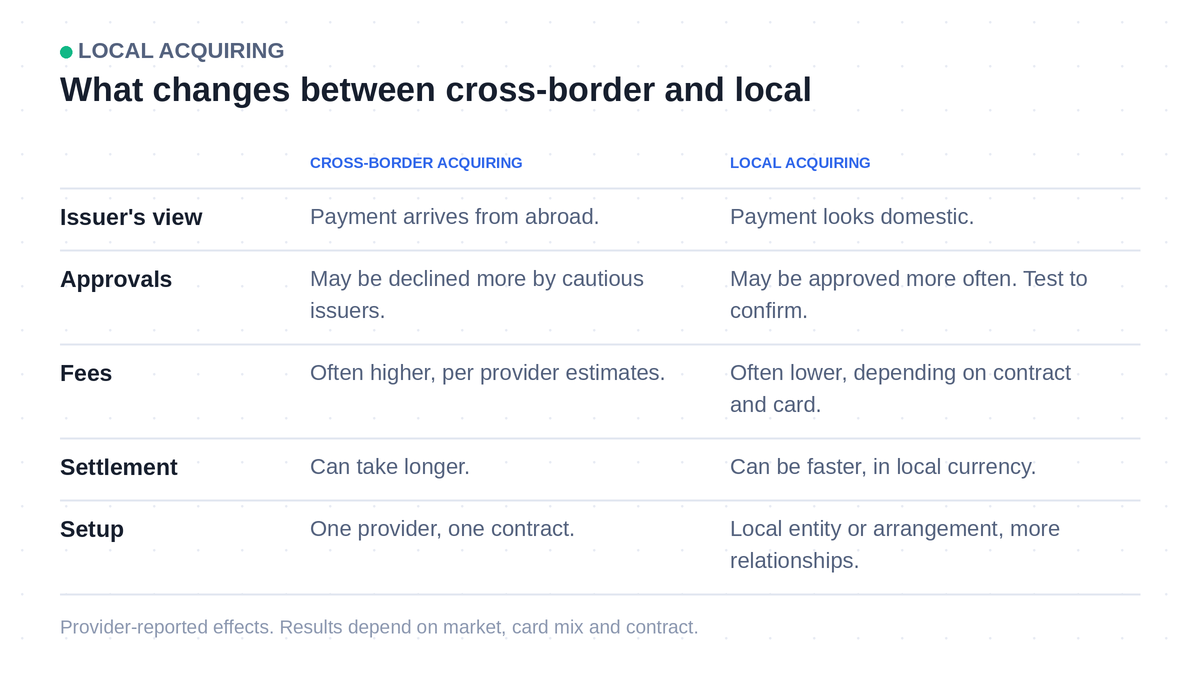
Your acquirer is the company that processes card payments for you and passes them on to the card networks and issuers. Local acquiring means the acquirer sits in the same country as the cardholder's bank, or at least runs the payment through a local entity there. A customer in Germany pays with a German card, and the payment goes through a German acquiring setup. To the issuer, it looks like a domestic payment.
With cross-border acquiring, the same customer pays with the same card, but the payment comes from an acquirer abroad. The card works. It just arrives with a different label on it.
Why the label matters to issuers
Issuers decide in a fraction of a second whether to approve a payment. Whatever they know about the transaction goes into that decision, and the country of the acquirer is part of it.
There's a reason for caution. Card fraud data from the European Central Bank, quoted in a May 2026 brief by the International Center for Law & Economics, shows that cross-border card transactions made up roughly a tenth of card value between 2016 and 2021, and close to two thirds of fraud losses by value. The ICLE is a think tank that argues for different interchange rules, so read its conclusions as one side of that debate. The underlying point, that issuers see more risk in cross-border payments, is also made by payment providers. Checkout.com notes that some issuers look closely at cross-border payments and may treat a foreign acquirer as higher risk.
The result for a merchant can be a good customer with a good card who still gets declined, with nothing wrong on their side or on the cardholder's.
What you can gain
Providers describe four possible benefits.
- Approvals. Payments that look domestic may be approved more often. Providers say so, and the logic holds. What we couldn't find is a published, independently checked number. The figures out there come from vendors who sell local acquiring, so treat any percentage as a claim to test on your own traffic.
- Fees. Cross-border payments often carry higher interchange, scheme and processing fees. Checkout.com estimates the difference at up to 1% or more per payment. That's the provider's own estimate and it will vary with card type, market and contract.
- Settlement. Domestic settlement can be faster than cross-border settlement, which helps cash flow planning.
- Currency. Charging customers in their own currency can reduce currency-related declines and spares them foreign transaction fees from their bank.
What it costs you
Local acquiring is not free of friction, and this is where many projects stall.
- Setup. You typically need a legal entity or a local arrangement in each country, along with local banking. Checkout.com describes this as lengthy and laborious.
- Complexity. Each acquirer has its own pricing, support, reporting and rules. Ten markets can mean ten relationships to manage.
- Currency again. Money settled locally still has to come home, and converting it costs something.
- Tools. Local acquirers may offer fewer fraud tools or payment methods than a global provider.
It's also rare in practice. Research by Checkout.com with Oxford Economics found that only 20% of companies have direct access to a local acquirer in their key global markets. That number comes from a provider that sells these services, but it matches what most merchants tell us: it's something they know they should look at and haven't gotten to.
Routing: choosing the path for each payment
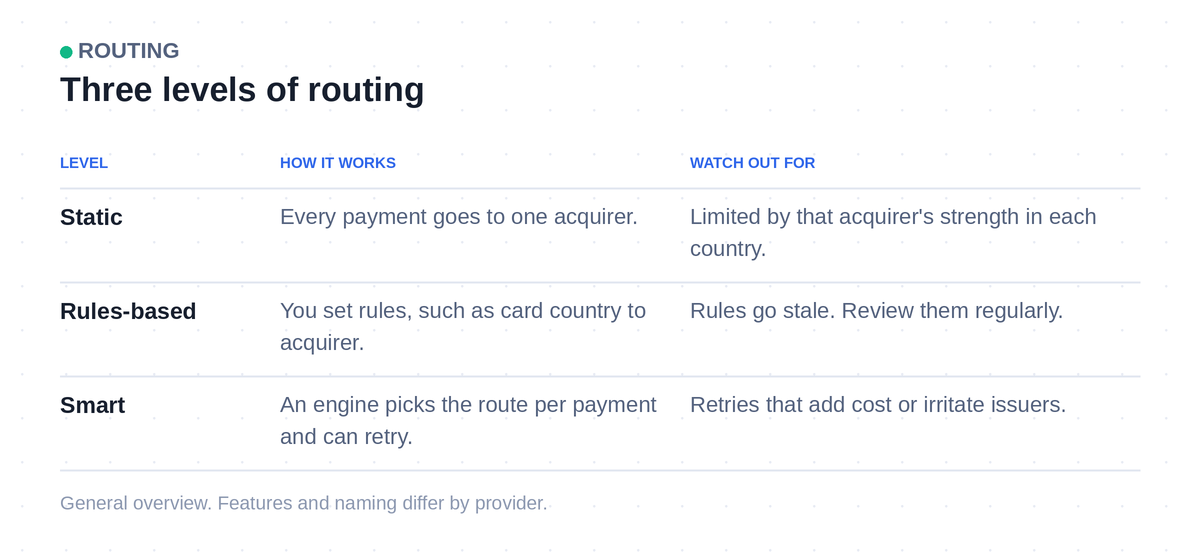
Once you have more than one route available, the next question is how a payment picks one. There are roughly three levels.
Static. Every payment goes to one acquirer. Simple, easy to report, and you're limited to what that acquirer does well in each country.
Rules-based. You decide in advance: cards from country A go to acquirer X, cards from country B go to acquirer Y. This is where local acquiring usually starts.
Smart or dynamic. A routing engine picks the path per payment, using performance data and provider health, and can retry a failed payment on another route. Stripe describes this approach and makes one point worth keeping in mind: the cheapest route is rarely the best one if it measurably hurts approval rates. Stripe also warns that badly tuned retries can raise costs or irritate issuers. Its own page gives no measured results for routing, so as with local acquiring, the proof has to come from your data.
An example, to make it concrete
Picture a merchant based outside the EU who sells to customers across Europe through one acquirer back home. Germany is its second biggest market. When the team splits the reports by the country of the card, German cards get declined noticeably more than French or Dutch ones. The reasons are mixed: some are normal issuer declines, some look like risk rules.
The team doesn't switch everything. It asks a provider with a local setup to take a share of German card traffic for a few weeks, keeps the rest where it is, and compares approval rate, cost per successful sale and decline reasons. If the numbers improve, Germany moves over. If they don't, the merchant has lost nothing but a small test. This is an invented example, and the point is the method: one market, one change, a clean comparison.
Where it tends to go wrong
- Looking only at the blended approval rate. An average can look fine while one country is struggling. Split by country and by issuer country.
- Changing several things at once. New acquirer, new currency display and new retry rules in the same week make results impossible to read.
- Aggressive retries. Sending the same declined payment again and again can irritate issuers, and it can add cost.
- Ignoring reporting. If you can't see results by country and by route, you can't tell whether the change worked.
Do you need it?
Most merchants shouldn't start by asking "should we get local acquiring?" A better first question is "where do our numbers say we lose payments?"
If approval rates are similar across your markets, a single global setup may be fine for now. If one country or one group of issuers stands out with more declines than the rest, and it's a market with real volume, that's the place to test. A common pattern is local acquiring in the few largest markets and a cross-border setup everywhere else. Nuvei's guide recommends a mix along those lines, and it's the one that keeps complexity in check.
Sector matters too. Acquirers' appetite for different business types varies by country, so merchants in higher-risk categories should ask early which local options exist at all.
Questions to ask a provider
Before you switch anything, these four questions will tell you a lot.
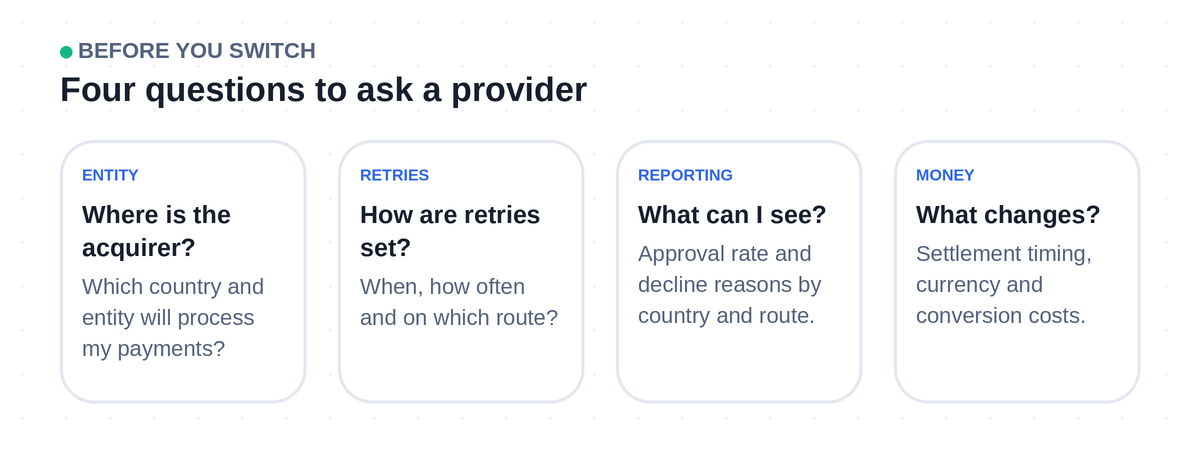
And ask for a test. A fair way to check any claim is to send part of the traffic from one market through the new route and compare approval rate, cost per successful sale and decline reasons with the rest. A few weeks of data beats any brochure.
What comes next
The last article in the series moves to the checkout: local payment methods, currency display and how to handle the fact that location detection is never perfect.
If you'd like to talk through routing or acquiring options for your own markets, get in touch with our team.
Get in touchThis article was researched and written with the help of AI tools as part of our content process, and reviewed and fact-checked by the MMG team before publication.
Sources
- Checkout.com: Unlocking global commerce with local card acquiring (provider blog, 2023)
- Checkout.com: What are the most common reasons for card declines? (provider blog)
- Stripe: Intelligent payment routing for higher authorization rates and lower costs (provider guide, 2026)
- Nuvei: The 2026 guide to global payment acceptance, local acquiring and approval rates (provider guide)
- International Center for Law & Economics: Declined at the border, how interchange caps disrupt cross-border commerce (Issue Brief, May 2026), citing European Central Bank data