
Ask an operator where their chargebacks come from and you'll usually hear "deposits." That's right, but it leaves out half the story. Deposits are where disputes get filed. Withdrawals are where a lot of them get decided, long before anyone contacts a bank.
This article walks through both sides of the cashier: what actually triggers a dispute, what happens when money goes out instead of in, and what's worth capturing so you can answer a dispute when one arrives. A quick note on sources: much of the public material on gaming chargebacks comes from payment vendors, so we treat specific numbers with care and say so where we're reasoning from how the business works.
Deposits are where the dispute is filed
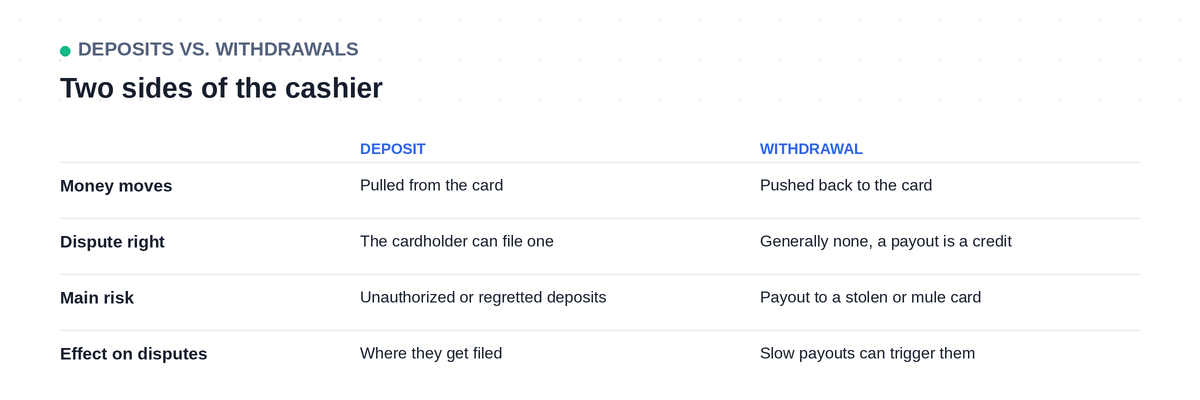
A card deposit is a pull payment. The player authorizes it, the money leaves their account, and from that moment the cardholder has dispute rights with their bank. That's true for every merchant. Gaming just has an unusual mix of reasons behind it.
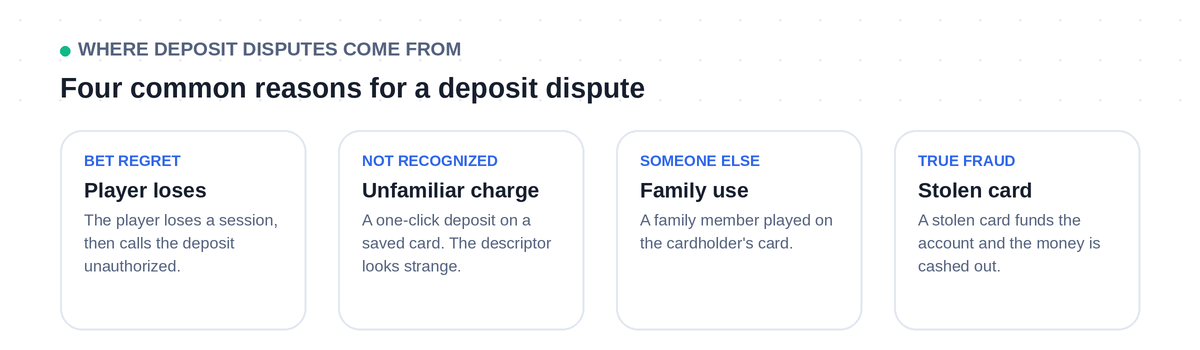
In practice, deposit disputes tend to fall into four groups:
- Bet regret. The player loses a session, then tells the bank the deposit was unauthorized. Industry sources describe this as the most common cause, often called first-party misuse or friendly fraud.
- Not recognized. One-click deposits on a saved card are convenient. They also mean the player may not remember doing it, especially if the name on the statement looks nothing like the brand they play on.
- Someone else. A partner, a teenager, a friend who borrowed the card. The cardholder disputes, and the operator has to prove who was actually at the keyboard.
- True fraud. A stolen card funds an account, a little gets played, and the balance is withdrawn elsewhere. These disputes are legitimate, and they carry anti-money-laundering weight on top.
Gaming has a few extra headwinds. Many issuers decline or block gambling transactions outright, and decline rates run high, especially across borders. Every decline is lost revenue, and some of the players who get declined try again with a different card, which makes the fraud picture messier.
Withdrawals can't be charged back, but they shape disputes
A withdrawal back to a card is a credit. The money goes toward the cardholder, not away from them, so as far as we know there's generally no dispute for the player to file against it. That's a big structural difference from deposits.
The connection to chargebacks is indirect, and it runs through player behavior. When a player has won and the payout drags on for days, they start to worry. Some processors and industry commentators report that long withdrawal delays, in the range of five to seven days, go together with players disputing their deposits. We haven't found independent data that proves cause and effect, so treat this as a pattern operators describe rather than a measured rule. It does match what you'd expect from people. Someone who can't reach their money and gets vague answers from support will often try the one channel that always gets a response, which is their bank.
Expectations have moved too. One 2024 PYMNTS piece, cited by a payments vendor, puts the share of players who expect instant or near-instant payouts at 79%. Even if the exact figure is off, the direction is clear: deposits are instant, so a payout that takes a week feels like a broken promise.
Fast, predictable payouts help in two ways
Most major card networks offer push-to-card payout services, which are the same rails used for deposits, run in reverse. They typically let funds reach the player's card quickly and give the operator a clear success or failure message. Details and limits vary by acquirer and by card, so check what yours supports before you promise anything to players.
Used well, payouts do two things. They remove a common reason for a dispute, which is a player who thinks they were never paid. And they leave a record: a successful payout to the same card that funded the account is useful evidence later.
The payout side has its own risks
Faster isn't automatically better. Once money is sent, you generally can't pull it back. A payout to a card that was stolen, or to a mule account that receives funds for someone else, is a direct loss for the operator, and it can also draw attention from the acquirer.
That's why the usual controls sit in front of the payout, not after it. Identity checks, source-of-funds questions for larger amounts, and a rule that withdrawals go back to the card that funded the account all do real work here. Many operators also set payout speed by player risk. A verified player with a clean history gets money quickly. A new account with one deposit and a large win gets a closer look first. It's a reasonable trade, as long as the player is told what to expect.
Build the file before the dispute
When a dispute does arrive, the operator who can show what happened wins more often than the one who can only say it. Card network rules for fraud disputes, including Visa's Compelling Evidence 3.0, let a merchant point to earlier undisputed transactions that share data elements such as device ID and IP address. As vendors describe the rule, at least two matching elements are needed, one of them the IP or device, across transactions from a window of roughly four to twelve months. Check the current rule text with your acquirer, because details change.
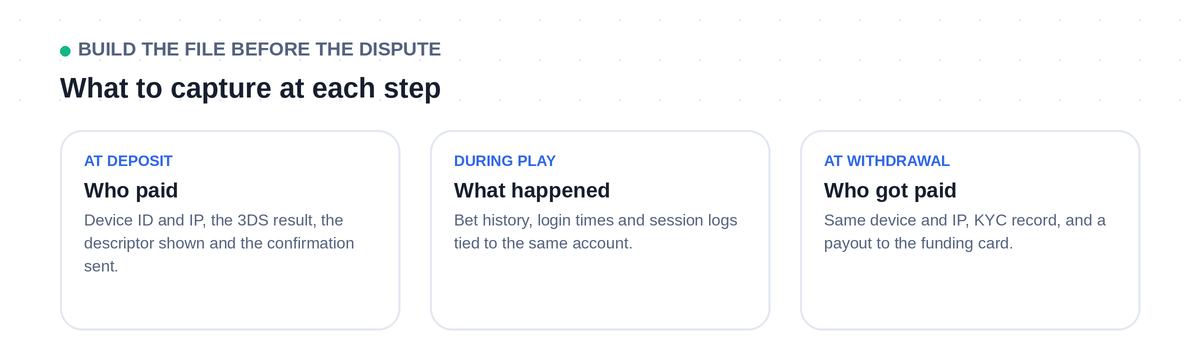
The practical lesson is to collect the evidence at every step, not just the first deposit.
At deposit, that means device ID, IP, the 3-D Secure result, the descriptor the player saw and the confirmation you sent. During play, it means bet history and login times tied to the account. At withdrawal, it means the same device and IP signals again, the KYC record, and the payout going back to the funding card. Authenticated deposits are also harder to call unauthorized, so 3-D Secure helps even when it adds a step.
A short checklist
- Use a billing descriptor players recognize, and send an instant confirmation for every deposit.
- Capture device and IP on logins, deposits and withdrawals.
- Pay withdrawals back to the funding card, and tell players the timeline up front.
- Set payout speed by risk level, and make sure support can answer "where is my money?" with a real status.
- Honor self-exclusion and deposit limits. A deposit that never happens can't become a dispute.
- Look at your disputes by reason code every month, so you can see which of the four groups is actually hurting you.
Dispute programs such as Visa's VAMP count disputes against the merchant, and acquirers can apply their own limits for gaming that sit below the published ones. Ask yours where your line is before you find out the hard way.
The short version
Deposits are where chargebacks start. Withdrawals are where players decide whether they trust you enough not to file one. If you treat both as part of the same risk picture, you'll usually end up with fewer disputes and a better file when one does come in.
At MMG Corporation, we also work with merchants in higher-risk verticals, including gaming, on payment setups that fit how their business really runs. If you'd like to talk through your deposit and payout flow, get in touch.
Get in touchThis article was researched and written with the help of AI tools as part of our content process, and reviewed and fact-checked by the MMG team before publication.