
Geo Targeting Today
Ask ten merchants what geo targeting means for payments and you get ten answers. Some think of the flag in the corner of the checkout. Some think of showing prices in local currency. Others think of which country their payment provider processes cards in. All of them are right, and that's part of the problem. When people ask "is geo targeting still important for conversions?", they usually mix several different things together.
This is the first article in a short series of three. Here we sort out what geo targeting actually covers in payments and where it still moves results. The second one looks at local acquiring and routing. The third covers local payment methods, currency and location detection at checkout.
The short answer: yes, location still matters. But the part most merchants focus on, the look of the checkout, is the part with the smallest effect. Most of the impact sits behind it.
Four things people mean by "geo targeting"
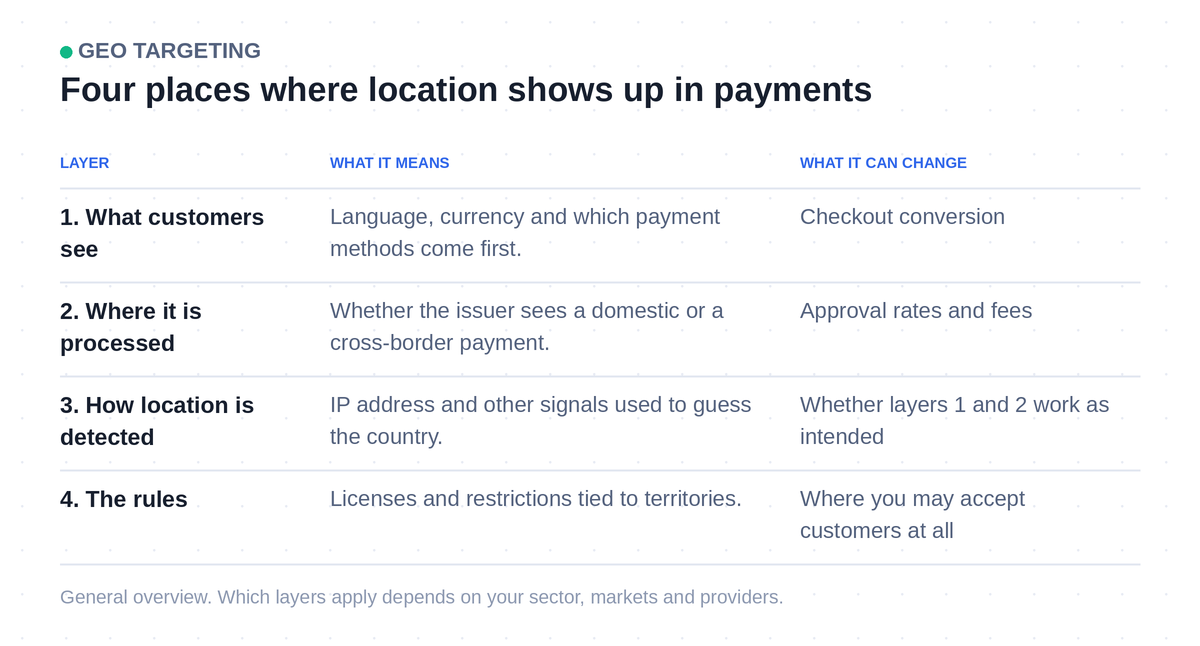
In payments, location shows up in four places. It helps to keep them apart, because each one has a different owner and a different effect on your numbers.
1. What the customer sees. Language, currency, and which payment methods are shown first. This is the layer your web team controls, and it is the one people usually mean.
2. Where the payment is processed. A card issued in Germany can reach the issuer as a domestic payment or as a cross-border one, depending on how your acquirer is set up. The customer never sees this. The issuer does.
3. How you detect location. Everything above depends on knowing where the customer is. That usually starts with the IP address, and an IP address is an estimate.
4. The rules. In some sectors, where a customer is located decides whether you may serve them at all. In regulated iGaming, for example, licenses are tied to territories. That is a compliance requirement and has nothing to do with optimization.
The visible layer: still useful, no longer a differentiator
Showing the right language and currency is now what customers expect. Doing it well rarely wins you much. Doing it badly can cost you.
Payment methods are the exception. Preferences differ a lot between countries. Think of iDEAL in the Netherlands, BLIK in Poland, Pix in Brazil or Pay by Bank in the UK. A customer who doesn't see their usual method may switch to a card, or leave. A survey of about 5,000 European consumers published by Nuvei in 2026 found that 27% say they would likely abandon a purchase if their preferred payment method isn't offered. That's one provider's survey, and it covers consumers in general rather than any one industry, so treat it as a sign of direction and not a benchmark for your own checkout.
The practical point is that "local" doesn't mean "add every method everywhere." It means finding out which one or two methods your customers in a specific country actually use, and putting those where they can be seen. We cover that in the third article.
The hidden layer: where the issuer sees the payment come from
This is the part most merchants don't think about, and it's where location can affect approval rates and costs.
When your acquirer is based in the same country as the cardholder's bank, the payment is treated as domestic. When it isn't, it's treated as cross-border. Issuers can be more cautious with cross-border payments. Checkout.com notes that some issuers, in France and the US for example, look closely at them, and some decline authorizations from countries they see as higher risk. Costs differ too. For cards issued in the EEA and used in the EEA, EU rules cap interchange at 0.2% for consumer debit and 0.3% for consumer credit. For cards issued outside the EEA and used online with EEA merchants, the caps Visa and Mastercard committed to are higher: 1.15% for debit and 1.5% for credit, extended until November 2029. Those are interchange fees only. Scheme fees, acquirer fees and currency conversion come on top.
Several payment providers report that local acquiring improves approval rates and lowers cross-border costs. Most of them also sell local acquiring, and the published figures rarely come with a method you can check. Checkout.com, for instance, says only that approval rates get "a big boost" and gives no number. Nuvei reports an uplift in approvals from routing, but that figure describes its own platform. We'd treat all of this as a reason to test, not as a promise.
There are also real downsides. Local acquiring usually means a legal entity or a local arrangement in each country, a separate relationship to manage, and sometimes fewer fraud tools or payment methods than a global provider. That's why Nuvei's own guide recommends a mix: local acquiring in big markets, and a cross-border setup elsewhere. We go through this in article two.
Detection: an estimate, not a fact
Whatever you show or route depends on where you think the customer is. IP geo location is a good starting point, and it is generally more reliable for the country than for the city. It also goes wrong in ordinary situations: someone on a VPN, a traveler on a foreign mobile network, a company network that exits in another country, an expat who still pays with a card from home.
The takeaway is simple. Use location as a hint and look at other signals as well, such as the country of the card, the billing address and the language of the browser. If your checkout hides a customer's usual method because their IP is in another country, you've created a conversion problem out of a data problem. Let people change the country or the method themselves.
The rules layer
For many merchants this layer is invisible. For some it decides everything. If you work in regulated sectors such as iGaming, location isn't only about conversion. Your licenses define where you may accept players, and your acquirers and banks expect those limits to be enforced. A geo check that is too loose is a compliance risk. One that is too strict blocks legitimate customers.
In that case the question changes. It becomes: how do we apply the required restrictions in a way that creates as little friction as possible for the players who are allowed in? Our earlier article on KYC and deposits touches on the same balance.
When it's worth the effort
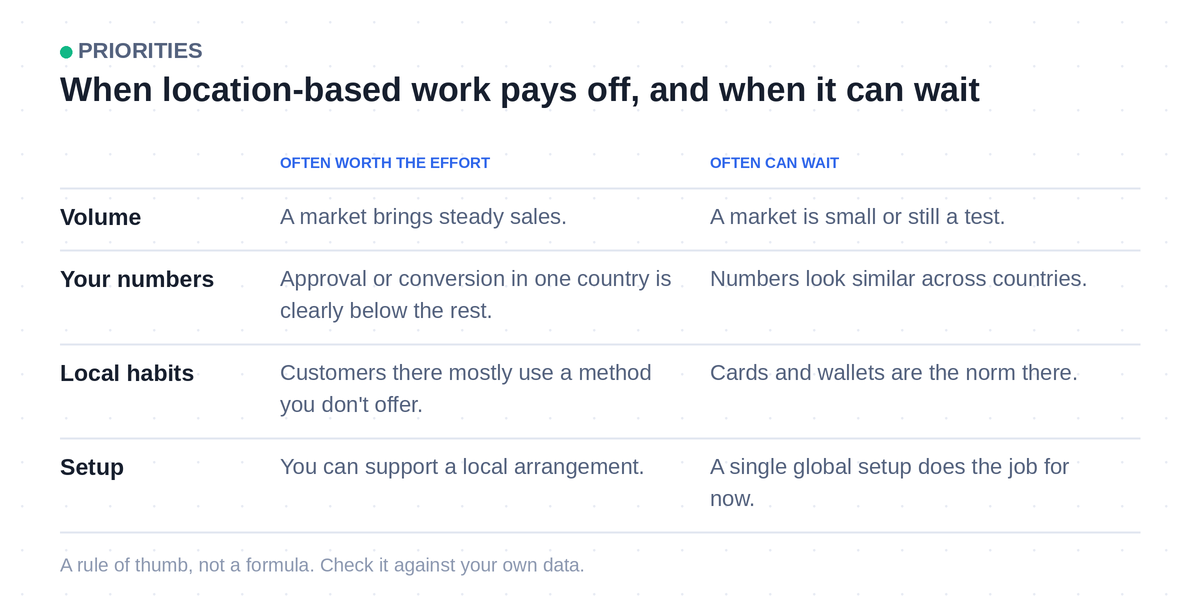
Not every market needs a local setup. A few simple questions help to decide.
- Does the market bring steady volume? A local setup has fixed effort. It pays off where there's enough volume to justify it.
- Do the numbers for that country look different? If approval rates or conversion in one country are clearly below your other markets, that's where to look first.
- Do customers there use something you don't offer? If local habits differ from cards, the method matters more than the routing.
- Is it a one-off or a growth market? A market you're testing can run on a simple setup for a while.
Start with your own numbers
Before changing anything, look at what your data already says. Split your reports by country, and where possible by the country of the card. Four numbers tell you most of what you need.
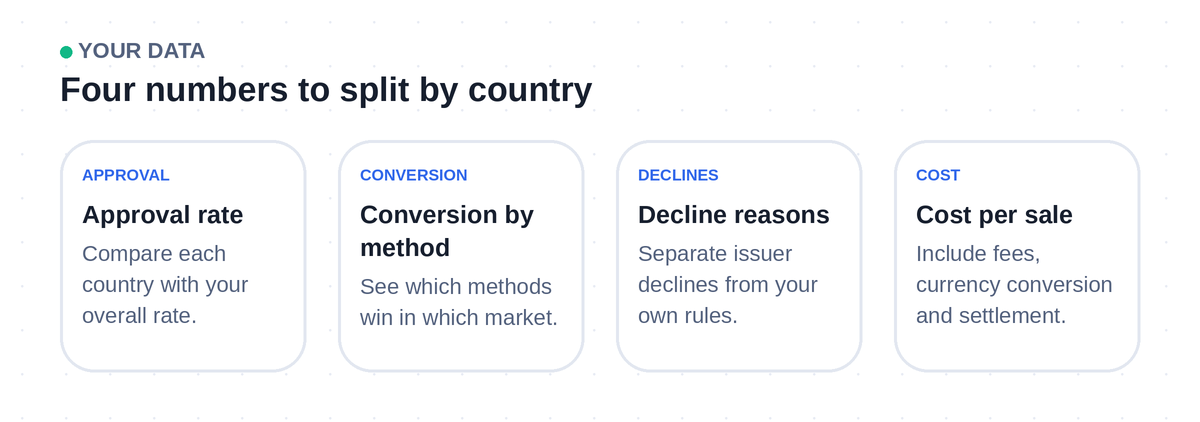
If one country stands out, you have a starting point for a test: a different acquirer for that market, a local method added, or a cleaner decline message. If nothing stands out, you may have saved yourself a project. Both are good outcomes.
What comes next
Next up: how local acquiring and routing work, what they can and can't do for approval rates, and what to ask a provider before switching. After that, the checkout side: local methods, currency and how to deal with VPNs and travelers.
If you'd like to talk through how location affects your own payment setup, get in touch with our team.
Get in touchThis article was researched and written with the help of AI tools as part of our content process, and reviewed and fact-checked by the MMG team before publication.
Sources
- Checkout.com: What is local acquiring and how does it unlock ecommerce growth (provider guide)
- Nuvei: The 2026 guide to global payment acceptance, local acquiring and approval rates (provider guide)
- Nuvei: How Europe pays, payment preferences across five markets (2026 research with Sapio Research)
- FinTech Futures: Visa and Mastercard extend inter-regional interchange fee caps in the EEA until 2029
- Regulation (EU) 2015/751 on interchange fees for card-based payment transactions