
It's just September, but Black Friday is coming soon. And not only in the US, but as strong in the EU.
Every piece of Black Friday advice tells merchants to watch out for fraud during the peak weekend itself. That's true, but it's also the easy part — the spike is visible, expected, and by definition happens while everyone's already paying attention. The damage that actually catches high-risk merchants off guard doesn't show up in November at all. It shows up in January and February, on a chargeback ratio nobody was watching anymore, from orders everyone had already stopped thinking about.
The Volume Spike Is Real, and It's Not Small
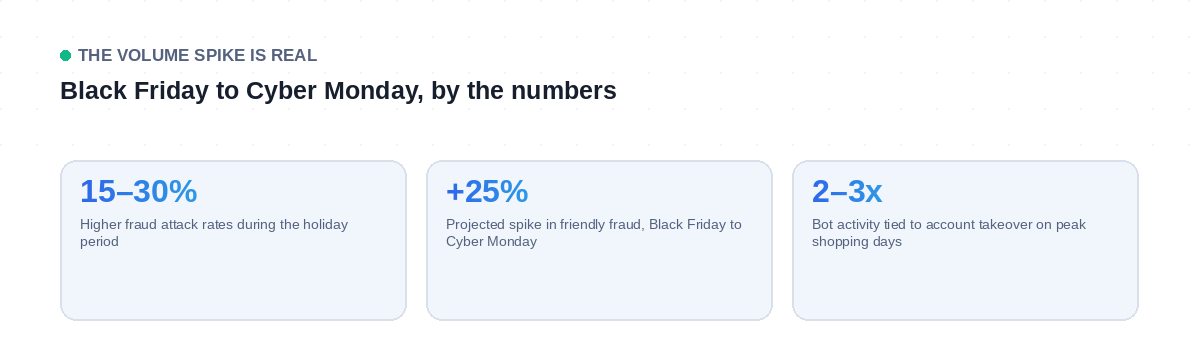
The headline numbers are worth having in view before anything else. Fraud attack rates run 15% to 30% higher during the holiday period than the rest of the year. Friendly fraud specifically — legitimate purchases disputed anyway — is projected to spike 25% between Black Friday and Cyber Monday alone, and bot activity tied to account takeover has been observed running two to three times normal levels on peak shopping days. Transaction volume itself climbs sharply too, with year-over-year Black Friday-to-Cyber-Monday volume up around 27% in recent measurement, alongside a continuing shift toward mobile checkout.
None of that is surprising on its own — more shoppers, more sales, more opportunity for both fraud and honest confusion. What's easy to underweight is the actual cost multiplier behind those numbers: merchants lose an average of $5.13 for every dollar of fraud once chargeback fees, lost merchandise, and operational overhead are factored in, not just the face value of the disputed transaction. Return fraud compounds this further — fraudulent returns run around 9% of volume year-round, and that rate climbs two to three points higher specifically during the holiday period, adding a second dispute-adjacent problem on top of chargebacks themselves. The part worth sitting with is what happens to all of that activity after the weekend ends.
Why the Pain Arrives Late
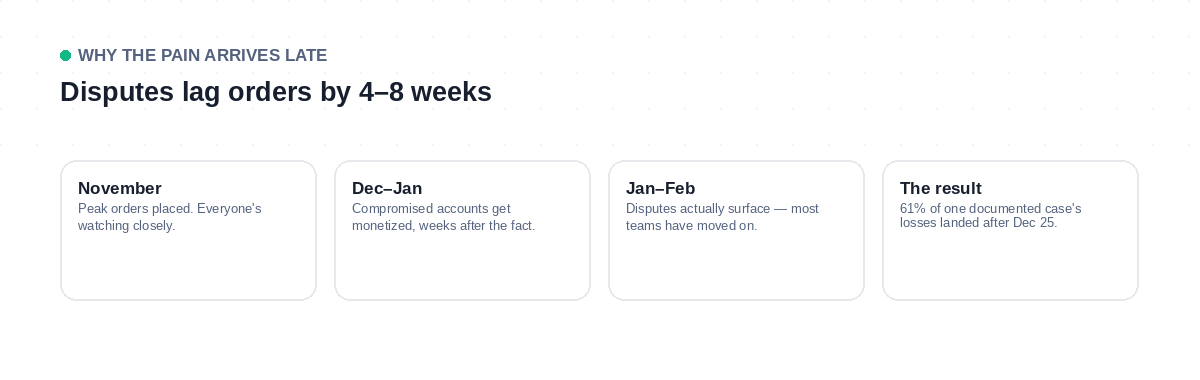
Here's the mechanism most merchants underestimate: peak-season disputes lag peak-season orders by four to eight weeks. A cardholder doesn't necessarily notice or act on a questionable charge the moment it posts — they notice it when the statement arrives, when a compromised account gets monetized weeks after the actual takeover, or when the initial excitement of a purchase fades into buyer's remorse. Holiday account-takeover surges specifically follow this pattern: the takeover happens during the shopping rush, but the resulting disputes don't surface until the following quarter, once the stolen access has actually been used and the real cardholder finally notices.
That delay means a November order becomes a February chargeback with real regularity — and by February, most merchants have mentally closed the book on the holiday season and moved on to Q1 planning. One documented case makes the shape of this concrete: a merchant's chargeback ratio for the December-through-February window landed at 1.38%, high enough to trigger processor review, with a peak-window fraud and dispute write-off around $128,000. The detail that actually changed how that team thought about the problem afterward: roughly 61% of the total loss landed after December 25 — well past the point where the operational team had already shifted focus to the new year.
What This Actually Does to a Chargeback Ratio
This is where the delay becomes a genuine account-level risk rather than just an accounting surprise. Chargeback ratios are monitored by the card networks on an ongoing basis, and a ratio that creeps upward from a concentrated batch of late-arriving holiday disputes doesn't get graded on a curve for timing — it counts the same as a ratio that climbed for any other reason. A merchant who ran a clean, well-managed November can still watch their ratio drift toward VAMP's monitoring thresholds in Q1, entirely because of orders placed months earlier, evaluated by an acquirer that has no way of knowing the spike was seasonal rather than a sign of a genuinely deteriorating account.
For merchants already operating close to a threshold, this is precisely the kind of gap that turns a strong sales quarter into a compliance problem the following one. The revenue from Black Friday lands in Q4. The chargeback exposure it creates can land squarely in the quarter after — on a ratio that's being watched independently of which quarter actually generated the disputes.
The Reserve Question Nobody Asks in November
There's a second, quieter version of this same timing problem that's specific to reserve terms rather than chargeback ratios. A merchant expecting a strong Black Friday naturally expects strong Q4 cash flow to match it — but if that volume spike also means a proportionally larger reserve held back by the acquirer, and a wave of late-arriving disputes on top of it, the cash a merchant is counting on in December can be meaningfully smaller than the sales figures alone suggest. This is worth raising with a payment partner before the peak, not after: whether reserve percentages adjust automatically with volume, whether a holiday spike triggers any kind of reserve review, and how quickly held funds actually release once the post-holiday dispute window has genuinely closed rather than just gone quiet.
Merchants who ask this question in October get a straightforward answer and can plan cash flow around it. Merchants who only discover the answer in January are finding out during the exact quarter they can least afford the surprise.
Building the Defense Before Peak, Not After
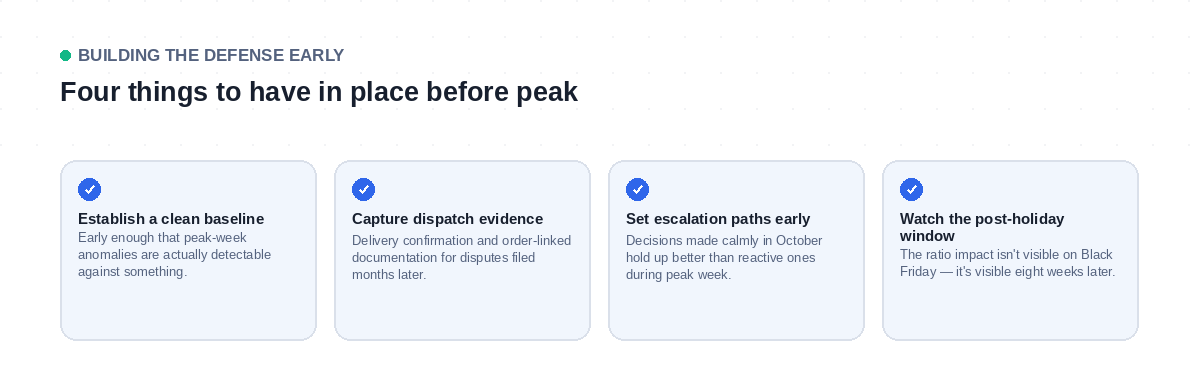
The operators who avoid getting caught by this treat holiday preparation as a six-week project that starts well before the actual shopping weekend, not a fraud-filter setting flipped on the Wednesday before Black Friday. That means establishing a clean baseline of normal transaction patterns early enough that peak-week anomalies are actually detectable against something, rather than getting lost in a general spike. It means capturing strong evidence at the point of sale and dispatch — clear delivery confirmation, order-linked documentation — specifically because that evidence is what will matter for a representment case filed in February about an order from November, long after anyone remembers the specifics without it.
It also means setting clear escalation paths before the volume hits, not during it — seasonal spikes reliably overload fraud and support teams, and decisions made calmly in October about thresholds and review processes hold up better than decisions made reactively during peak week itself. And it means treating the post-holiday window, not just the holiday weekend, as the period that actually needs monitoring attention: the ratio impact of Black Friday isn't visible on Black Friday. It's visible eight weeks later, to whoever's still paying attention by then.
The Real Deadline Isn't Black Friday
Most Black Friday fraud advice optimizes for the wrong window. The weekend itself is when everyone's paying attention anyway — fraud teams are staffed up, thresholds are tightened, and the volume spike is expected. The actual vulnerability sits eight weeks later, when the disputes generated by that volume start arriving against a ratio nobody's watching as closely anymore, from a team that's already moved on to planning the next quarter.
MMG Corporation works with high-risk merchants across EU markets on exactly this kind of seasonal risk planning. If your team's holiday prep stops at the weekend itself, that's worth extending — the numbers that actually determine your account's standing in Q1 are still being written in the weeks after everyone else has stopped watching.
Get in touchThis article was researched and written with the help of AI tools as part of our content process, and reviewed and fact-checked by the MMG team before publication.