
Why Dating Platforms Lose More Money to Billing Confusion Than to Fraud
Most dating platforms assume their chargeback problem is a fraud problem. They build fraud stacks, implement 3DS2, add velocity rules — and their chargeback rate barely moves. That's because the majority of disputes on dating platforms don't come from criminals. They come from confused, embarrassed, or frustrated users who couldn't figure out how to cancel. Here's what's actually driving the numbers — and why regulators are now making this an urgent compliance issue as well as a payment one.
← Read first: Why the Dating Industry Has One of the Hardest Payment Problems in E-Commerce
The Numbers That Don't Add Up
Subscription businesses face 70% more chargebacks than one-time purchase models. (Chargebacks911, 2024) Dating platforms sit at the sharp end of that statistic — running chargeback rates of 2% to 5% against an industry average of 0.5% to 1%. (Electronic Transactions Association, 2024) When most operators see those numbers, they reach for fraud tools. But the data tells a different story.
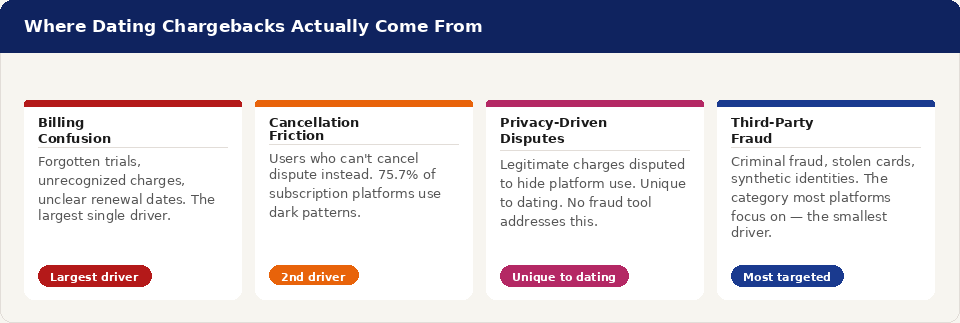
Research across subscription platforms consistently shows that the majority of chargebacks in subscription categories are not the result of third-party fraud — they are the result of first-party disputes: users who don't recognize the charge, forgot they subscribed, couldn't find the cancellation button, or didn't realize a free trial had converted to a paid plan. In dating specifically, a fourth driver adds volume that has no equivalent elsewhere: users disputing legitimate charges to protect their privacy. None of these are solved by better fraud detection.
An ICPEN sweep in 2024 that examined 642 subscription platforms across 27 countries found that 75.7% used at least one dark pattern in their subscription or cancellation flows, and 66.8% used two or more. (ICPEN 2024) The dating category has historically been among the most aggressive in using these patterns — a fact that regulators have now formally documented and are actively enforcing against.
The Four Billing Patterns That Drive Disputes
Dating platforms have converged on a set of billing practices that individually seem like reasonable product decisions. Together, they create a chargeback environment that no fraud tool can solve.
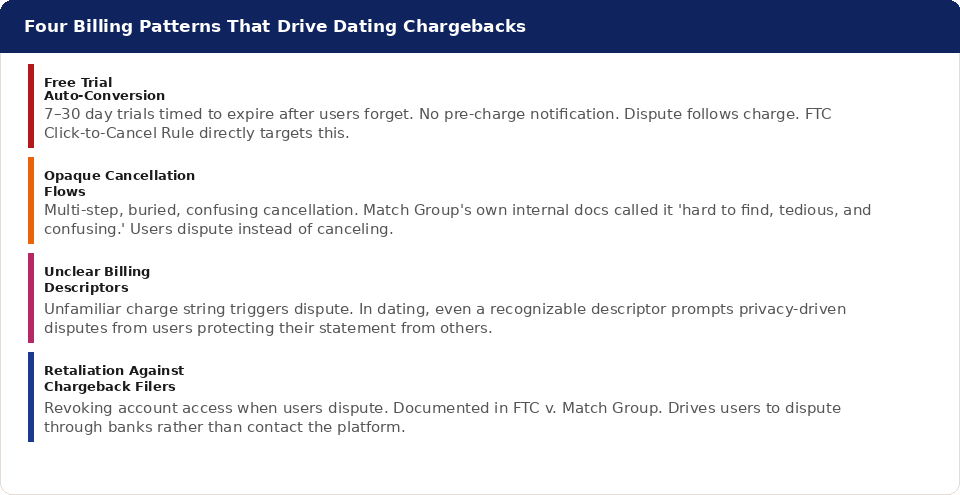
Free trial auto-conversion. The most documented chargeback trigger in subscription billing. A user signs up for a free trial — 7 to 30 days is the standard range (SubBuddy, February 2026) — intending to evaluate the platform. The trial period is timed to be just long enough that the user forgets about the conversion date. The platform charges without a reminder. The user disputes. This pattern is so well documented that the FTC's Click-to-Cancel Rule, which came into enforcement effect in 2025 and 2026, specifically targets it — requiring clear disclosure of the fact that charges will begin, the exact date, and the amount, before the trial starts. (FTC Negative Option Rule, 2026)
Opaque cancellation flows. The "roach motel" pattern — easy to enter, nearly impossible to exit — is endemic in subscription businesses and has been particularly aggressive in dating. Internal Match Group documents disclosed during FTC litigation described the cancellation process as "hard to find, tedious, and confusing." (FTC v. Match Group, August 2025) Uber forced users through 23 screens and 32 individual actions to cancel Uber One. (SubBuddy, 2026) Users who cannot cancel dispute instead — which is rational behavior, not fraud.
Unclear billing descriptors. When a charge appears on a statement as an unfamiliar string — a parent company name, an abbreviated platform name, or a technical processing descriptor — users who don't immediately recognize it dispute it. For dating specifically, this mixes with the privacy dynamic: a user who might have recognized "TINDER*SUBSCRIPTION" on their statement still has an incentive to dispute it if someone else sees the statement. Unclear descriptors amplify both genuine confusion and deliberate privacy-motivated disputes.
Retaliation against chargeback filers. The FTC's case against Match Group included an allegation that the company revoked access to paid accounts for users who lost chargeback disputes — even when subscription time remained. (FTC v. Match Group, August 2025) This practice, seen across multiple platforms, creates a feedback loop that is well documented: users who fear account termination are more likely to dispute quietly through their bank rather than contact the platform — which generates chargebacks rather than resolvable customer service interactions.
The Regulatory Moment — And Why It Matters for Payment Infrastructure
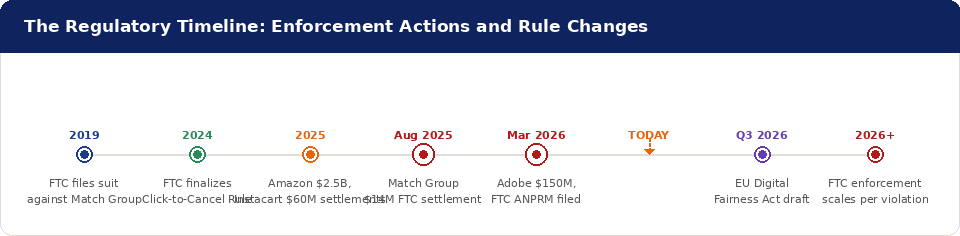
The dating industry's billing practices didn't become a regulatory issue overnight. But the enforcement calendar has accelerated significantly, and the settlements now on the record are large enough to be existential for mid-sized platforms.
Match Group paid $14 million in August 2025 to settle FTC allegations covering misleading guarantees, dark cancellation patterns, and retaliation against chargeback filers. (FTC v. Match Group, August 2025) Amazon paid $2.5 billion over Prime auto-enrollment practices in 2025. (SubBuddy, 2026) Adobe paid $150 million in March 2026 for burying early termination fees and making cancellation a deliberate maze. (DOJ/FTC v. Adobe, March 2026) The FTC's maximum civil penalty for knowing violations is $53,088 per violation — per affected customer, per day — which means penalties can scale into the millions within days at subscription volumes. (Cookie-script, February 2026)
On March 11, 2026, the FTC announced an Advance Notice of Proposed Rulemaking specifically addressing negative option practices — subscription auto-renewals and free-trial conversions — seeking public comment on how to modernize enforcement. (Hogan Lovells / FTC ANPRM, March 2026) The EU's Digital Fairness Act, expected in draft form in Q3 2026, will impose similar obligations across European markets, where 69% of consumers have already encountered cancellation barriers and 62% have faced undisclosed auto-renewals. (ShareUHack, April 2026)
> The connection between regulatory compliance and payment infrastructure stability is direct. A dating platform with high chargebacks driven by billing confusion is simultaneously a candidate for FTC enforcement, VAMP program entry, and acquirer termination. These are not separate risks managed by separate teams — they are the same underlying problem manifesting across three different oversight systems at once.
What Fixes the Problem — And What Doesn't
The instinct to solve dating chargebacks with fraud tooling is understandable but misdirected. 3DS2, velocity rules, and device fingerprinting protect against criminal fraud. They do not protect against a user who genuinely forgot they had a subscription, or who deliberately disputes a legitimate charge because they're embarrassed to have a dating platform on their card statement. The tools that actually reduce confusion-driven chargebacks are billing communication and UX changes — not fraud controls.
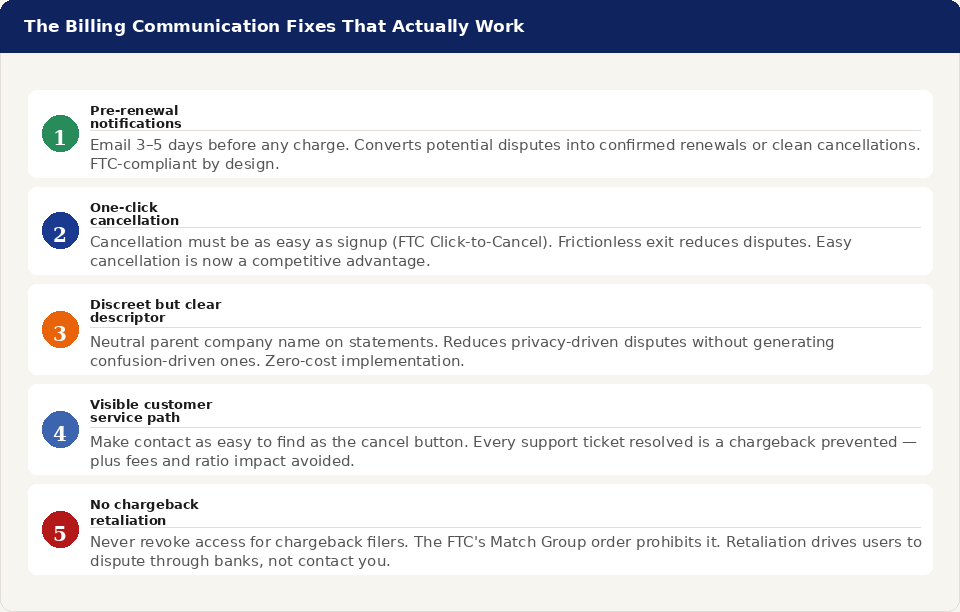
Pre-renewal notifications. A notification sent 3 to 5 days before a renewal charge gives users the opportunity to cancel before the transaction occurs rather than dispute it after. This converts a potential chargeback into either a legitimate cancellation or a confirmed renewal from a user who has actively chosen to continue. Both outcomes are better than a dispute. The FTC's Click-to-Cancel framework explicitly requires clear disclosure of renewal dates and amounts — platforms that implement genuine pre-billing notifications are both reducing chargebacks and building regulatory compliance simultaneously.
One-click cancellation. The FTC's enforcement principle is symmetry: if a user can subscribe online in one step, they must be able to cancel online in one step. No phone calls, no chatbots, no retention gauntlets, no surveys that loop back to the start. (FTC Click-to-Cancel Rule, 2025–2026) Platforms that implement genuinely frictionless cancellation lose some subscribers they might have retained — but they avoid the chargeback, the regulatory exposure, and the reputational damage that comes with users who feel trapped. Easy cancellation is becoming a competitive advantage. (SubBuddy, 2026)
Discreet but clear billing descriptors. The optimal billing descriptor for a dating platform is one that is recognizable to the subscriber but not identifying to a third party viewing the statement. A neutral parent company name combined with a recognizable product reference — "TECH HOLDINGS · DATING PRO" rather than "MEETINGPEOPLE.COM" — serves both goals. It reduces privacy-driven disputes without generating confusion-driven ones.
Customer service as a chargeback prevention tool. Every dispute that reaches a bank is a dispute that didn't reach customer service first. Platforms with accessible, responsive, and visible customer service convert a meaningful proportion of would-be chargebacks into resolvable support tickets. The contact path should be as visible as the cancellation path — ideally on the billing statement follow-up email, on the account page, and in the subscription confirmation.
The dating industry's chargeback problem is not primarily a fraud problem — it's a billing design problem that has been allowed to persist because the short-term retention gains from friction outweighed the visible cost. That calculation is changing fast. Regulators on both sides of the Atlantic are now treating dark subscription patterns as enforcement priorities, with penalties scaled to subscription volumes. And Visa's VAMP thresholds give acquirers the leverage to exit merchants whose chargeback ratios reflect billing practices that generate disputes at industrial scale.
The platforms that get ahead of this — not because they're forced to, but because they understand the compounding cost of confusion-driven chargebacks — are the ones that will have stable payment infrastructure, lower regulatory exposure, and better long-term subscriber relationships. Clear billing, easy cancellation, and visible customer service are not consumer-friendly gestures. They are payment infrastructure decisions with direct financial consequences.
MMG processes for adult and dating platforms across EU markets. If you're reviewing your billing flows, your descriptor setup, or your chargeback management strategy, we're glad to help you think through it.
Get in touchSources
- FTC Negative Option Rule / Click-to-Cancel — finalized 2024, enforcement 2025–2026
- FTC v. Match Group — $14M stipulated order, August 12, 2025
- FTC v. Amazon — $2.5B settlement, 2025
- DOJ/FTC v. Adobe — $150M settlement, March 13, 2026
- FTC ANPRM on Negative Option Practices — March 11, 2026 (via Hogan Lovells)
- ICPEN 2024 Subscription Platform Sweep — 642 platforms, 27 countries
- SubBuddy — Subscription Trap Analysis, February 23, 2026
- CaptainCompliance — Match Group Settlement Analysis, August 2025
- EmpireStats — Dark Patterns 2026, February 25, 2026
- Cookie-script — FTC Click-to-Cancel Rule Analysis, February 9, 2026
- Chargebacks911 — Subscription Scams Guide, 2025
- ShareUHack — EU Digital Fairness Act / SaaS Dark Patterns, April 7, 2026
This article reflects publicly available information as of July 2026 and does not constitute legal or financial advice.