
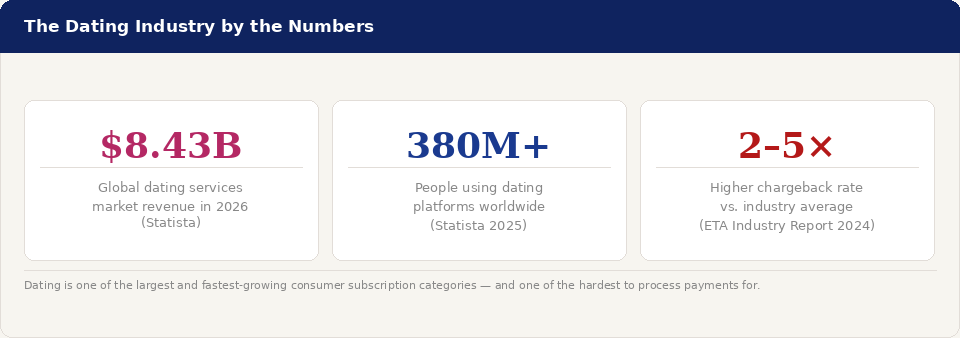
Online dating generates over $8 billion in global revenue and serves 380 million users worldwide. It also produces chargeback rates that run two to five times the industry average, attracts three times more fraud attempts than standard e-commerce, and operates a billing model that mainstream processors routinely refuse to underwrite. Here's why the payment infrastructure problem in dating is more complicated than it looks — and what platforms operating in this space actually need to fix it.
A Market That's Growing Faster Than Its Payment Infrastructure
Online dating is a genuinely large and growing industry. The global dating services market is projected to reach $8.43 billion in revenue in 2026, with the online dating segment alone contributing $3.24 billion. (Statista, 2026) Over 380 million people use dating platforms worldwide (Statista, 2025), with more than 53 million in the US alone — roughly 31% of American adults aged 18 to 65. (Pew Research, 2024) The industry is growing at 7–8% annually, and the total market is forecast to nearly double to $13.57 billion by 2031. (Mordor Intelligence, 2026)
Match Group — the parent company of Tinder, Hinge, Match.com, OkCupid, and Plenty of Fish — generated $3.48 billion in revenue in 2024, representing approximately 53% of the global market. (WhichDating State of Online Dating, March 2026) Bumble Inc. added another $1.05 billion. (WhichDating, 2026) These are not fringe businesses. They are large-scale consumer platforms generating subscription revenue at the scale of mid-sized SaaS companies.
And yet, the payment infrastructure behind virtually every one of these platforms is more complicated, more expensive, and less stable than almost any other consumer subscription category. The reason is a combination of factors that interact in ways that mainstream processors are simply not equipped to handle.
Why Dating Is Classified as High-Risk
Most high-risk classifications are driven by a single dominant factor — gambling has regulatory complexity, nutraceuticals have refund rates, travel has future-delivery exposure. Dating has several compounding factors operating simultaneously, which is what makes it particularly difficult for processors to underwrite.
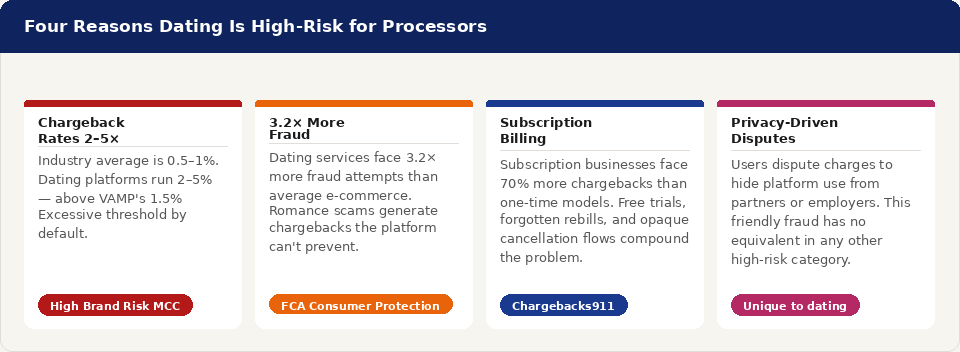
Chargeback rates that exceed standard thresholds by definition. The average chargeback rate across all industries sits at 0.5% to 1%. (Electronic Transactions Association Industry Report, 2024) Dating platforms routinely experience rates between 2% and 5% — well above the 1% threshold that triggers high-risk classification, and well above the 1.5% VAMP Excessive threshold that came into effect in April 2026. Exceeding that threshold isn't an edge case in dating. For many platforms, it's the baseline.
Fraud rates that dwarf standard e-commerce. Dating services experience 3.2 times more fraud attempts than the average e-commerce business. (FCA Consumer Protection Report, 2023) Romance scams — where fraudsters build fake relationships to extract money from genuine users — are epidemic at scale. One in seven American adults has lost money to romance fraud. (McAfee, 2026) This fraud doesn't just harm users. It generates chargebacks that flow directly back through the payment infrastructure to the merchant's acquiring relationship.
A billing model built for disputes. Subscription-based businesses face 70% more chargebacks than one-time purchase models. (Chargebacks911, 2024) Dating subscriptions amplify every characteristic that makes subscription billing difficult: free trials that convert to paid plans without adequate warning, monthly renewals charged to cards that users have forgotten they registered, cancellation flows that users describe as deliberately confusing, and a product whose value is inherently subjective — which makes "service not as described" a plausible dispute reason even for entirely legitimate charges.
Privacy dynamics that create unique chargeback triggers. This is the factor that distinguishes dating from almost every other high-risk category. A user who doesn't want a partner, parent, or employer to see a charge on their statement has a strong personal incentive to dispute it as fraudulent — even when the transaction was entirely legitimate. The billing descriptor on the statement is the trigger point. "MATCH GROUP" or a platform name on a statement can prompt a chargeback that has nothing to do with the quality of the service and everything to do with protecting the user's privacy. This is documented friendly fraud, and it has no parallel in other high-risk categories at this scale. (Chargebacks911; Zenti)
The Aggregator Problem
Most dating platforms encounter their first payment crisis when they try to use a mainstream aggregator — Stripe, Square, or PayPal — as their primary processor. The initial onboarding is straightforward. The problems emerge once the aggregator's risk systems start seeing the actual transaction patterns: subscription rebills, high dispute rates, privacy-related chargebacks, and fraud-linked transactions. At that point, the aggregator makes a simple calculation: the revenue from processing a dating platform is modest; the liability exposure is significant. The account gets flagged, frozen, or terminated — often without warning and often at the worst possible moment.
The instability isn't just a financial problem. A dating platform that loses payment processing mid-month cannot bill existing subscribers, cannot onboard new paying users, and may not be able to operate its core product at all. Unlike a retailer who can pause trading while switching processors, a dating platform's subscriber base begins churning immediately when payment fails. The operational cost of a processing disruption in dating is disproportionately large.
Processors evaluate the dating category based on its historical reputation rather than individual business practices. Modern dating platforms have implemented robust fraud prevention, transparent billing practices, and strict content moderation. Underwriting policies often still reflect the industry's early reputation rather than current operating standards — which means even well-run, fully compliant platforms pay a premium for payment infrastructure that mirrors the risk profile of the worst operators in the category. (Fibonatix, 2025)
The MCC Question
Dating platforms are typically assigned MCC 7273 (Dating and escort services) or MCC 5967 (Direct marketing — inbound teleservices, the latter commonly used for adult content adjacent to dating). Both MCCs sit in Visa's High Brand Risk category — which means the monitoring program treatment described in our previous article applies in full. No grace period on first breach. Fines from month one. Active scrutiny from the card schemes. (Visa VAMP documentation; Finix, 2026)
The MCC assignment also matters for card acceptance rates. Some issuing banks apply category-level blocks on MCC 7273 transactions — meaning a percentage of entirely legitimate transactions will be declined at the issuing bank level, not the merchant level, regardless of the platform's fraud prevention quality. Multi-acquiring with intelligent routing can recover a significant proportion of these declines by routing to acquirers with stronger issuer relationships in specific regions. For a dating platform processing cross-border volume — which most do — this can represent a meaningful improvement in net authorization rates.
What Good Payment Infrastructure Actually Looks Like
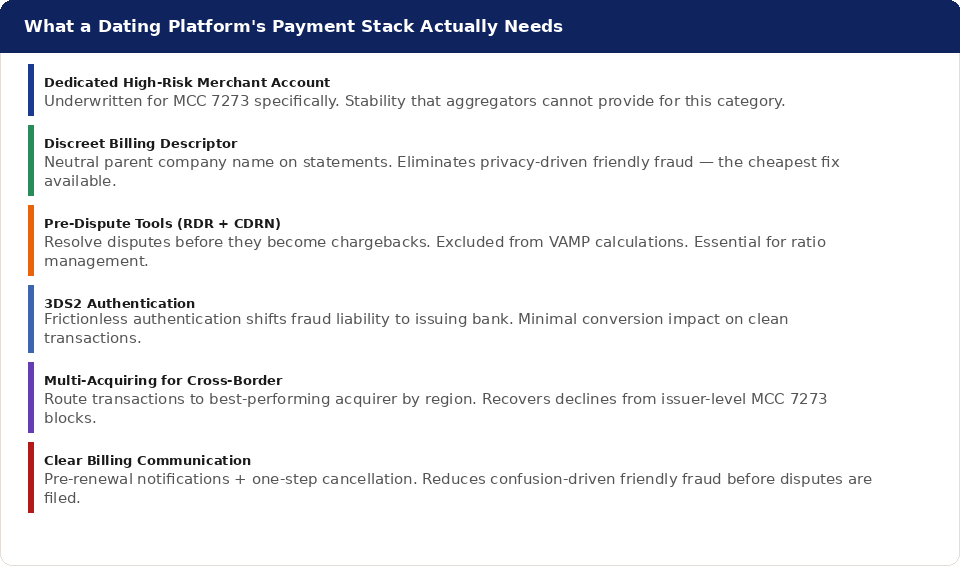
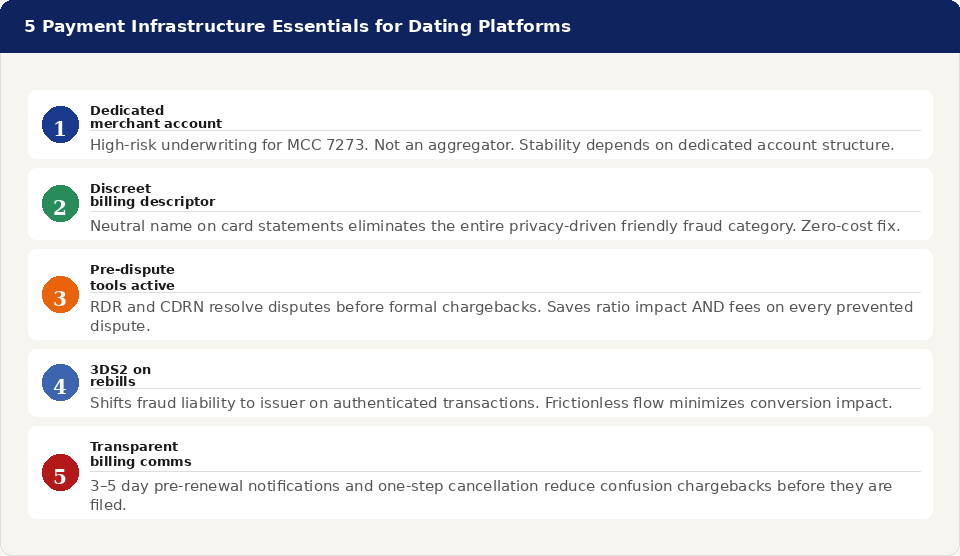
Dating platforms that successfully manage their payment infrastructure tend to share a common approach across five areas. None of these are optional extras. In this category, each one addresses a specific, documented point of failure.
A dedicated high-risk merchant account, not an aggregator. The starting point is an account underwritten specifically for the dating category, with an acquirer that has evaluated the business model, the chargeback exposure, and the compliance posture before approval. This account stands or falls on the platform's own performance — it does not share risk tolerance with unrelated merchants. The documentation required is more extensive than for a standard account, but the stability it provides is worth it. (Payment Nerds, April 2026; SecureGlobalPay, 2025)
Discreet billing descriptors. The single most effective chargeback prevention measure available to a dating platform costs almost nothing to implement. A billing descriptor that doesn't identify the platform as a dating service eliminates an entire category of privacy-driven friendly fraud. Platforms that use neutral parent company names or generic descriptors consistently report lower dispute rates than those that use platform-branded descriptors. (Zenti; Chargebacks911)
Pre-dispute tools active on every transaction. Visa's Rapid Dispute Resolution (RDR) and Mastercard's Cardholder Dispute Resolution Network (CDRN) alert merchants when a dispute is initiated, creating a window to refund proactively before the transaction becomes a formal chargeback. For dating platforms, where a high proportion of disputes are friendly fraud rather than genuine criminal fraud, this window is valuable. A refunded transaction costs the platform the transaction value. A formal chargeback costs the transaction value plus fees, plus VAMP ratio impact. (Fibonatix, 2025)
3DS2 on subscription rebills and high-value transactions. 3D Secure version 2 adds a frictionless authentication layer that shifts liability for fraudulent transactions to the issuing bank. For dating platforms — where criminal fraud accounts for a meaningful portion of dispute volume — this liability shift is directly material. 3DS2's frictionless flow means that for most transactions, the authentication happens invisibly with no user action required, so the conversion impact is minimal. (SecureGlobalPay; PG Dating Pro Payment Systems Guide, 2026)
Transparent billing communication. A significant proportion of dating subscription chargebacks are not malicious. They are the result of genuine user confusion about billing cycles, trial conversion dates, or cancellation processes. Clear pre-billing notifications — ideally sent 3 to 5 days before a renewal charge — combined with a simple, one-step cancellation flow, reduce this category of dispute substantially. Platforms that make cancellation difficult create short-term retention at the cost of long-term chargeback exposure and reputational damage. (Zenti; Payment Nerds, 2026)
The Bottom Line
The dating industry's payment problem is structural, not incidental. It is built into the product model, the user behavior patterns, the MCC classification, and the category's historical reputation. The platforms that navigate it successfully are not the ones that find a processor willing to ignore the risk — they are the ones that build payment infrastructure that actively manages it.
That means dedicated underwriting, discreet descriptors, pre-dispute tools, 3DS2 authentication, clear billing communication, and multi-acquiring for cross-border volume. It also means working with a payment partner that understands MCC 7273 before the account is opened — not one that discovers what the category entails after the first chargeback spike.
MMG processes for adult and dating platforms across EU markets. If you're building or operating a dating platform and want to talk through the payment stack — from acquiring to chargeback management — we're glad to help.
Get in touch