
- and most merchants never read it
Your acquirer can legally hold a percentage of your revenue for up to 180 days — including after your account is closed. The terms that determine how much they hold, for how long, and under what conditions they release it sit in a clause that most merchants sign without reading. Here's what that clause actually says, why it matters more than your processing rate, and what you can negotiate before you sign.
What a Reserve Actually Is
A merchant account reserve is a portion of your processed revenue that your acquiring bank holds back as a financial buffer. It is not a fee — the money is yours — but you cannot access it during the holding period. The reserve exists to protect your acquirer from losses caused by chargebacks, refunds, fraud, or sudden account closure. Because disputes can be filed weeks or months after a transaction is processed, acquirers need a way to cover that exposure without chasing a merchant who may no longer be operating.
For high-risk merchants — those in iGaming, adult entertainment, nutraceuticals, travel, online lending, and subscription-based businesses — reserves are standard. They are not a penalty and not a sign that your acquirer distrusts you. They are the structural trade-off that makes processing possible in categories that standard banks won't touch. The question is not whether you'll have a reserve. The question is what your reserve clause says about how it works.
The Three Reserve Structures — And What Each Costs You
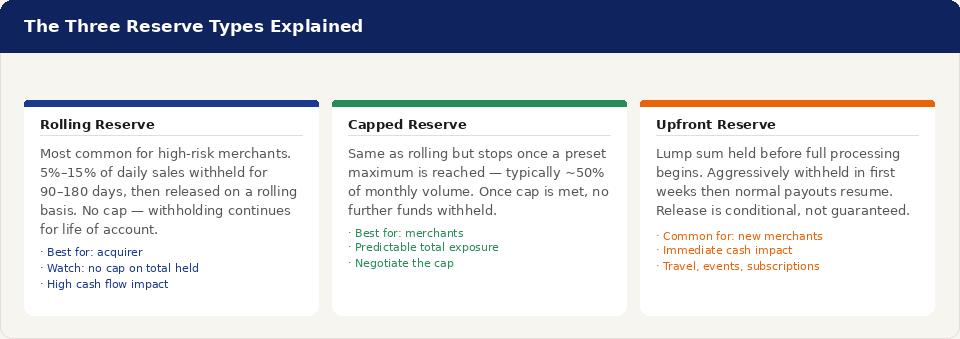
Not all merchant reserve clauses work the same way. There are three common structures, and understanding the difference between them determines how much working capital you actually have access to at any point in time.
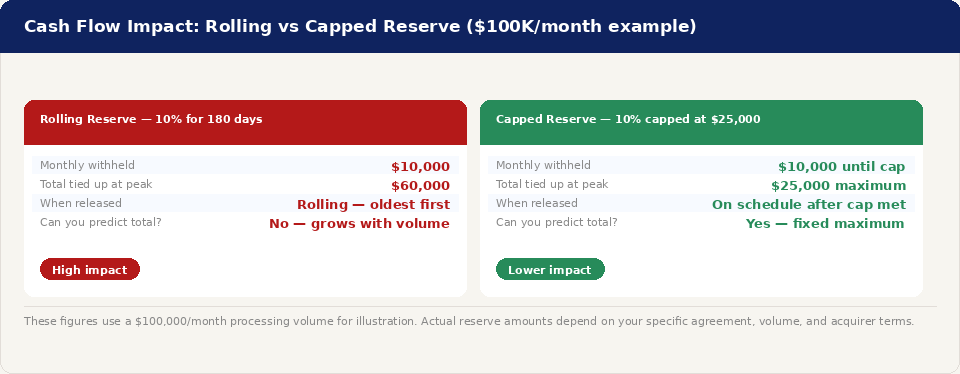
Rolling reserve. The most common type for high-risk merchants. Your acquirer withholds a fixed percentage — typically 5% to 15% of daily card sales — and holds those funds for a defined period, most commonly 90 to 180 days. After the holding period, the oldest funds are released on a rolling basis while new funds continue to be withheld. A business processing $100,000 per month with a 10% rolling reserve held for 180 days would have up to $60,000 tied up in reserve at any given point during a six-month window — money that is technically yours but completely inaccessible.
Capped reserve. Similar to a rolling reserve in that a percentage of each transaction is withheld, but stops once a predetermined maximum balance is reached. The cap is typically set at around half your monthly processing volume. Once the cap is met, withholding stops — which gives you more predictability. For merchants with stable, consistent volumes, a capped reserve is almost always preferable to an uncapped rolling reserve. The cap is negotiable.
Upfront reserve. A lump sum deposited before processing begins, or withheld aggressively during the first weeks of the account until the target amount is collected. Common for new merchants, those with limited processing history, or very high-ticket industries like travel and events. Once fully funded, normal payout resumes. Release is conditional on account performance and is not guaranteed.
The Clauses Inside the Clause
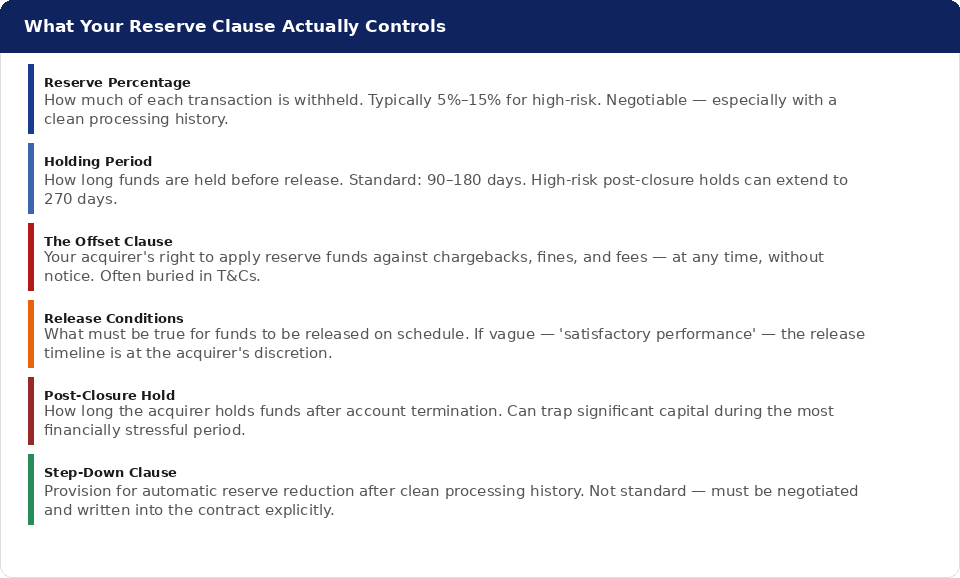
The reserve structure — rolling, capped, upfront — is only the beginning. What most merchants miss are the provisions nested inside the reserve clause that govern how the reserve actually behaves in practice. These are the terms that determine whether your reserve is a manageable working capital consideration or a business-threatening cash flow problem.
The offset clause. Almost every merchant processing agreement includes an offset provision — language that allows your acquirer to apply reserve funds toward any outstanding obligations, including chargeback costs, network fines, scheme fees, and related operational expenses. This means the reserve is not a fixed pool sitting untouched until release. It is a pool your acquirer can draw down at any time, for any qualifying liability, without notice. If your chargeback ratio spikes in month four of a six-month rolling reserve, your acquirer may be withdrawing from the reserve while simultaneously withholding new funds to replenish it.
The release conditions. Most contracts specify that reserve funds are released after the holding period — but that release is conditional, not automatic. Common conditions include maintaining your chargeback ratio below a defined threshold, not breaching the processing agreement, remaining in good standing with the card schemes, and — critically — the absence of open or anticipated disputes. If your acquirer believes chargeback risk persists at the time of scheduled release, they may extend the hold. Without explicit release conditions written into your agreement, the timing is entirely at the acquirer's discretion.
The post-closure hold. This is the clause that surprises merchants most. If your merchant account is terminated — voluntarily or otherwise — your acquirer can legally hold your reserve funds for the duration of the post-closure period specified in the agreement. Industry standard is 90 to 180 days. For high-risk merchants, longer holds of 180 to 270 days are documented. Because chargebacks can be filed up to 120 days after a transaction, and disputes in some card scheme categories extend further, the acquirer's exposure doesn't end when the account closes. Neither does their right to hold your money.
> A business processing $500,000 per month with a 10% rolling reserve that closes its account could have $300,000 or more held for up to 180 days — capital the business cannot access while it searches for a new processor, manages wind-down costs, or attempts to continue operations through alternative channels.
What You Can Actually Negotiate
Reserve terms are not fixed. Most merchants assume the agreement presented at signing is take-it-or-leave-it. It is not — particularly for merchants who approach the conversation with documentation, processing history, and an understanding of what they're asking for.
The percentage. Standard high-risk reserves run 5% to 15%. Very high-risk categories can reach 20% to 35% according to QuadraPay's 2026 reserve benchmarks. For the same merchant, reserve offers from different acquirers can vary by 10 percentage points or more — which, on $100,000 per month of processing, is a $10,000 per month difference in accessible working capital. Shopping acquirers on reserve terms, not just processing rates, is one of the most underused levers available to high-risk merchants.
The cap. If you're offered a rolling reserve, push for a cap. A capped rolling reserve — for example, 10% withheld until a $25,000 maximum is reached — gives you predictability and limits the total capital tied up. Acquirers that specialize in high-risk processing are generally more willing to negotiate caps than general processors.
The step-down clause. This is a provision that automatically reduces the reserve percentage after a defined period of clean processing — typically 6 to 12 months. Some processors offer automated reserve reduction programs in 2026. A step-down clause should be written explicitly into your agreement, not left as a verbal understanding or a future conversation.
The release schedule. Push for an explicit, dated release schedule rather than conditional language. If your agreement says funds are released "at the acquirer's discretion" or "subject to satisfactory performance," that is not a release schedule — that is permission for indefinite holds. Specific dates, specific conditions, and specific amounts create enforceable obligations. Vague language does not.
5 Things to Do Before You Sign
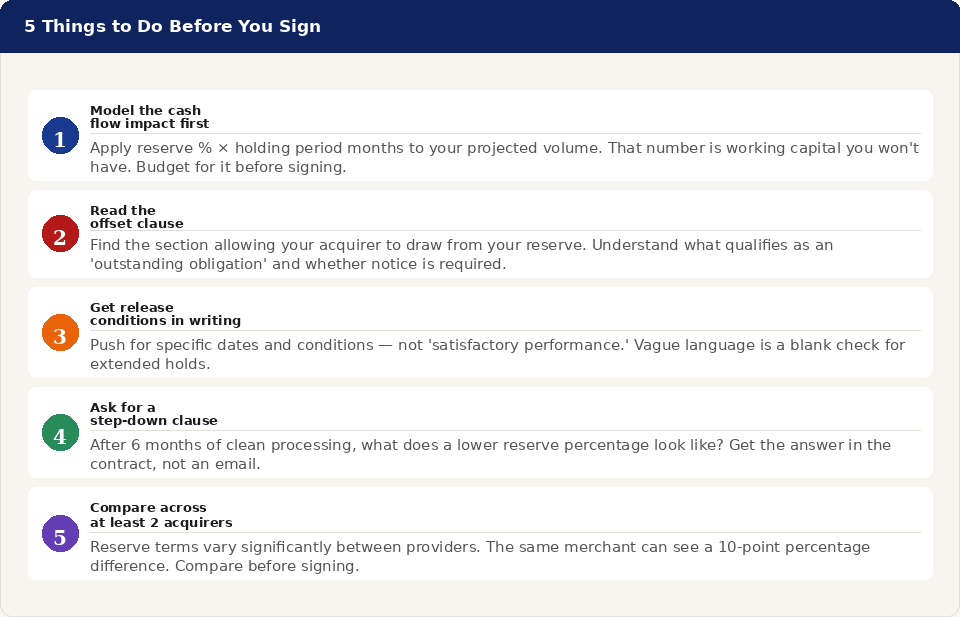
1. Model the cash flow impact before you sign, not after. Take your projected monthly processing volume, apply the reserve percentage, multiply by the holding period in months. That number is the working capital you will not have access to. Factor it into your operating budget, your inventory planning, and your growth projections before the agreement is in place — not when you notice the gap in your bank account three months in.
2. Read the offset clause specifically. Find the section of your agreement that describes when and how your acquirer can draw on your reserve. Understand what qualifies as an "outstanding obligation" and whether there are notice requirements before funds are applied. If the language is vague, ask for clarification in writing. An offset clause with no defined trigger conditions is an open-ended right to reduce your reserve balance at any time.
3. Get the release conditions in writing. Ask your acquirer to state explicitly: what conditions must be met for the reserve to be released on schedule, what would cause the release to be delayed, and what the maximum post-closure hold period is. If the answer is "we'll review it at the time," that is not an acceptable answer. Push for specific language in the contract.
4. Ask about step-down terms proactively. Even if a step-down clause isn't offered in the initial terms, ask for one. Frame it as a performance-linked conversation: after six months of clean processing, what does the path to a lower reserve percentage look like? Get the answer in the contract, not in an email that isn't binding.
5. Compare reserve structures across at least two acquirers. The same merchant with the same processing history can receive materially different reserve offers from different acquirers — different percentages, different holding periods, different caps, different step-down provisions. The acquirer you sign with determines the reserve terms you live with. Comparing terms across providers before signing is the most straightforward way to reduce the capital tied up in your reserve from day one.
The Bottom Line
Your processing rate is visible every time you look at a transaction report. Your reserve clause operates in the background — quietly holding a percentage of every sale, subject to conditions you may not have read, for a period that can extend well beyond the life of your account. For high-risk merchants processing significant volumes, the capital tied up in a poorly negotiated reserve can exceed the cost of fees many times over.
The reserve clause is not boilerplate. It is one of the most financially consequential sections of your merchant agreement — and it is negotiable. Understanding what it says, what it allows, and what you should push back on before you sign is one of the highest-value conversations any high-risk merchant can have with their acquirer.
At MMG, we work with high-risk merchants on acquiring strategy across EU markets, including helping merchants understand and negotiate the reserve terms in their processing agreements. If you want to talk through your current reserve structure or what to look for in a new agreement, we are glad to help.
Get in touch