
The most common assumption about Mastercard's MATCH list is also the most wrong one: that getting listed starts a clock you can stop early by fixing whatever went wrong. Clean up the chargeback ratio, resolve the compliance gap, show the acquirer you've changed — and the listing goes away sooner. For all but two narrow exceptions, that isn't how it works. The list runs its full term regardless of how quickly or thoroughly the underlying problem gets fixed.
What MATCH Actually Is
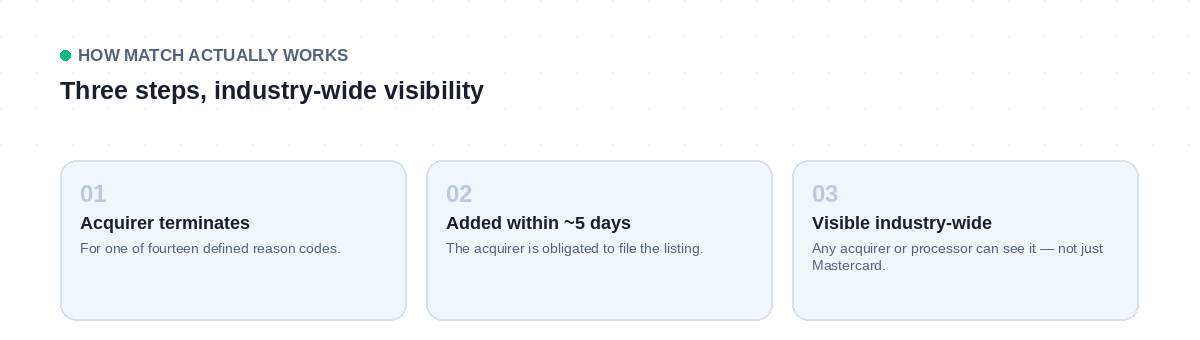
MATCH — Member Alert to Control High-Risk Merchants — is Mastercard's shared database of merchants whose acquirers have terminated their processing relationship for one of fourteen defined reasons. When an acquirer ends a merchant relationship for a qualifying reason, it's obligated to add that merchant to the list, typically within about five days of the termination decision. Only acquiring banks and payment processors can see it; a merchant can't look themselves up, and most only learn the specific reason code by asking the bank that listed them.
Being Mastercard-managed doesn't make the practical impact Mastercard-only. Acquirers evaluating a new merchant application treat a MATCH entry as a strong risk signal regardless of which network the new relationship would run on, because the underlying reason — fraud, excessive chargebacks, a compliance failure — says something about the business itself, not just its Mastercard history.
The Reason Code Is Everything
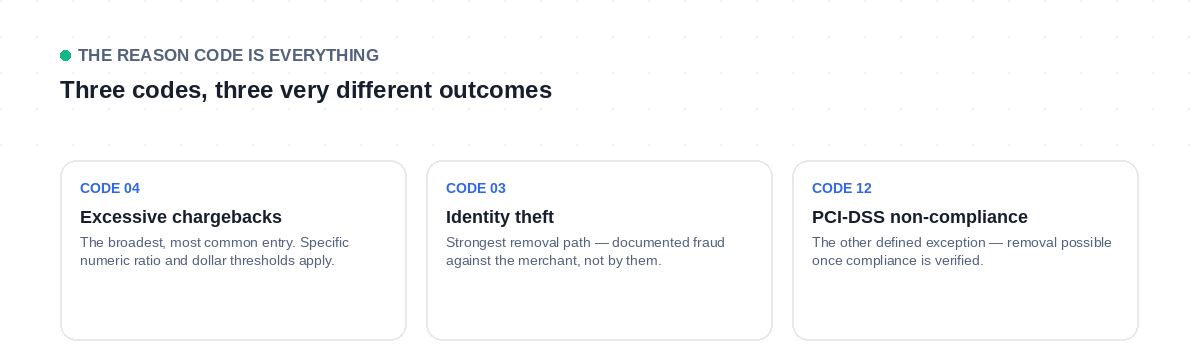
Not all fourteen reason codes carry the same weight, and treating a MATCH listing as one undifferentiated black mark misses the detail that actually determines what happens next. Reason code 04 — excessive chargebacks — is the broadest and most commonly used entry, with specific numeric thresholds (a chargeback-to-transaction ratio alongside a dollar-amount floor) that have to land in the same month before it applies. Fraud and illegal-activity codes sit at the difficult end: low approval odds with most specialist processors afterward, and little realistic path to early removal. Identity theft, by contrast, is the strongest position to be in — a merchant who can document that the listing resulted from fraud committed against them, rather than by them, has the clearest case for removal. PCI-DSS non-compliance, reason code 12, is the other defined exception: once compliance is verified, there's an actual, documented path back off the list rather than just a wait.
The practical lesson is that the reason code shapes the entire next five years more than almost anything else about the business. Two merchants with identical revenue and identical current risk profiles can face completely different outcomes depending on which of the fourteen codes sits on their file.
The Five-Year Clock Doesn't Care About Reform
This is the part that surprises merchants most: outside of the two exceptions above, there is no general mechanism for shortening a MATCH listing based on improved performance, corrective action, or demonstrated change. The listing runs for five years from the date it was added and is then automatically purged by Mastercard. A merchant who spent three of those years rebuilding clean processing history, tightening fraud controls, and operating without a single further incident is in exactly the same position, five-year-clock-wise, as one who did nothing differently at all.
Removal outside the two defined exceptions requires the original acquirer — the one that added the listing — to go back to Mastercard and report that the addition was made in error. Mastercard does not accept removal requests directly from merchants, and there's no appeal process to Mastercard itself if the underlying reason for listing was accurate. If the acquirer's original decision was correct, the record simply runs its full term. The only certain way off the list for the other twelve reason codes is time.
Finding Out the Reason Code Is the First Real Step
Because MATCH is invisible to the merchant directly, a surprising number of businesses spend months applying to new processors and collecting declines without ever learning the specific reason code attached to their listing. That's a genuine problem, because every decision that follows — whether to pursue the identity-theft removal path, whether a PCI-compliance fix is actually relevant, which specialist processors are even worth approaching — depends on knowing exactly which of the fourteen codes is on file.
The reason code isn't available through Mastercard directly. It has to come from the acquirer that filed the listing, and getting it in writing — not just a verbal confirmation — matters if there's ever a case for error-based removal down the line. A merchant who skips this step and simply starts applying to processor after processor is operating without the one piece of information that would tell them which applications are worth the time and which are very unlikely to go anywhere.
What This Actually Means for Processing
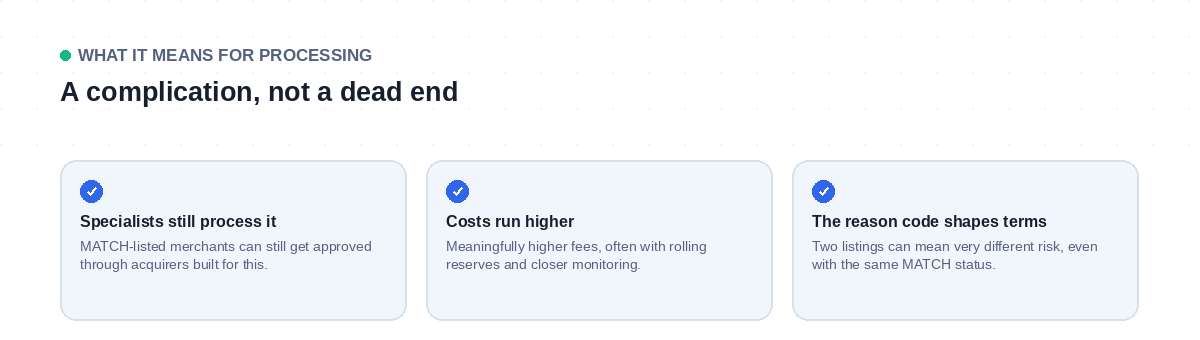
A MATCH listing is a serious complication, not an automatic end to card acceptance. Specialist high-risk processors routinely work with MATCH-listed merchants, though the terms reflect the added risk — meaningfully higher processing costs than a clean merchant would pay, often alongside rolling reserves and closer ongoing monitoring. The specific reason code matters here too: a processor evaluating a reason-03 identity-theft listing is looking at a fundamentally different risk than one evaluating a reason-04 excessive-chargebacks listing, even though both show up as "MATCH-listed" on paper.
What doesn't work is assuming pricing normalizes the moment the listing clears. A merchant's five-year MATCH record is one input among several an acquirer weighs; by the time removal actually happens, the processing relationship built during that period — payment history, dispute patterns, the specialist processor's own track record with the account — tends to matter more to future terms than the listing's expiration date does on its own.
The Honest Version
MATCH isn't designed to be escaped early through good behavior, and understanding that upfront changes how a listed merchant should actually spend the next five years. Chasing an early removal that doesn't exist for most reason codes wastes time better spent building a clean processing record with a specialist acquirer — the thing that will actually determine what terms look like once the listing does expire. The reason code, not the listing itself, is the detail worth getting a precise answer on from day one.
MMG Corporation works with high-risk and MATCH-listed merchants across EU markets on exactly this kind of underwriting. If you're working through a listing and aren't certain what your specific reason code actually means for your options, that's worth a direct conversation rather than a guess.
Get in touchThis article was researched and written with the help of AI tools as part of our content process, and reviewed and fact-checked by the MMG team before publication.