
The Warm Introduction Economy
Why High-Risk Payments Still Runs on Who You Know
Most of fintech spent the last decade automating relationships out of existence. Stripe made getting a merchant account a form you fill out alone, at 2am, with no human involved until something goes wrong. High-risk payments went the other way — and it's not nostalgia keeping it there. It's structural.
With TES Prague coming up, it's worth naming the thing everyone in this industry knows and almost nobody writes down plainly: a warm introduction is not a nice-to-have on top of a good application. For a meaningful share of merchants, it's the actual underwriting shortcut.
The Referral Economy Isn't a Metaphor — It's a Line Item
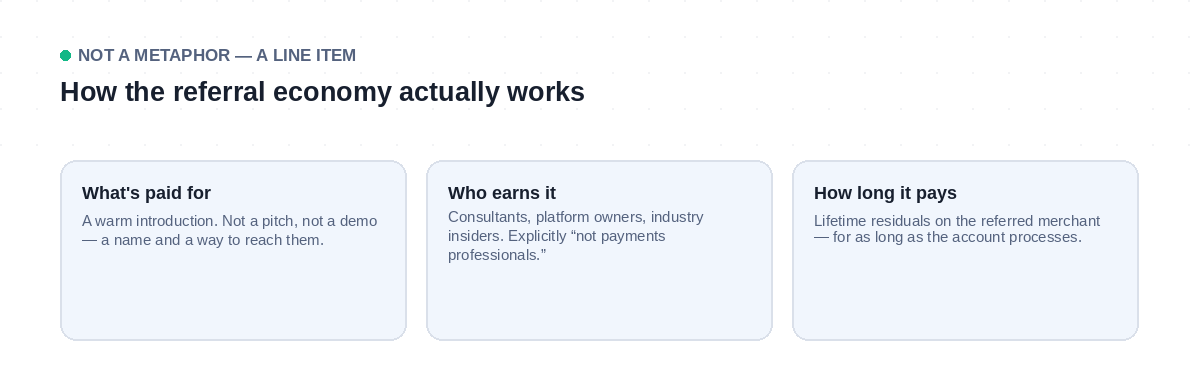
This isn't a vague industry vibe. It's a formalized, monetized business practice with its own commission structure. High-risk processors run explicit referral partner programs, paying lifetime residuals to whoever makes the introduction — and the programs are explicit that the referrer doesn't need to be a payments professional at all. One high-risk processor's own partner program describes its most successful referrers as "consultants, platform owners, and industry insiders — not payments professionals," and spells out the mechanic directly: "you provide a warm introduction and our high-risk specialists handle underwriting, account setup, integration, and ongoing support."
Read that again: the entire value being paid for is the introduction itself. Not a sales pitch, not a demo, not a proposal — a name and a way to reach them. Underwriting still has to happen, terms still have to be negotiated, and a bad business doesn't get approved just because someone vouched for it. But the door that would otherwise take weeks to find gets opened in a phone call, and the processor is willing to pay for that opening indefinitely, for the life of the account. That's not how a business pays for something incidental. That's how a business pays for something structurally valuable.
Why Algorithms Stop Being Useful Exactly Where High-Risk Begins
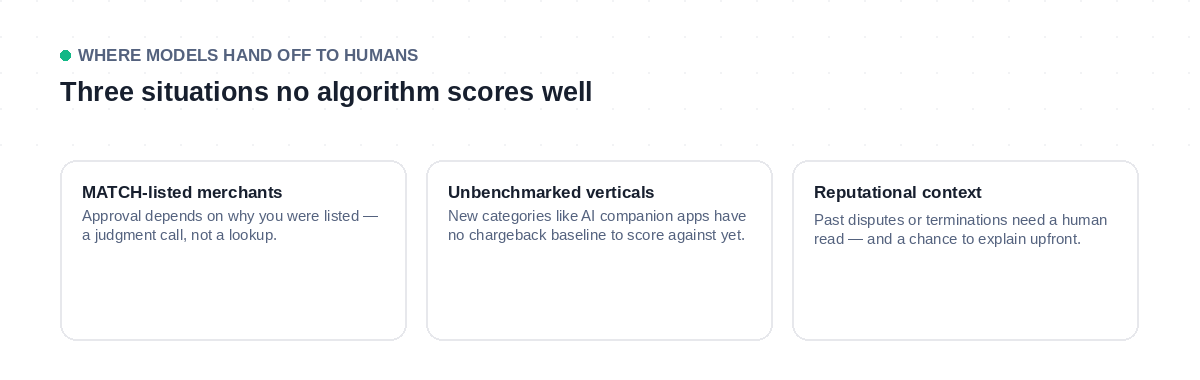
Standard e-commerce underwriting has largely automated because standard e-commerce risk is legible to a model: predictable dispute patterns, clean MCCs, transaction data that behaves the way the training data expects it to. High-risk merchants break that legibility on purpose, or by circumstance — a MATCH-listed business whose termination reason needs actual context to interpret, a genuinely new vertical like AI companion apps with no chargeback benchmark yet, a merchant whose numbers look fine but whose litigation history needs a human read to weigh properly.
Underwriters reviewing these files are explicitly instructed to look past the numbers into reputational territory a model can't easily score: prior public disputes, regulatory actions, how a business handled a past account termination, whether an applicant disclosed a problem upfront or waited to get caught. One underwriting guide puts the standard advice to merchants plainly — if there's something in your history that could be read negatively, "let's address them and be upfront about it and we can discuss." That's not a form field. That's a conversation, and conversations are exactly the thing a warm introduction gets you faster access to.
Specialist processors that handle MATCH-listed merchants say as much directly: approval "will depend on why your business was added to MATCH" — a judgment call, evaluated case by case, not a lookup. The businesses that navigate this well aren't the ones with the cleanest possible file. They're the ones who get their context in front of an actual underwriter before the file speaks for itself in a vacuum.
The Tangible Payoff: Timeline, Not Just Approval
It's worth being concrete about what a relationship actually buys, because "faster" undersells the gap. Specialist high-risk placement firms describe well-prepared, well-placed applications clearing underwriting in roughly 24 to 72 hours — but that speed depends entirely on the file landing with an underwriter already positioned to say yes to that specific category, not queued anonymously behind everyone else's application that week. The application itself doesn't move any faster because someone introduced you. What moves is which pile it lands in, and how quickly a human with the right context picks it up.
That distinction matters because it reframes what a relationship is actually worth. It's not a shortcut around scrutiny — the underwriting still happens, the documentation still has to hold up, the numbers still get checked. What a relationship buys is queue position and context, delivered at the moment the file is first read rather than reconstructed later through back-and-forth emails after a generic decline. For a merchant that's already been dropped by one processor and is burning revenue every week without a working account, that's not a marginal convenience. It's the entire difference between a problem measured in days and one measured in months.
What This Actually Means at a Conference Like TES
Not "network more." Everyone already knows to collect contacts. The more useful shift is what you're actually listening for in a conversation.
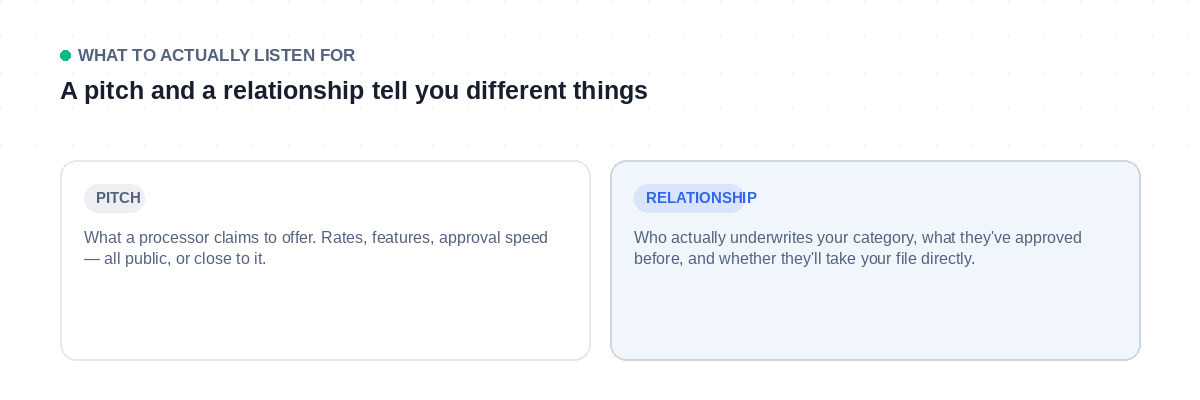
A pitch tells you what a processor claims to offer. A relationship tells you who their underwriter actually is for your specific vertical, what that underwriter has approved before, and whether the person in front of you can pick up a phone and get your file looked at this week instead of queued behind two hundred cold applications. Those are different pieces of information, and only one of them is available on a landing page. The question worth asking a new contact isn't "what are your rates" — that's public, or close to it. It's closer to: who at your organization actually reviews accounts in my category, and would you introduce me directly, or send my file in cold.
The same logic runs in both directions. If you're the one with an established relationship in a vertical — an affiliate, a platform owner, a consultant who's placed merchants before — that relationship has real, monetizable value to the businesses around you, whether or not you ever collect a formal referral fee for it. Treating an introduction as a small favor undersells what it actually is in this industry: a functioning substitute for the underwriting data an algorithm doesn't have yet.
Relationships Open the Door — They Don't Replace What's Behind It
It's worth being honest about the limits of this, because overselling the relationship angle is its own trap. A warm introduction gets a file read faster, by someone better positioned to understand it. It does not make a bad business fundable, and any processor treating it that way is one that won't be underwriting responsibly for long. Specialist processors who work MATCH-listed and hard-to-place merchants are explicit that approval still isn't guaranteed and still depends on the specifics of the case — the introduction changes who's reading the file and how quickly, not whether the underlying numbers hold up.
The honest version of this article isn't "who you know matters more than what you've built." It's that in a category where the numbers alone are often ambiguous — a new vertical, a MATCH listing with real context behind it, a chargeback spike with an explainable cause — the relationship is what gets that ambiguity resolved by a human instead of defaulted to a decline by a system with no way to ask a follow-up question.
The Asymmetry That Makes This Worth Taking Seriously
Here's the part that makes this more than a nice sentiment: the cost of a warm introduction and the cost of a bad underwriting outcome are wildly out of proportion to each other. A five-minute conversation at a conference costs nothing but time. A merchant declined by the wrong processor, or approved onto the wrong reserve terms by someone who didn't understand their vertical, can lose months and real revenue working through the consequences. When the downside of getting underwriting wrong is that lopsided, the upside of a relationship that shortcuts it correctly is worth far more than the effort of building it ever costs.
That's the case for taking relationship-building in this industry seriously as a strategy, not just as good manners. It isn't that high-risk payments is a friendlier corner of fintech. It's that the risk is genuinely harder to score from the outside, and the people who've done the work of building real relationships inside a vertical are functioning, whether they call it that or not, as a live underwriting signal the algorithms haven't caught up to yet.
MMG Corporation has built its high-risk underwriting around exactly this kind of relationship-first approach across EU markets — a named team, not a queue. If you're heading to TES Prague this September and want to know who to actually talk to about your category, that's a conversation worth starting before the event, not during it.
Want to skip the queue at TES Prague?
Get in touch