
The World Cup Is Live (soon) — And So Is the Fraud
The 2026 FIFA World Cup is kicking off on June 11 across the United States, Canada, and Mexico. Within days, it becomes one of the most heavily targeted commercial events in cybercrime history. If you operate in travel, ticketing, hospitality, or any sector that sees a spike in cross-border transactions during major sporting events, this concerns you directly.
The Scale of What's Already Happening
The numbers are not hypothetical. Group-IB, a cybersecurity firm that specializes in fraud intelligence, has identified over 4,300 fraudulent domains impersonating FIFA's official website — registered since August 2025 and sitting dormant, ready to activate as ticket demand peaks. The FBI, which issued its own advisory ahead of the tournament, lists dozens of known fake FIFA domains and warns that new ones will continue to appear throughout the June 11 to July 19 tournament window.
FortiGuard Labs counted more than 13,000 World Cup-themed domains registered between January and May 2026. Approximately 8.8% were flagged as malicious or suspicious. That is more than 1,100 fraudulent domains operating simultaneously, targeting fans, merchants, and payment infrastructure all at once.
At the center of the operation is a group that Group-IB tracks as GHOST STADIUM — a Chinese-speaking, financially motivated threat actor running a sophisticated phishing campaign across more than 300 domains. The fake sites are pixel-perfect clones of the official FIFA website, including a replicated PingIdentity single sign-on authentication flow and multi-language support in eleven languages. Victims who land on these pages see authentic branding loaded directly from FIFA's own content delivery network. Around 2,500 genuine FIFA account credentials have already been found trading on dark web markets as a result.
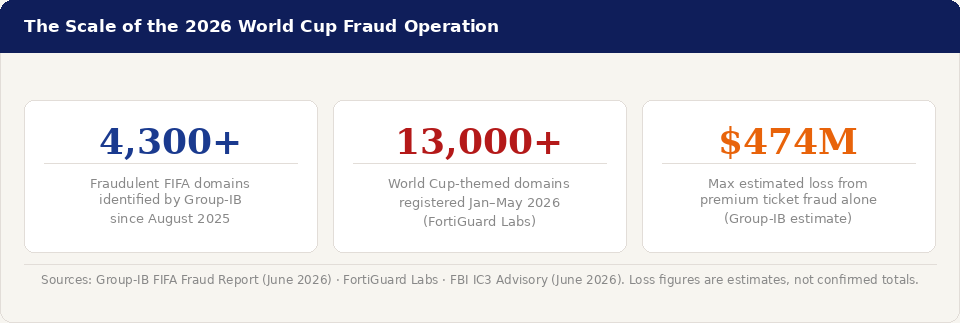
Group-IB estimates that premium and hospitality ticket fraud alone could cost victims between $71 million and $474 million. Total losses across the full campaign — including fake travel packages, fraudulent merchandise, phishing credential theft, and fake gambling platforms — could reach into the billions. These are estimates based on visible infrastructure, not confirmed loss figures, but the range reflects the scale of what has been built.
This is not spontaneous opportunism. This is organized, pre-planned, and well-funded criminal infrastructure that has been quietly assembling since late 2025, waiting for the tournament to begin.
What the Fraud Looks Like in Practice
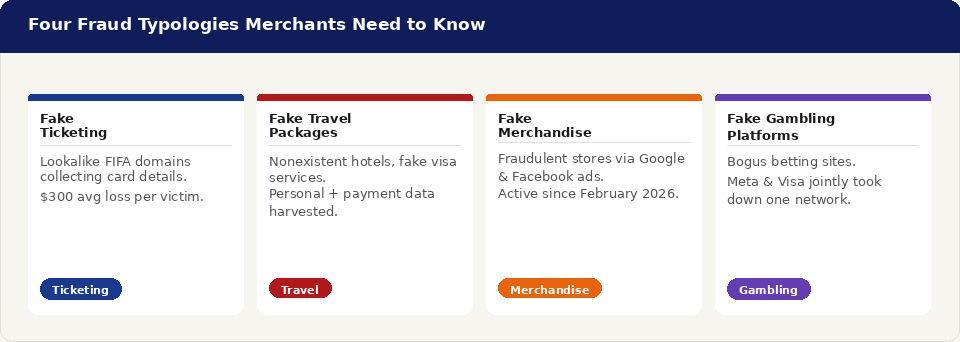
The fraud campaigns targeting the 2026 World Cup span several distinct schemes, each with its own fraud typology and chargeback implications for merchants.
Fake ticketing websites. Fraudulent domains — using typosquatting like "fiffa.com," alternative top-level domains (.org, .xyz, .live), and fake employment portals like "jobs-fifa.com" — collect payment details from fans desperate for tickets. FIFA received more than 150 million ticket requests in the first 15 days of sales, leaving the tournament roughly 30 times oversubscribed. That scarcity is the fuel. Consumers losing an average of nearly $300 per incident on fake season tickets or VIP packages, with some victims losing thousands through fraudulent payment schemes.
Fake travel and accommodation packages. The Canadian Anti-Fraud Centre has documented scammers advertising fake travel packages and nonexistent short-term rental accommodations. One fraudulent site was advertising a "Visa to the World Cup 2026 US" for $270 per person — a product that doesn't exist — harvesting payment data and personal information in the process.
Fake merchandise stores. Bitdefender Labs observed separate fraudulent merchandise campaigns running since February 2026, targeting fans across the UK, Germany, the US, Canada, Mexico, Brazil, and Australia, promoted through Google Search ads and Facebook advertising.
Fake gambling and betting platforms. The Los Angeles County Sheriff's Department warned that scammers are using fake World Cup betting promotions to steal money and personal information. Meta and Visa jointly identified and took down a Facebook network pushing bogus gambling through fake World Cup sites.
The Merchant Problem: Chargebacks and VAMP Exposure
Consumer fraud at this scale translates directly into merchant chargebacks — and for high-risk merchants already operating close to monitoring program thresholds, a tournament-driven spike in disputes can be the difference between compliance and a formal program entry.
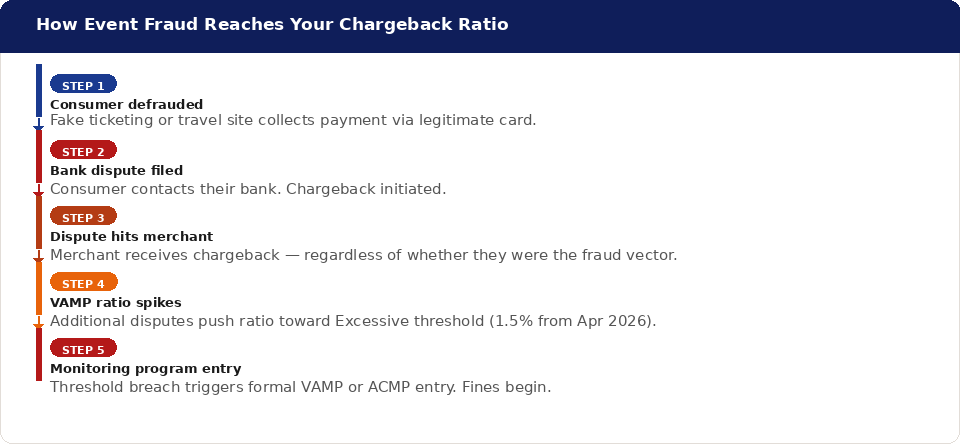
The mechanism is straightforward. A consumer is defrauded on a fake ticketing or travel site. The payment was processed — legitimately or otherwise — through a merchant account. The consumer contacts their bank. The bank initiates a chargeback. The merchant receives the dispute. If the merchant cannot demonstrate that the transaction was legitimate and fulfilled, they lose the chargeback and absorb the cost. If enough of these disputes arrive in a single month, their VAMP ratio spikes.
For travel and hospitality merchants operating under High Brand Risk MCCs — MCC 4722 (online travel agencies) being the most common — there is no grace period. Fines under VAMP can start in month one. A tournament-driven chargeback spike that pushes a ratio from 1.2% to 1.8% in June does not just cost the disputed transaction value. It can trigger a formal monitoring program entry, escalating fines, and acquirer scrutiny that outlasts the tournament by months.
> The fraud doesn't have to happen on your platform to affect your chargeback ratio. If fraudsters are using legitimate merchant accounts to launder proceeds from fake ticketing operations — a documented pattern at major events — chargebacks from those transactions flow back to the acquiring merchant regardless of intent.
AI Is Making This Harder to Catch
One factor that separates the 2026 fraud wave from previous World Cups is the role of AI in scaling and accelerating attacks. According to Spreedly's Chief Information Security Officer, AI and automation are dramatically shrinking the amount of time businesses have to identify and respond to threats. As transaction volume increases during the tournament, merchants can no longer rely on manual review processes alone.
Malwarebytes Labs notes that each World Cup generates its own scam economy with its own characteristic patterns: 2018 had fake ticket marketplaces; 2022 leaned on phishing around Qatar's Hayya fan ID system; 2026 is built around AI-generated sites, meme coin payment rails, and visa impersonation. The sophistication has increased meaningfully with each cycle. The GHOST STADIUM operation — with its pixel-perfect site replication, multi-language support, and automated ticket-buying bots — is an example of what organized fraud looks like when AI tools are available to every threat actor.
5 Things Merchants Should Do Right Now
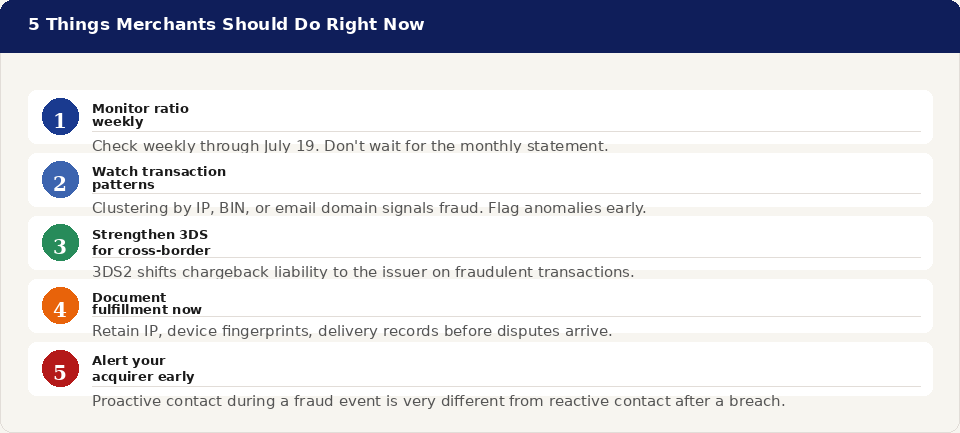
1. Monitor your chargeback ratio weekly through July 19. Don't wait for your monthly statement. During active fraud campaigns, dispute volumes can move fast. If your ratio is climbing, you want to know in week two of the tournament — not in August when your acquirer contacts you.
2. Review velocity and pattern anomalies in real time. Tournament fraud tends to show up in clustering patterns — multiple transactions from the same IP range, the same card BIN, or the same email domain within a short window. Check Point's research found that cyber-attacks on travel, hospitality, and media companies increased across all three host countries in April 2026 compared to both March 2026 and April 2025. The pattern was visible in the data before the tournament began.
3. Strengthen your 3DS implementation for cross-border transactions. A significant proportion of World Cup-driven transactions are cross-border — European fans buying from US-based merchants, or vice versa. Proper 3DS2 implementation shifts liability for fraudulent transactions to the issuer. For high-risk merchants, this is not optional hygiene — it is direct chargeback protection.
4. Document fulfillment evidence now, not after a dispute arrives. Compelling Evidence 3.0 allows merchants to fight back against friendly fraud by demonstrating prior non-disputed transactions with the same customer. Build the habit of retaining transaction-level evidence — IP addresses, device fingerprints, delivery confirmations — before disputes arrive, not after.
5. Alert your acquirer if you see an unusual spike. Proactive communication with your acquirer during a documented fraud event is very different from reactive communication after a threshold breach. If you process in travel, ticketing, or hospitality and see dispute volumes rising through June and July, flag it early. Your acquirer has context from across their portfolio — and that context can work in your favor if you surface the issue first.
The Bottom Line
The 2026 World Cup is the largest single fraud event of the year so far — and the tournament runs until July 19. For merchants in affected verticals, the next six weeks carry real chargeback risk that requires active management, not passive monitoring.
The fraud infrastructure was built over months. The window to act is now. Know your ratio, watch your patterns, protect your fulfillment evidence, and keep your acquirer in the loop. Merchants who do these things consistently come through event-driven fraud spikes without lasting damage. Those who don't often find themselves explaining the situation to their acquirer from inside a monitoring program.
At MMG, we work with high-risk merchants across travel, iGaming, and other sectors that are directly exposed to this kind of event-driven fraud pressure. If you want to talk through your current setup and what to watch for through the end of the tournament, we're happy to help.
Sources: FBI Internet Crime Complaint Center advisory (June 2026) · Group-IB FIFA World Cup Fraud Report (June 2026) · Spreedly / PR Newswire (June 4, 2026) · Check Point Research (May 14, 2026) · FortiGuard Labs · The Hacker News (June 5, 2026) · Infosecurity Magazine · Cybernews · Malwarebytes Labs / ASIS Online · Canadian Anti-Fraud Centre · Bitdefender Labs · Los Angeles County Sheriff's Department. This article reflects publicly available information as of June 5, 2026 and does not constitute legal or financial advice.
Get in touch