
What You're Actually Paying in 2026
Most high-risk merchants know their processing rate. Few know their effective total cost. Processing rates, chargeback fees, rolling reserves, monthly account charges, early termination clauses, and a stack of smaller line items that appear on statements without explanation — together, these can push the true cost of accepting cards to 7% per transaction or higher. Here's a complete, verified breakdown of what you're actually paying in 2026, and what you can do about it.
Standard vs. High-Risk: The Starting Point
Before going through the individual fee components, it helps to understand the baseline gap between standard and high-risk processing costs. This gap is the structural reality that every high-risk merchant operates within — and understanding it clearly is the first step toward negotiating within it intelligently.
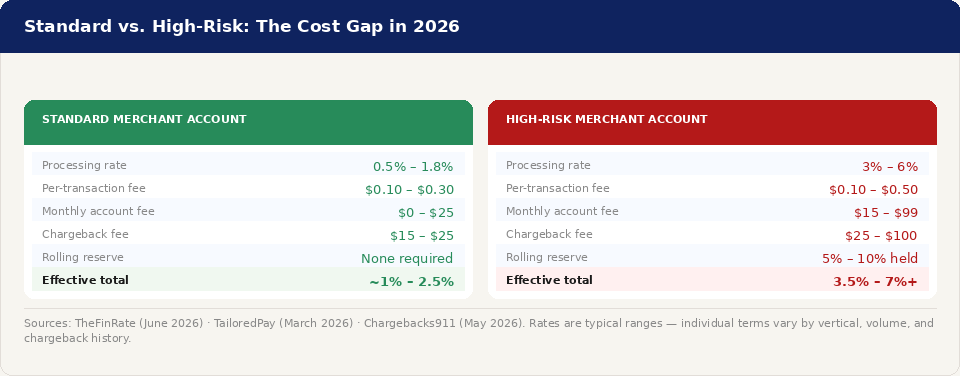
Standard merchant accounts in 2026 typically charge a processing rate of 0.5%–1.8% under interchange-plus pricing, a per-transaction fee of $0.10–$0.30, monthly account fees of $0–$25, and chargeback fees of $15–$25 per dispute, with no rolling reserve required. (TheFinRate, June 2026)
High-risk merchant accounts sit on a materially different cost curve. Processing rates typically run 3%–6% per transaction, with a fixed per-transaction fee of $0.10–$0.50. (TailoredPay, March 2026) Monthly account fees run $15–$99. Rolling reserves of 5%–10% are standard. Chargeback fees run $25–$100 per dispute. When all costs are combined, most high-risk businesses in 2026 end up paying an effective total processing cost of 3.5%–7% per transaction. (TailoredPay, March 2026)
That's a meaningful gap — but it's not fixed. Every component of that cost structure is influenced by your vertical, your chargeback history, your processing volume, and how well you understand what you're agreeing to when you sign.
The Fee Components, One by One
High-risk merchant account costs are not a single number. They are a stack of components — some visible in the headline rate, most buried in the contract or on the monthly statement. Here is what each component costs, what drives it, and what to watch for.
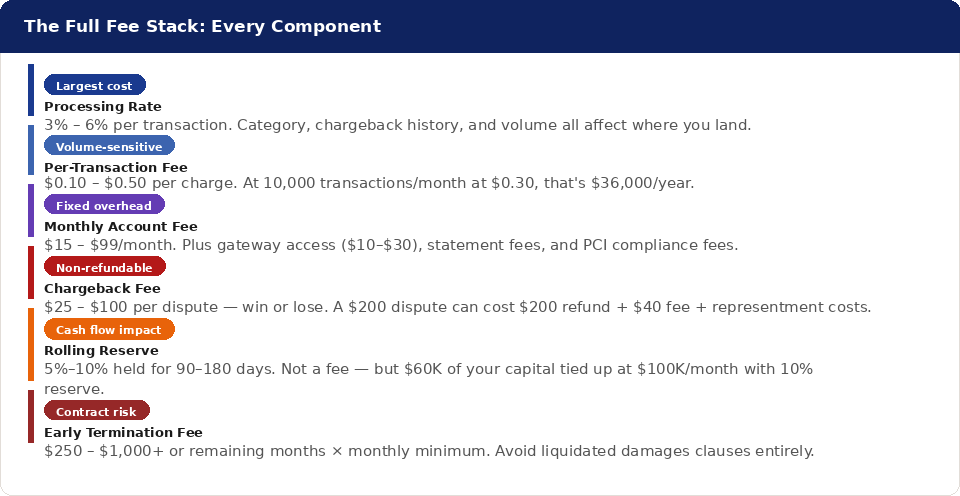
Processing rate. The percentage of each transaction charged by your acquirer. For high-risk merchants, typical rates run 3%–6% per transaction, though very high-risk categories — adult entertainment, iGaming, nutraceuticals — consistently skew toward the higher end. (Chargebacks911, May 2026) A 4.5% rate is roughly 2% in interchange and scheme assessments plus 2.5% processor margin. (KoronaPOS, May 2026) Interchange-plus pricing — where the interchange cost is passed through transparently with a fixed markup on top — offers the clearest view of where the margin sits. Tiered pricing, the most common pitch from aggressive ISOs, sorts transactions into "qualified," "mid-qualified," and "non-qualified" buckets with the processor deciding the sorting. Almost nothing lands in the qualified bucket. Avoid tiered pricing on high-risk accounts. (KoronaPOS, May 2026)
Per-transaction fee. A fixed fee charged on every transaction regardless of value. High-risk rates typically run $0.10–$0.50 per transaction. (TailoredPay, March 2026) At high volumes, this adds up fast. A merchant processing 10,000 transactions per month at $0.30 per transaction pays $3,000 monthly — $36,000 annually — in per-transaction fees alone, before the percentage rate is applied.
Monthly account fees. Monthly account or maintenance fees range from $15–$99 for high-risk accounts in 2026. (SecureGlobalPay, February 2026) Payment gateway access may add another $10–$30 per month. Some providers charge separate statement fees, PCI compliance fees, and batch fees that add a further $5–$20 per month. These are individually small but collectively meaningful at annualized rates.
Chargeback fees. Charged on every dispute filed — whether you win or lose. Standard accounts pay $15–$25 per chargeback. High-risk merchants pay $25–$100 per dispute. (chargeback.io, 2026) A $200 transaction that results in a chargeback doesn't cost you $200. It costs you $200 (the refund) plus $40 (the chargeback fee) plus any representment costs if you choose to fight it. (KoronaPOS, May 2026) This compounding cost structure is why keeping your chargeback ratio below 0.5% is a financial priority, not just a compliance one.
Rolling reserve. Not technically a fee — the money is yours — but it operates as a significant cash flow cost. In 2026, most high-risk accounts carry a rolling reserve of 5%–10% of each transaction, held for 90–180 days before release. (TailoredPay, March 2026) A merchant processing $100,000 per month with a 10% rolling reserve has $60,000 of their own revenue inaccessible at any given point over a six-month window. We covered the reserve clause in detail in a previous article — the key point here is that it should be factored into the total cost calculation from day one, not treated as a separate issue.
Setup fees. A red flag in 2026. Most reputable high-risk processors waive setup fees to win the business. If a provider quotes $100–$500 just to open the account, look elsewhere. (KoronaPOS, May 2026)
Early termination fees. One of the most consequential clauses in any merchant processing agreement. If your contract has a fixed term — typically one to three years — and you exit before it ends, you may face penalties of $250–$1,000 or more, sometimes calculated as the remaining months multiplied by the monthly minimum. (Sensapay, April 2026) The worst version is a liquidated damages clause that calculates the ETF based on projected lost revenue for the remainder of the contract. Push for month-to-month terms or a fixed, capped ETF. Never sign a liquidated damages ETF clause. (KoronaPOS, May 2026)
The Hidden Fees That Appear on Statements
Beyond the headline fees, a category of smaller charges appears on monthly statements that most merchants never see coming — and never think to ask about during contract negotiations.
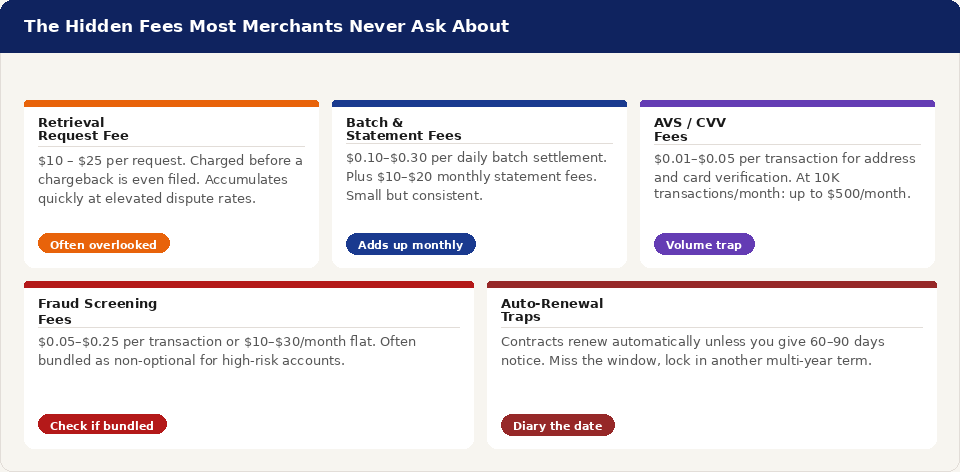
Retrieval request fees. Applied when card issuers request transaction information before filing a formal chargeback. These fees — typically $10–$25 per request — fly under the radar but accumulate steadily for merchants with elevated dispute rates. (Chargebacks911, May 2026)
Batch fees. Assessed each time you settle your daily transactions, typically $0.10–$0.30 per batch. A merchant settling daily pays 30 batch fees per month — roughly $3–$9 per month in batch fees alone. (Chargebacks911, May 2026)
AVS and CVV fees. Small charges of $0.01–$0.05 per transaction for address verification and card verification checks. Individually negligible — at 10,000 transactions per month, this represents $100–$500 per month in verification fees alone. (Chargebacks911, May 2026)
Fraud screening fees. Some processors charge additional fees for advanced fraud detection tools — $0.05–$0.25 per transaction or a flat monthly fee of $10–$30. For high-risk merchants, this is often bundled as a non-optional service. (SecureGlobalPay, February 2026)
Auto-renewal traps. Many high-risk processing contracts renew automatically for additional terms unless you provide notice within a specific window — sometimes 60 to 90 days before the renewal date. Missing this window can lock you into another multi-year term at rates that may no longer reflect your risk profile. (Chargebacks911, May 2026) Diary the renewal date when you sign. Treat it as a mandatory review point.
If you see terms like "stmt fee," "merchant service charges," "bankcard merch fees," or "voice authorization fee" on your statement, ask your provider to explain each line in writing. Reputable processors will document every charge. Reluctance to disclose a fee structure is a warning sign. (PremierPaymentsOnline, May 2026)
What You Can Actually Negotiate
High-risk processing is competitive. Most components of the fee structure have more flexibility than processors typically present at the outset. The key is knowing what to ask for, and when.
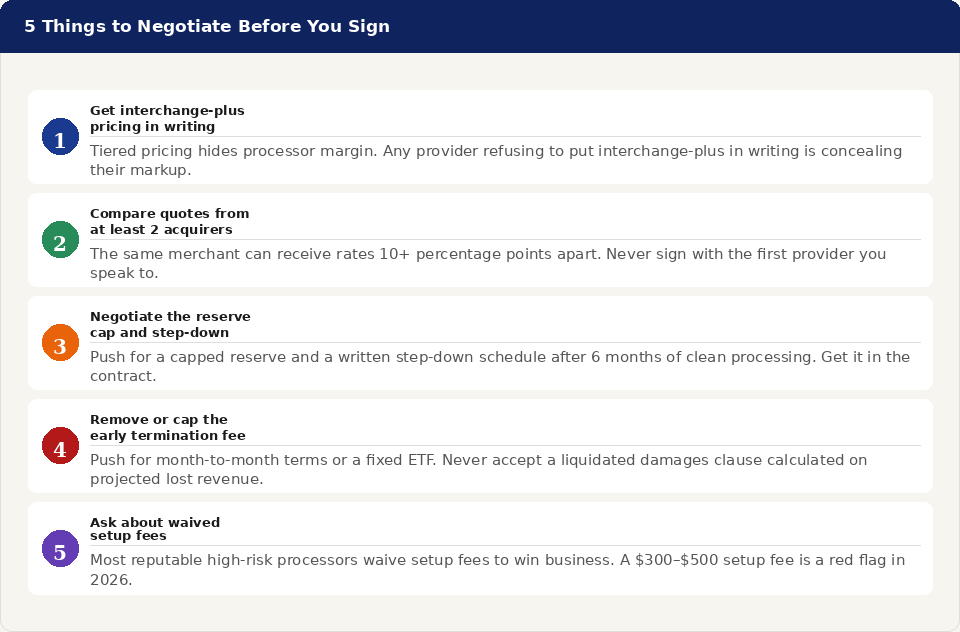
Before signing. Get multiple quotes. The same merchant with the same processing history can receive materially different rate offers from different acquirers. Use competing offers as leverage. Ask specifically about interchange-plus pricing — any provider unwilling to put this in writing is hiding margin. Ask about setup fees — most reputable processors waive them. Push for month-to-month terms or a clearly capped ETF. And ask for a step-down provision on the reserve: after six months of clean processing, what does a lower reserve percentage look like? Get the answer in the contract. (KoronaPOS, May 2026)
After 3–6 months of clean processing. Once you have documented chargeback ratios below 0.5% and a processing track record, you have leverage you didn't have on day one. Schedule a direct conversation with your account manager. Ask specifically for: a reserve review (target a 50% reduction or a step-down schedule), a rate reduction based on demonstrated performance, and shorter holding periods on reserve funds. Processors will accommodate at least part of this request to retain your business. The ones that won't are the ones to leave at contract renewal. (Sensapay, April 2026; KoronaPOS, May 2026)
A high-risk merchant account is more expensive than a standard one. That is unavoidable — the risk profile justifies a higher cost structure, and the alternative for most high-risk merchants is no processing at all. But "more expensive" does not mean "any price the processor names." The fee structure has more room than most merchants realize, the contract terms have more flexibility than most acquirers initially present, and the total cost over a two- or three-year relationship is heavily influenced by choices made before the first transaction is processed.
Know your effective total cost — not just the headline rate. Understand every line on your statement. Compare terms across at least two acquirers before signing. And treat your processing relationship as a negotiation that continues after the contract is signed, not one that ends at approval.
At MMG, we work with high-risk merchants across EU markets on acquiring strategy and processing terms. If you want to understand what a fair rate structure looks like for your vertical, or want to talk through your current agreement, we are glad to help.
Get in touch