
The Big-Name Bet
Why More Merchants Are Giving Smaller, Established Processors a Second Look
When it's time to pick a payment processor, most merchants reach for the name they already recognize. It feels like the safe choice — the one with the biggest marketing budget, the slickest sign-up flow, the logo everyone's seen before. And for a large share of straightforward, low-risk businesses, that instinct works out fine.
But talk to enough merchants — especially the ones running subscriptions, high-ticket sales, international volume, or anything that lands in a "high-risk" category — and a pattern shows up. The account that was approved in minutes gets frozen just as fast. Funds sit on hold for months. Support is a ticket queue, not a person. And when it's time to find out why, there's often no one on the other end who can actually explain the decision.
None of that means the big platforms are doing anything wrong. It means their model is built for a different kind of business than the one that's outgrowing it — and it's worth understanding why before you sign with anyone, big or small.
The trade-off behind "sign up in minutes"
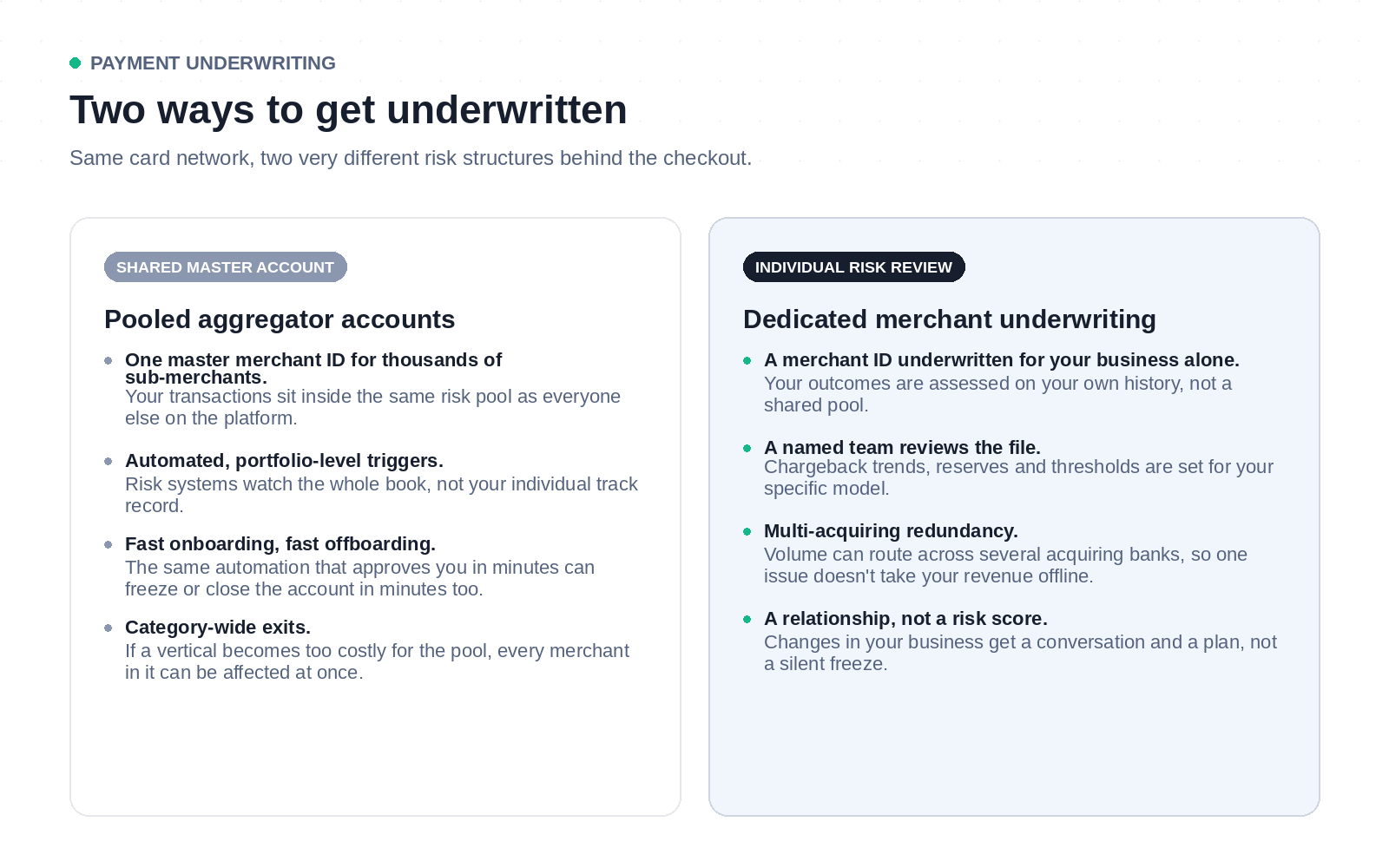
Large aggregator platforms can onboard merchants almost instantly because most of them use a pooled account structure: thousands of businesses process under one shared master merchant ID, rather than each getting an account underwritten individually. That's what makes the sign-up flow so fast — and it's also what makes the risk management so blunt.
When your transactions sit inside a shared pool, the platform's risk systems aren't really watching you. They're watching the pool. A spike in chargebacks anywhere in your category, a shift in how a card network scores your industry, or a policy change at the sponsoring bank can trigger a hold or a closure that has nothing to do with your own performance. Merchants increasingly report exactly this: solid businesses, clean records, and an account frozen anyway because the platform decided the category itself was getting too expensive to carry.
What a dedicated, established processor does differently
This is where smaller, specialist processors tend to earn their keep — not because size is a virtue on its own, but because the underwriting model is structurally different.
A dedicated merchant account is underwritten around your business specifically, not folded into a shared pool. That usually means a named team reviewing your file, chargeback thresholds and reserve terms set for your actual model, and — critically — a person you can call when something changes. Established high-risk specialists also tend to route volume across multiple acquiring banks, so a single decline, outage, or bank-level policy shift doesn't take your whole revenue stream offline. And because your vertical is the business, not an exception the compliance team tolerates, the underwriting decisions are usually more predictable and easier to plan around.
None of this is a knock on the big platforms — they're genuinely excellent at what they're built for: fast, self-serve, standardized payments at massive scale for low-risk merchants. The problem only shows up when a business that's grown more complex, more international, or more specialized keeps using a tool that was designed for something simpler.
How to evaluate any processor — including us
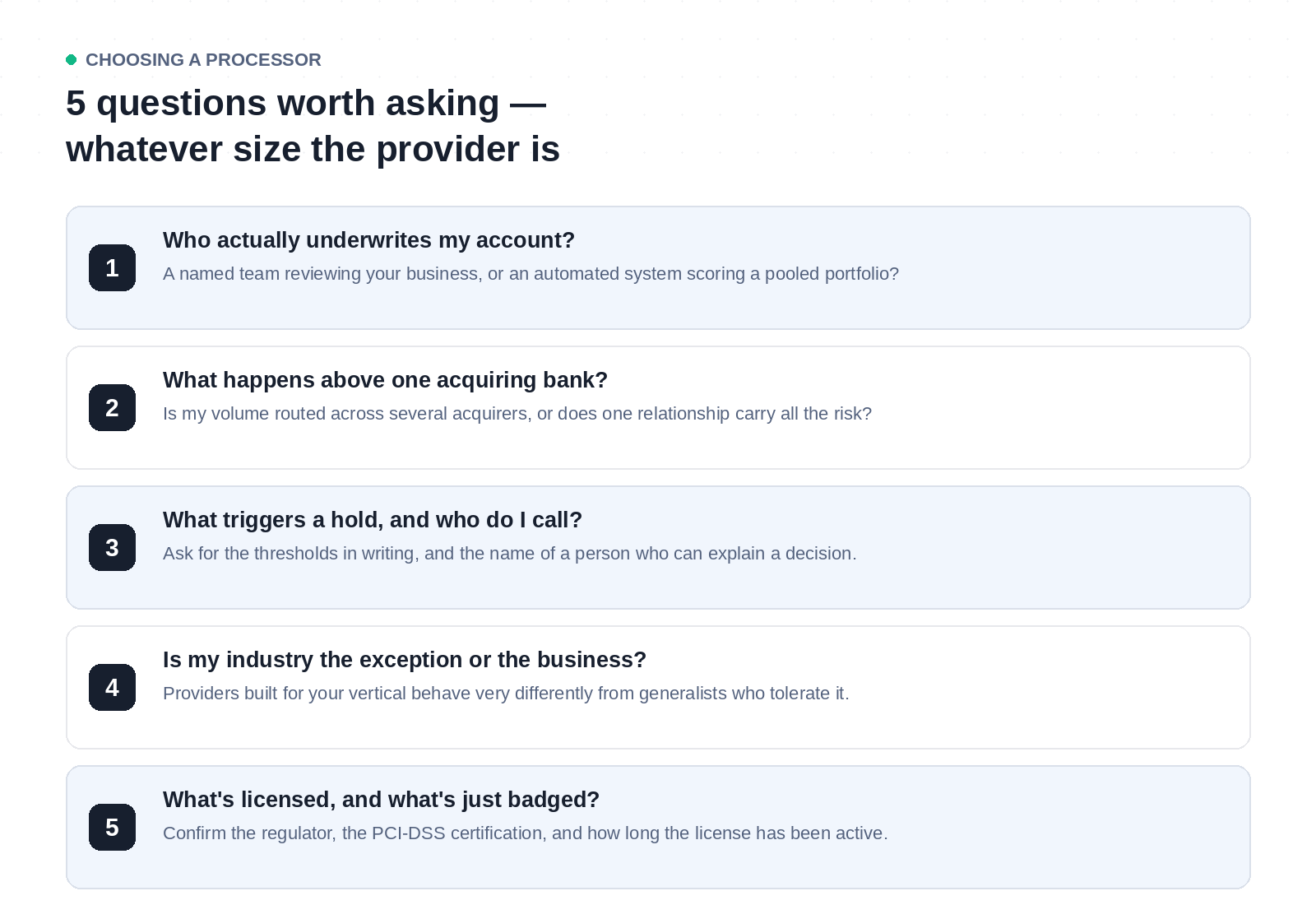
The goal isn't to write off big providers or assume small automatically means better. Plenty of small processors are under-capitalized, under-licensed, or simply not built for your volume. The useful question isn't "how big are they," it's "how are they actually structured to handle my risk." Before signing with anyone, it's worth getting straight answers on a few things: who underwrites the account and how, whether volume is routed across more than one acquiring bank, what specifically triggers a hold and who explains it when it happens, whether your industry is a core focus or a tolerated exception, and what license and certifications actually back the provider — not just what's on the homepage.
A processor that can answer those clearly, with a name attached rather than a policy document, is usually the one that's actually built for your business — whatever size the logo is.
Get in touch