
What's Actually in Your Payment Processing Agreement
Most merchants read a processing agreement exactly once — the day they sign it, usually skimming past the legal sections to get to the pricing table. That's understandable. It's also how a business ends up surprised, months or years later, by a clause that was sitting in plain sight the whole time.
The pricing table is rarely where the real risk lives. It's in four sections most merchants skip: reserves, chargeback monitoring, termination terms, and the fee schedule's fine print. Here's what's actually in them, and what's worth checking before you sign anything.
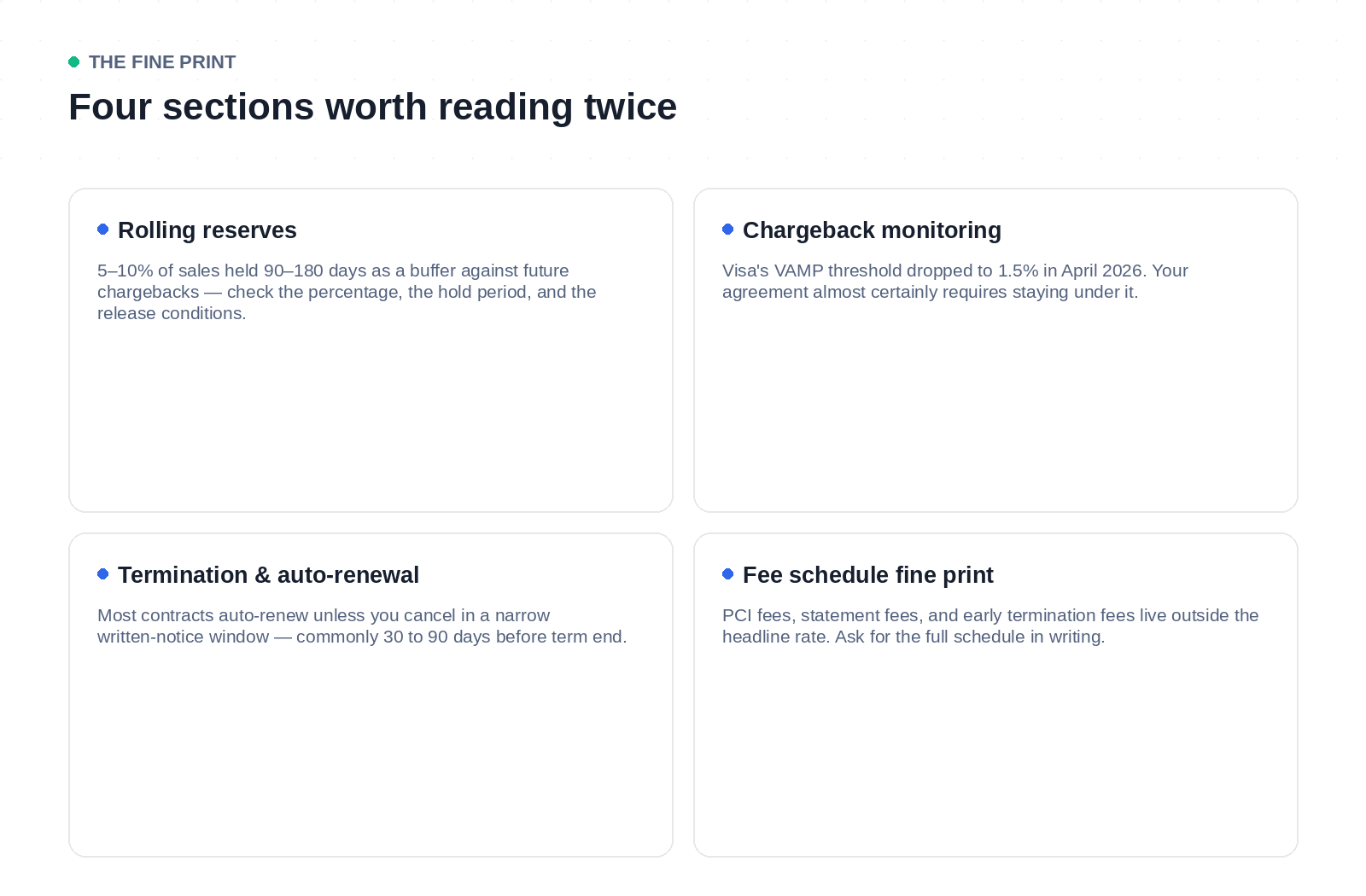
Rolling reserves: the clause that holds your own money
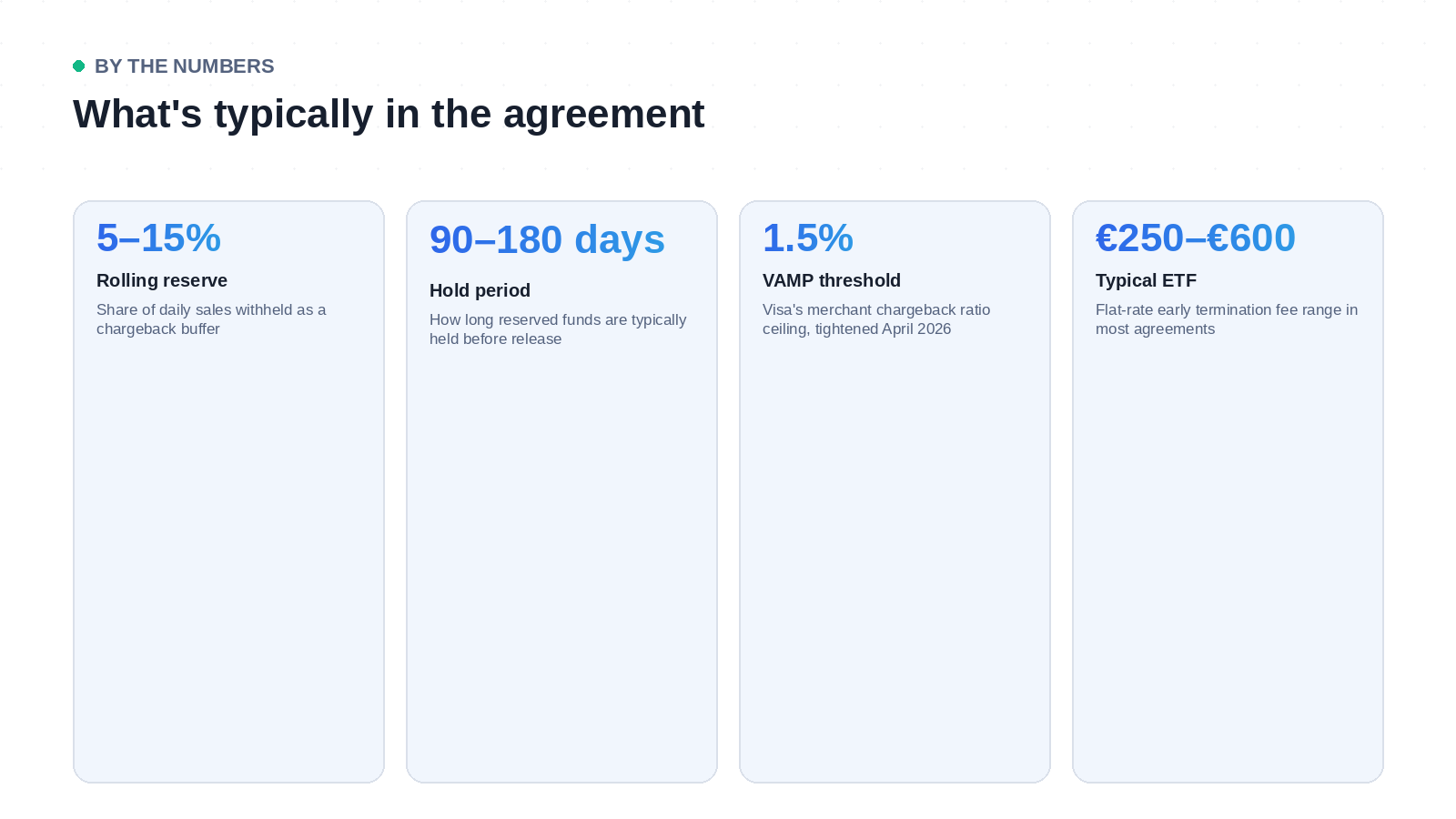
A rolling reserve lets your processor withhold a percentage of each day's card sales — typically 5% to 10%, sometimes up to 15% for higher-risk categories — for a set window, commonly 90 to 180 days, before releasing it back to you. It's not a fee; it's your own revenue, held as a buffer against future chargebacks and refunds. For a business processing €1M a month with a 10% reserve held 90 days, that's roughly €300,000 in working capital sitting outside your reach at any given time.
Reserves aren't inherently a red flag — they're standard for high-risk categories and often what makes approval possible in the first place. What matters is whether the terms are specific. A vague clause that lets the processor set or change the reserve "at its discretion" is very different from one that states the percentage, the hold period, and the exact conditions under which it can be increased or reduced. Ask for the number in writing, not a range.
Chargeback monitoring: a program you're bound to without signing it
Somewhere in most agreements is a clause requiring you to stay compliant with the card networks' own rules — and in 2026, that reference matters more than it used to. Visa's Acquirer Monitoring Program (VAMP) tightened its merchant "Excessive" threshold from 2.2% to 1.5% in April 2026 across the US, Canada, EU and Asia-Pacific, combining fraud reports and chargebacks into a single ratio. Cross that line and the consequences aren't hypothetical: per-transaction fines, forced reserves, and — for sustained non-compliance — the kind of network blacklisting that ends your ability to process that card brand at all.
None of this is negotiable; it's set by Visa and Mastercard, not your processor. But it's worth understanding that your processing agreement almost certainly obligates you to stay under these thresholds, and that your processor's own portfolio-level thresholds are tighter still — which is exactly why a processor might tighten your terms or add a reserve well before you'd consider your chargeback rate a problem.
Termination and auto-renewal: the exit that's harder than the entrance
Getting approved for a merchant account usually takes days. Getting out of the agreement can take a written notice sent inside a very specific window. The majority of processing agreements include an automatic renewal clause — commonly renewing for one to three years unless you cancel in writing 30 to 90 days before the term ends. Miss that window and the contract quietly rolls forward, early termination fee and all.
The termination clause usually runs in both directions, and it's worth reading both sides of it. Most agreements also let the processor end the relationship with roughly 30 days' notice and no cause required — standard practice across the industry, but worth knowing is there rather than discovering it during a dispute.
The fee schedule's fine print
Two merchants can see the same headline rate and pay very different amounts, because the pricing model matters more than the number. Tiered pricing — where transactions get sorted into "qualified," "mid-qualified," and "non-qualified" buckets — routinely runs 0.6 to 0.75 percentage points above what the same card mix would cost under interchange-plus pricing, where you pay the actual interchange cost plus a transparent markup. If your statement only shows a blended rate with no breakdown, that's worth asking about directly.
Then there's everything outside the headline rate: PCI compliance fees, statement fees, monthly minimums, batch fees, and — if you cancel early — an early termination fee. Flat-rate ETFs typically run €250 to €600, though liquidated-damages clauses that calculate the fee from your remaining contract term and average monthly profit can add up to considerably more. Ask for the exact fee schedule as an attachment, not a verbal summary, and get the termination fee structure in writing before you sign — not after you've decided to leave.
What to ask for before you sign
None of these clauses are unusual, and none of them should be dealbreakers on their own — they're standard tools processors use to manage risk. What separates a fair agreement from a costly surprise is specificity. Before signing, it's worth asking for the reserve percentage and hold period in writing, the exact chargeback ratio that would trigger a review or reserve increase, the notice window and fee for terminating early, and a full fee schedule broken out by interchange cost and markup rather than a single blended number.
A processor willing to put all of that in writing before you sign is usually the one worth signing with.
Get in touchThis article was researched and written with the help of AI tools as part of our content process, and reviewed and fact-checked by the MMG team before publication.