
The Fastest-Growing High-Risk Vertical Nobody's Prepared For
More AI companion businesses fail because of payment problems than because of product problems. That's not a guess — it's the pattern showing up across the operator community right now, as a genuinely new vertical scales faster than the payments infrastructure built to support it.
The numbers behind the category are messy, and worth being honest about upfront. Broad analyst forecasts for "AI companion" markets swing anywhere from the low billions to the hundreds of billions of dollars, largely because they blend in enterprise AI, healthcare, and adjacent use cases that have nothing to do with a consumer paying for a romantic or companionship app. The cleanest verified figure — actual observed consumer spend inside companion apps — sits closer to a few hundred million dollars for 2026, still up sharply year over year. What's undisputed is the growth rate: the number of active, revenue-generating AI companion apps has grown roughly 60% since 2024, and investment into the category has surged from around $7 million in 2021 to roughly $299 million since 2022. However you size the market, it's growing faster than most operators' payment stacks are built to handle.
This article is about the part of that growth story nobody's writing about yet: what actually happens when an AI companion app tries to get, and keep, a working merchant account.
Why This Vertical Gets Classified High-Risk From Day One
There is no dedicated merchant category code for "AI companion app." Acquirers and card networks route this category through the same MCCs already used for dating and adult-coded content — codes like 7273 (dating and escort services) or 5967 (direct marketing, inbound teleservices, a common home for adult-coded billing) — because the underlying risk profile looks the same to an underwriter, even when the product itself is a chatbot rather than a person.
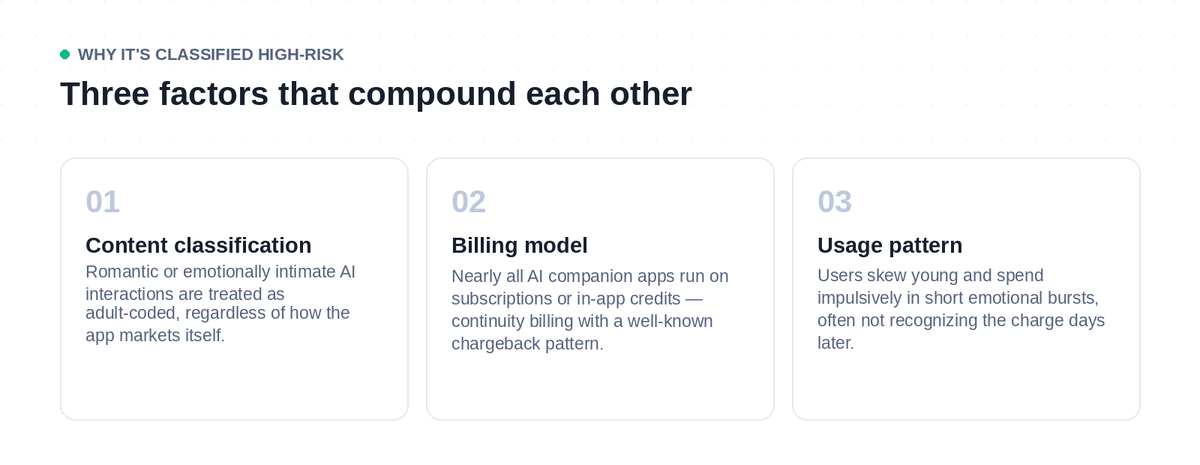
Three factors drive that classification, and they compound each other. First, the content: romantic or emotionally intimate AI interactions are treated as adult-coded regardless of how the app markets itself, which brings the same card-brand scrutiny applied to dating and adult entertainment. Second, the billing model: nearly all AI companion apps run on subscriptions or in-app credit purchases, and continuity billing has a well-established chargeback pattern of its own. Third, the audience and usage pattern: AI companion users skew young, spend impulsively in short emotional bursts, and often don't recognize a charge on their statement days or weeks after making it.
The Chargeback Pattern Is Different — and Generic Fraud Tools Miss It
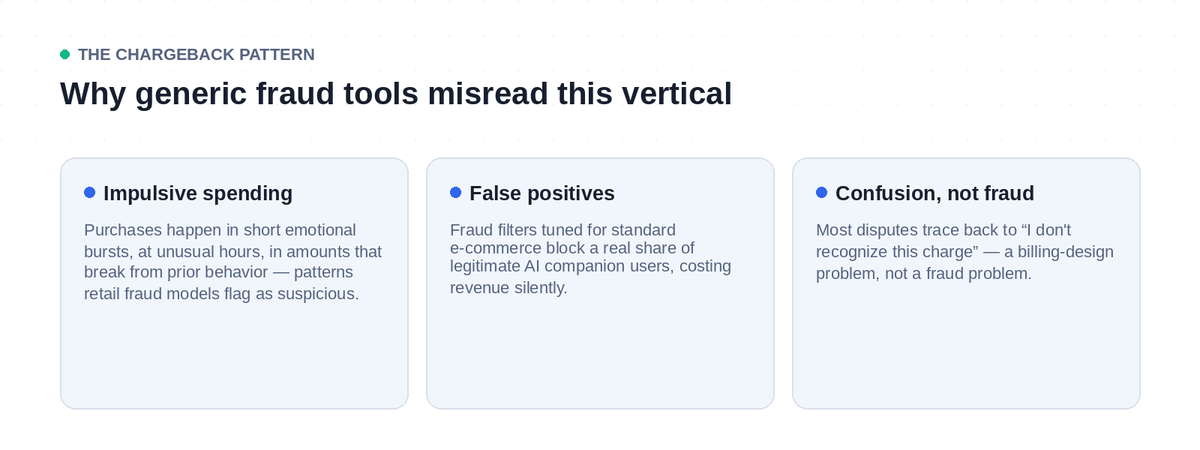
Standard e-commerce fraud tools are built around a different shopping pattern: a customer researches, compares, and buys — usually planned, usually rational. AI companion spending doesn't look like that. Users often subscribe or buy credits in a short emotional burst, at unusual hours, in amounts that don't correlate with their prior behavior. A fraud filter tuned for retail will flag a large share of that as suspicious, generating false declines on legitimate customers — the same false-positive problem covered in our piece on fraud filters that are too aggressive. Tune the filter the other way, and genuinely fraudulent or bot-driven signups slip through instead.
The chargebacks that do land tend to share one root cause: the customer doesn't recognize the charge, not because it's fraudulent, but because the billing descriptor or the emotional context of the purchase doesn't match what they remember. That's a confusion-driven dispute, not a fraud dispute — and it's fixable at the billing-design level rather than the fraud-model level, which is exactly why descriptor strategy and clear renewal communication matter more in this vertical than almost any other.
What VAMP Means for an Adult-Coded, Subscription-Heavy Category
Because AI companion apps are typically coded under the same MCCs as dating and adult content, they inherit the same exposure to Visa's Acquirer Monitoring Program (VAMP), which combines fraud reports and disputes into a single ratio measured at the acquirer's portfolio level. The "Excessive" threshold tightened to 1.5% in April 2026 across the US, Canada, EU and Asia-Pacific — and acquirers typically enforce internal limits tighter than that published number, precisely because adult-coded, high-chargeback categories are the ones dragging their portfolio ratio toward the ceiling.
For a fast-growing AI companion app, this creates a specific trap: the same emotional-burst spending that drives strong revenue growth also drives the confusion-driven disputes that push a chargeback ratio toward VAMP thresholds — often before the business has scaled enough to justify a dedicated compliance function watching for it.
The Controls That Actually Work for This Vertical
None of this is unmanageable. The operators handling AI companion payments well in 2026 are converging on a similar playbook, most of it borrowed from adult and subscription verticals that have been managing this exact problem for years.
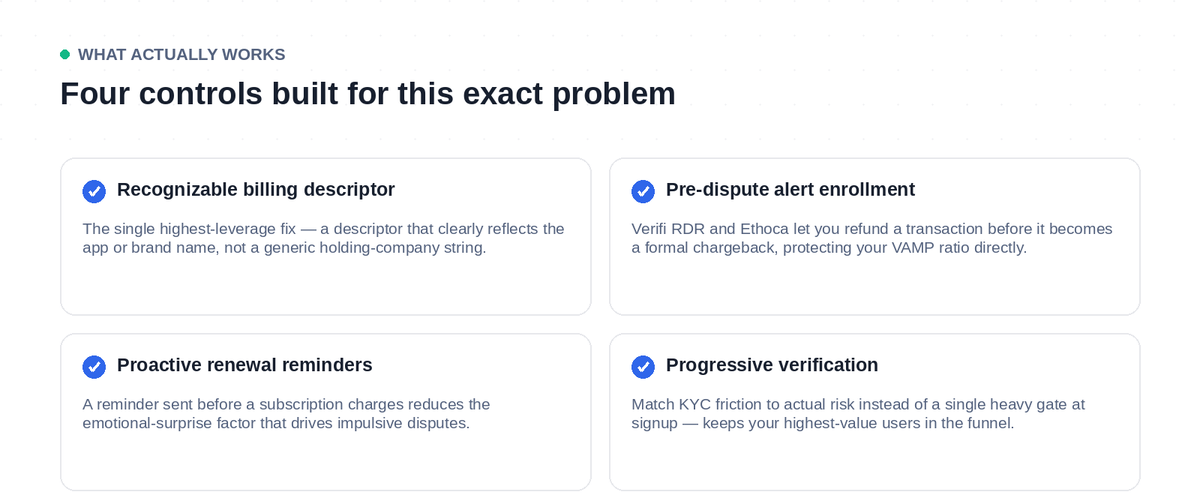
A recognizable billing descriptor is the single highest-leverage fix — one that clearly reflects the app name or brand rather than a generic holding-company string, since descriptor confusion is one of the most common root causes of "I don't recognize this" disputes. Enrollment in pre-dispute alert networks (Verifi RDR, Ethoca) lets a merchant refund a transaction before it ever becomes a formal chargeback, which protects the ratio directly. Renewal reminders sent before a subscription charges — not after — reduce the emotional-surprise factor that drives impulsive disputes. And progressive verification, rather than a single heavy-handed KYC gate at signup, keeps the onboarding friction proportional to actual risk rather than losing the highest-value users at the door.
Build Redundancy Before You Need It
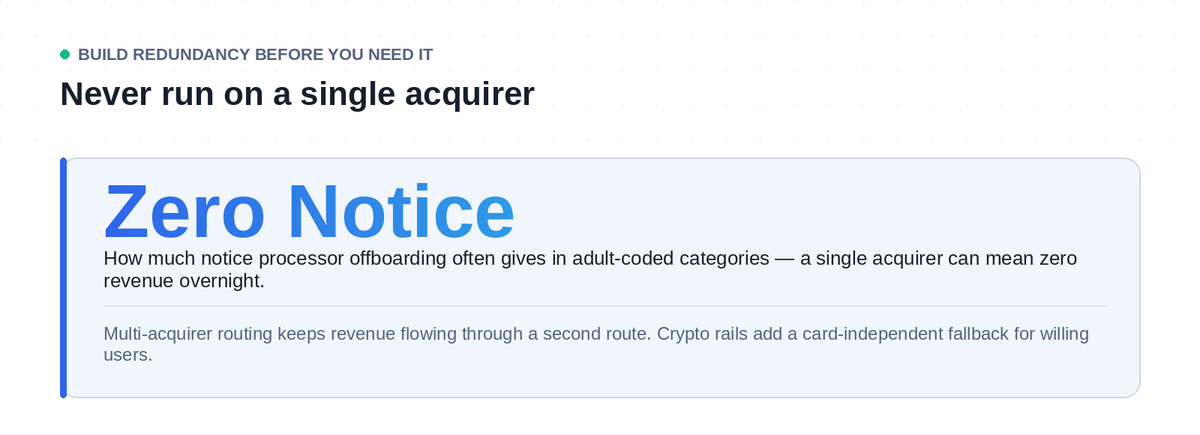
The single most consistent piece of advice from operators already running AI companion payments at scale: never run on one acquirer. Processor offboarding in adult-coded categories is common, often comes with little warning, and can take a business's entire revenue to zero overnight if there's no fallback route already in place. That's the same single-point-of-failure risk covered in our piece on risk routing and smart cascading — except in this vertical, the risk of an abrupt exit is materially higher than average, which makes the case for redundancy correspondingly stronger.
Some AI companion operators are also building crypto rails as a backup route, since stablecoin payments sidestep card-brand risk entirely for the segment of users willing to pay that way — though that comes with its own compliance and volatility considerations, and works best as a supplement to card acceptance rather than a replacement for it.
A Vertical Still Being Defined
AI companion apps sit in an unusual position: a genuinely new product category running on payment infrastructure built for entirely different businesses. There's no dedicated MCC, no vertical-specific chargeback benchmark yet, and no settled consensus on where the line falls between "companionship app" and "adult content" in the eyes of an underwriter. That ambiguity cuts both ways — it means acquirers are still cautious, but it also means the operators who build clean billing practices and acquiring redundancy early are the ones positioned to scale without a payment shock derailing them.
The businesses treating payments as core infrastructure — not an afterthought bolted on after product-market fit — are the ones still processing a year from now.
MMG Corporation provides specialist acquiring for high-risk merchants across EU markets, including emerging categories that don't fit cleanly into existing underwriting boxes. If you're building in the AI companion space and want to talk through what a stable payment setup looks like before you scale, we're glad to help.
Get in touchThis article was researched and written with the help of AI tools as part of our content process, and reviewed and fact-checked by the MMG team before publication.