
Every comparison of "Merchant of Record vs. Payment Facilitator" reads the same way: two entrees on a menu, each with trade-offs, pick whichever suits your business. For a large share of high-risk merchants, that framing is misleading before you even get to the trade-offs — because one of the two options was often never actually available to you.
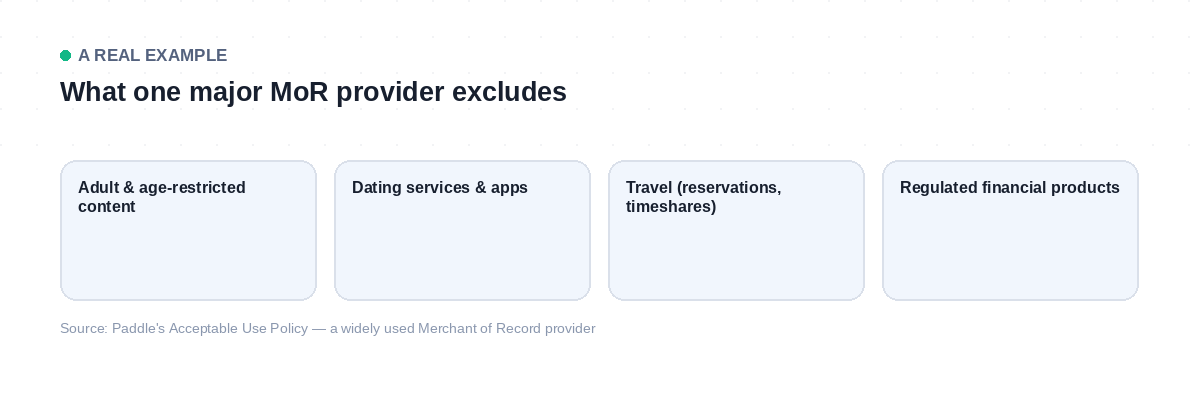
Take Paddle, one of the better-known Merchant of Record providers in the software and digital goods space. Its acceptable use policy explicitly excludes adult and age-restricted content, dating services and applications, and heavily restricts travel services including reservations, travel clubs, and timeshares — three categories that describe a meaningful share of MMG's own client base. That's not an oversight. It's structural, and understanding why makes the real decision a lot clearer than the generic version of this comparison usually explains.
What Each Model Actually Does
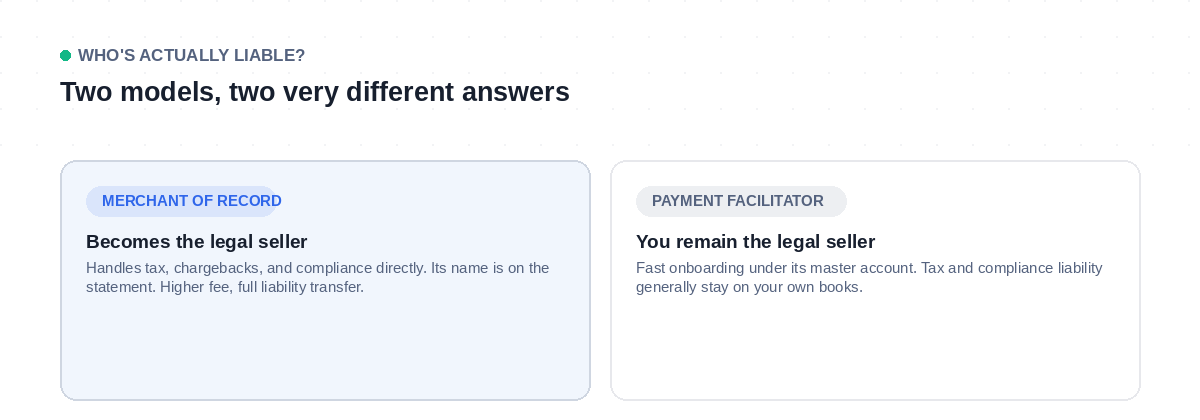
The distinction between the two models comes down to one question: who is legally responsible for the transaction?
A Merchant of Record becomes the legal seller of the product or service. It's the name that appears on the customer's bank statement, the entity that collects payment, and the party responsible for calculating, collecting, and remitting sales tax across every jurisdiction it sells into. It handles refunds and chargebacks directly, and it carries the compliance and fraud liability that would otherwise sit with the underlying business. In exchange for taking on all of that, an MoR typically charges a meaningfully higher percentage fee than a standard payment processor — the cost of the liability transfer is built into the rate.
A Payment Facilitator works differently. It gives a business fast access to card acceptance by onboarding it as a sub-merchant under the PayFac's own master merchant account — which is what makes signup so quick compared to setting up an independent merchant account. But the underlying business remains the legal seller. Tax calculation, remittance, and regulatory compliance generally stay on the merchant's own books; the PayFac's liability runs toward the acquirer for onboarding, monitoring, and transaction risk, not toward the end customer's tax authority. It's faster and cheaper to get started, but it doesn't remove the responsibilities an MoR takes off your plate.
The Catch Nobody Mentions
Here's the part most comparisons skip entirely: an MoR's willingness to take on full liability is exactly why MoR providers are so selective about which businesses they'll represent. When a provider becomes the legal seller of your product, your chargebacks, your regulatory exposure, and your tax risk all become theirs too — which means the businesses most likely to need that protection are often the exact businesses an MoR is least willing to accept.
Paddle's policy is a useful, publicly available example of the pattern rather than an outlier. Alongside adult content, dating services, and restricted travel, its acceptable use policy also excludes any business that is itself a regulated financial product or service, and specifically bars anyone operating as a Payment Facilitator, Payment Services Provider, Money Transmitter, or Merchant of Record from using its platform — the model doesn't stack. Other MoR providers vary in their exact exclusion lists, but the underlying logic is consistent across the category: full liability transfer only makes commercial sense for a provider when the underlying risk is low and well understood, which is precisely the opposite of what defines a high-risk vertical.
The practical result is that for gambling, adult, dating, CBD, and similar categories, "Merchant of Record" is rarely a live option in the first place — not because of a technicality, but because the entire commercial logic of the model depends on avoiding exactly this kind of risk.
Why "Payment Facilitator" Isn't Automatically the Answer Either
If MoR is off the table, the instinct is to assume PayFac must be the fallback — but generic payment facilitators carry their own restricted-business lists, and they overlap with MoR exclusions more than most merchants expect. Major PayFacs maintain published prohibited and restricted business policies that commonly exclude unlicensed gambling outright, treat adult content and CBD as conditional at best, and reserve the right to approve an account on signup only to close it weeks later once automated monitoring flags the actual activity. A merchant that gets through onboarding isn't necessarily in the clear — funds can still be held for up to 180 days after an account closure to cover potential disputes, which is a materially worse outcome than never being approved in the first place.
This is where the comparison most high-risk merchants actually need isn't "MoR vs. PayFac" at all. It's "generic PayFac vs. specialist high-risk acquirer." A generalist PayFac processes your vertical the way it processes every other sub-merchant under its master account — with the same automated risk tools tuned for low-risk categories, and the same tendency to exit a vertical abruptly if it becomes expensive for the portfolio as a whole. A specialist high-risk acquirer, by contrast, underwrites your specific business individually, understands what "normal" actually looks like in your vertical, and is built to keep serving categories that a generalist platform treats as a liability to manage down rather than a business to support.
A Third Option Is Starting to Emerge
The MoR-versus-PayFac framing is also getting less binary. Large payment platforms have begun rolling out hybrid products — Stripe's own managed payments offering is one example — that borrow pieces of the MoR liability model while keeping more of the operational structure of a standard processing relationship. These hybrids are worth watching rather than relying on yet, particularly for high-risk merchants: the same commercial logic that makes pure MoR providers avoid high-risk categories applies just as strongly to a hybrid product built by a company with its own restricted-business list. A more flexible label doesn't automatically mean a more permissive one.
For now, the practical decision for most high-risk merchants still runs through the same two real options: a generic facilitator that tolerates the vertical, or a specialist built around it. The hybrid category is one to revisit as it matures, not one to wait on.
How to Actually Decide
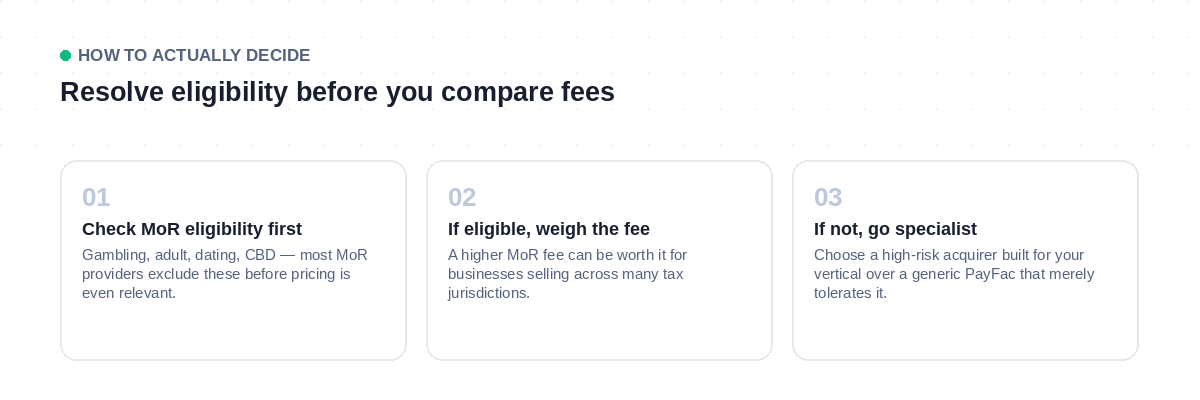
The decision tree is simpler than most comparisons make it look, once the eligibility question is resolved first rather than last. Start by checking whether your vertical is realistically eligible for the MoR model at all — if you're in gambling, adult, dating, CBD, or a similarly restricted category, most MoR providers will exclude you before pricing ever becomes relevant, so it's worth confirming eligibility before evaluating fees or features. If MoR genuinely is available to you — most commonly true for SaaS, digital goods, and other low-dispute categories — weigh whether the higher fee is worth fully offloading tax and compliance, which tends to make the most sense for businesses selling across many tax jurisdictions with limited internal finance capacity.
If MoR isn't realistically available, the real choice is between a generic PayFac optimized for fast, low-friction onboarding of low-risk businesses, and a specialist high-risk acquirer built specifically to underwrite and retain your category. The fee difference between those two is usually smaller than the difference in how the relationship actually behaves once your chargeback ratio moves, your volume grows, or your vertical falls out of favor with a generalist platform's risk committee.
The Question Underneath the Question
"MoR or PayFac" is the wrong first question for a lot of high-risk businesses, because it assumes both are actually on the table. The more useful first question is whether your vertical is one a full-liability model will accept at all — and if it isn't, the real decision is between a generalist processor that tolerates your category and a specialist that's actually built for it. That distinction, not the MoR-versus-PayFac framing most content defaults to, is usually what determines whether a payment setup holds up as the business scales.
MMG Corporation provides specialist high-risk acquiring across EU markets for exactly the categories most MoR providers won't touch. If you're trying to work out which model actually fits your business, that's a more useful starting conversation than comparing fee schedules for options that were never really available to you.
Get in touchThis article was researched and written with the help of AI tools as part of our content process, and reviewed and fact-checked by the MMG team before publication.