
Why In-Play Betting Carries a Different Payment Risk Than Pre-Match
On paper, a bet is a bet. A player deposits funds, places a wager, and either wins or loses. But for the payment side of a sports book, it matters a great deal when that deposit happens. A deposit made on Thursday for Saturday's match and a deposit made 40 seconds after a red card are two very different payment events, even if the amount and the card are identical.
That difference is growing in importance. Industry estimates put in-play betting at roughly half of all wagers in many mature European markets, though the numbers vary widely by source and country. This article looks at why that shift changes the payment risk profile, and what operators and their payment partners can do about it.
A note on evidence: we found no published study that directly compares payment risk for in-play and pre-match betting. What follows combines verified market facts with our own analysis of how the two modes work. Where we are reasoning rather than citing, we say so.
How big is in-play, really?
Estimates differ. One widely cited industry figure puts in-play at about 54% of European wagers in 2024, with Greece around 70%, Italy and Spain in the mid-50s, and the UK closer to 34%. Other analysts give higher projections for the coming years, and US estimates generally sit lower. The honest summary: in-play is a large and growing share of handle, but the exact number depends on the market and who is counting.
It also tends to be the more profitable product. Operator margins on in-play are commonly cited at roughly 7–12%, compared with about 4–6% for pre-match. That gives operators every reason to push it, and every reason to make deposits as frictionless as possible.
The deposit is part of the bet
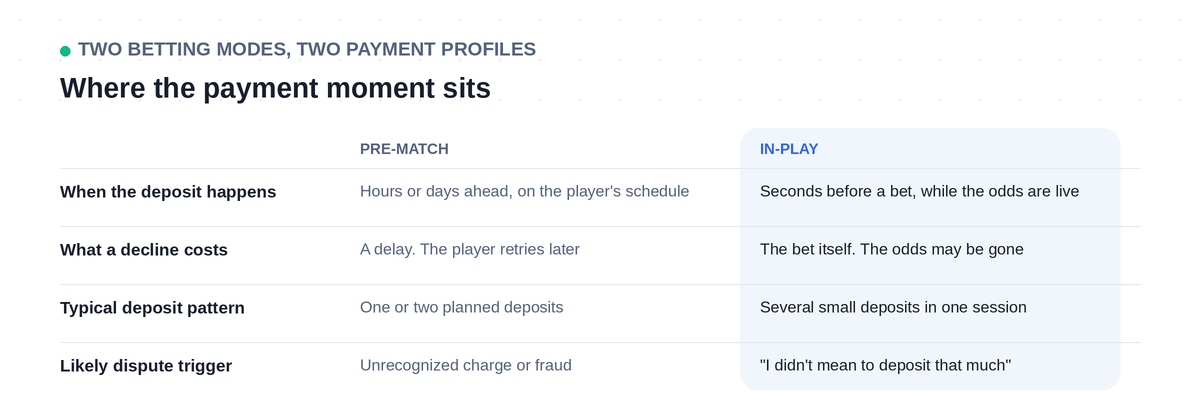
In pre-match betting, funding and wagering are loosely coupled. A player can top up a balance well ahead of time. If a card is declined, the player retries, switches cards, or comes back later. The cost of a failed payment is a delay.
In-play removes that buffer. Odds move in seconds, and a player who wants to act on what just happened needs funds now. If the deposit fails, the odds may have moved or the market may have closed. The cost of a failed payment is the bet itself. In our view, this is the single biggest difference: in-play turns payment friction into lost revenue within seconds, not hours.
Where the friction comes from
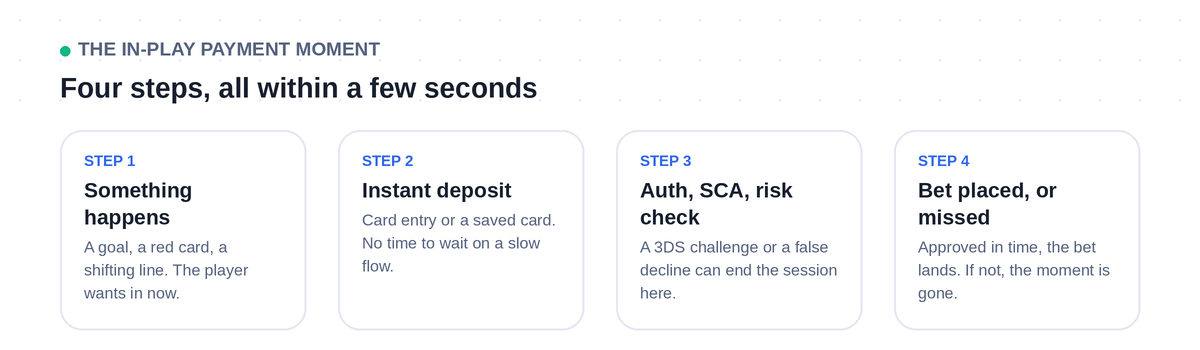
Three things typically sit between a player and a successful in-play deposit.
Strong customer authentication. Under PSD2, many European card payments require SCA, usually through a 3-D Secure challenge. That is entirely appropriate for security, but a challenge that sends the player to a banking app mid-match is a very different experience from one completed days before kickoff. Exemptions and frictionless flows can help where they apply, though eligibility depends on the issuer and the transaction.
Issuer decisions. Gambling transactions are already scrutinized by issuers, and some decline them outright. A false decline is frustrating at any time. During a live event, it often ends the session.
The operator's own risk rules. This is where in-play gets tricky, and it is our analysis rather than a published finding. In-play sessions naturally produce several smaller deposits in a short window as players top up between events. Fraud rules tuned on pre-match behavior can read that pattern as card testing or velocity abuse and block good customers at exactly the wrong moment.
Peaks make everything harder
Live betting also concentrates activity. Deposits cluster around big fixtures, tournament finals and weekend schedules, so payment traffic arrives in sharp peaks rather than a steady flow. This is our own reasoning, but the consequence is straightforward: an acquirer outage, a slow issuer response or an overloaded fraud engine does the most damage when the most players are trying to deposit at once. A weakness that stays invisible on a quiet Tuesday can cost real volume on a Saturday evening, which is why load testing and fallback routes belong in the in-play conversation, not only in the technical backlog.
The dispute side of the picture
Chargebacks come from two places: genuine fraud and so-called friendly fraud, where a cardholder disputes a legitimate charge. Card-funded gambling deposits are widely regarded as carrying some of the highest chargeback risk among deposit methods.
There is a plausible reason in-play adds to this. Fast, emotionally charged sessions tend to produce more deposits than a player planned, and some players later dispute charges they regret. This is reasoning from how live betting works, not a measured result. What is better documented is a link between slow withdrawals and disputes: processors and industry commentators report that when payouts take days, players are more likely to contest their deposits. If in-play teaches players to expect instant deposits, a slow payout feels worse by comparison.
Two practical points follow. First, clear billing descriptors reduce disputes from players who simply don't recognize a charge. Second, payout speed is a risk lever. Many operators set payout timing by player risk level, so low-risk, verified players get faster withdrawals while higher-risk accounts get more review. Withdrawals must also go back to the funding source, which keeps anti-money-laundering controls intact.
What to tune for in-play
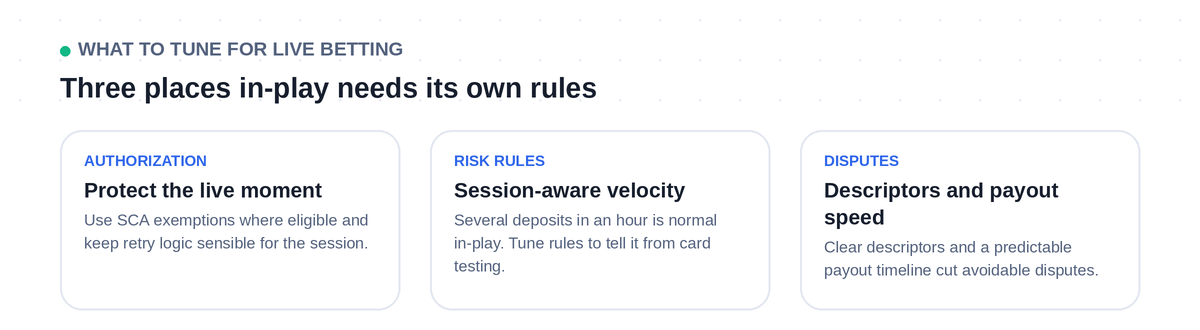
None of this means in-play should be avoided. It means the payment stack should not treat it like pre-match. In practice:
- Protect the live moment. Make saved-card and tokenized flows quick, use SCA exemptions where eligible, and review how retries are handled when a deposit fails.
- Make risk rules session-aware. Several deposits in an hour is normal behavior in-play. Rules should distinguish it from card testing instead of treating both the same way.
- Use more than one acquiring route. Splitting traffic across acquirers can improve approval rates and protects against a single point of failure during peak fixtures.
- Keep disputes down upstream. Clear descriptors, predictable payout timelines and responsible-gambling tools all reduce the volume of disputes before they start.
In-play betting moves the payment from a background task to a live, time-critical part of the product. That raises the cost of every decline and challenges risk rules built for slower play. Operators who plan for it, with the right authorization strategy, session-aware risk logic and acquiring redundancy, can capture in-play volume without inheriting avoidable declines and disputes.
At MMG Corporation, we work with merchants in higher-risk verticals, including gaming and betting, on payment setups built for how their businesses actually operate. If you'd like to talk through your in-play payment flow, we'd be glad to hear from you.
Get in touchThis article was researched with the help of AI tools and reviewed by the MMG team. Market figures come from third-party industry estimates and may differ by source.