
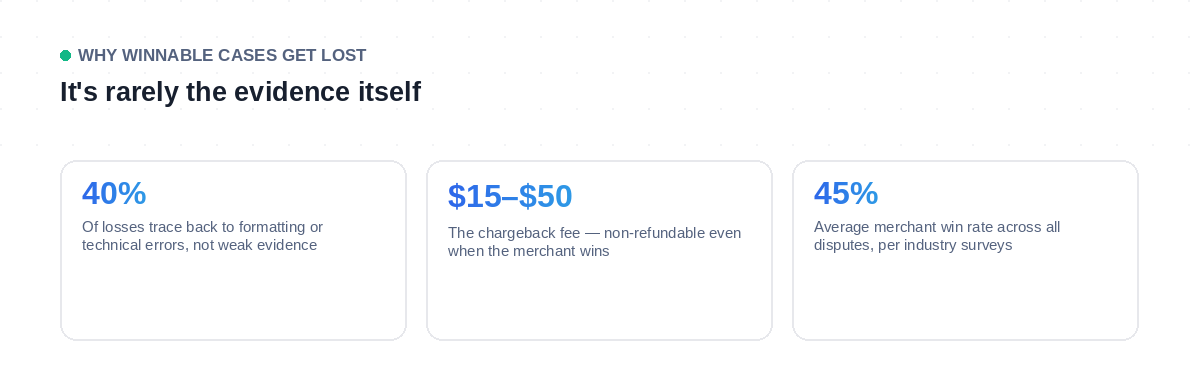
The honest answer to "what's my chargeback win rate going to be" is that nobody can tell you a fixed number, and any processor who guarantees one is selling certainty that doesn't exist. Industry surveys put the average merchant win rate around 45%, with a realistic range of 20% to 45% depending on category, reason code, and how well the evidence was prepared. That's the number most guides stop at. The more useful — and more uncomfortable — fact is what happens after a win: the dispute still counts against your chargeback ratio, whether you win the representment or not. Beating a chargeback recovers the money. It does not undo the dispute.
What Representment Actually Is
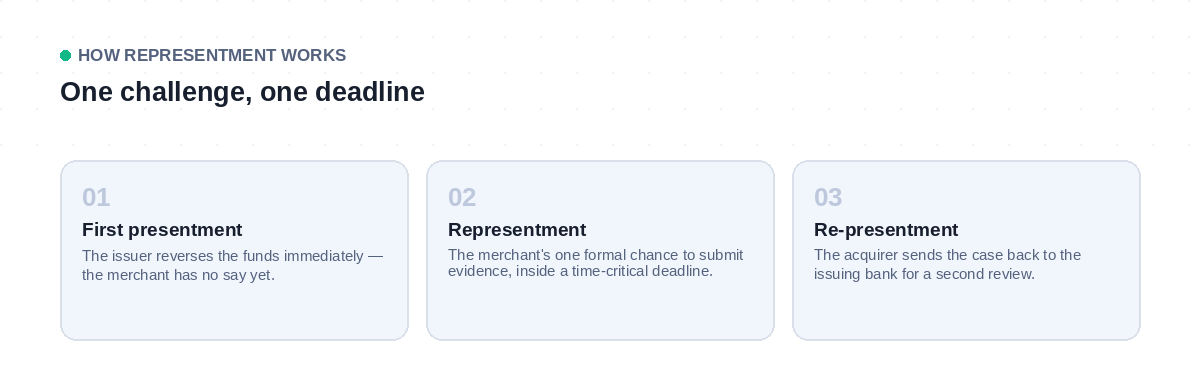
When a cardholder disputes a charge, the issuing bank reverses the funds immediately — that's called first presentment, and it happens before the merchant gets any say. Representment is the merchant's one formal opportunity to challenge that reversal: submitting evidence to the acquirer, who re-presents the transaction to the issuing bank for a second look. It's a real, legal right to contest the dispute, but it's also the only chance a merchant gets. Miss the deadline and the strongest evidence in the world is worthless — the case is lost by default, no matter how compelling the underlying facts are.
The deadline itself is the part merchants most often underestimate. It varies by card network, reason code, and the acquirer's own internal cutoff — which is frequently earlier than the network's headline deadline. The practical rule worth operating on: treat every chargeback as time-critical from the moment it posts, and confirm the actual deadline for that specific case with your processor rather than assuming a standard window.
The Scale Behind the Pressure
It's worth sizing the broader trend, because it explains why card networks keep tightening monitoring rather than loosening it. Mastercard projected total chargeback volume would pass 337 million cases in 2026, and friendly fraud — a legitimate purchase the cardholder disputes instead of contacting the merchant — now accounts for up to 70% of credit card losses by some industry estimates. Mastercard has also been developing its own VAMP-style program merging fraud and dispute monitoring more tightly, mirroring the direction Visa has already taken. None of this is merchant-specific bad luck; it's a system-wide volume problem that both networks are responding to by making individual merchant ratios matter more, not less.
Why Most Merchants Lose Cases They Could Have Won
The evidence itself usually isn't the problem. About 40% of losses trace back to merchants failing to follow the card network's specific formatting and technical requirements — not to having a weak underlying case, but to submitting evidence that doesn't match what the reviewer is checking for. Every reason code has a specific standard of proof attached to it, and a generic evidence packet — the same documents submitted regardless of what was actually disputed — reliably loses to an issuer's default assumption in the cardholder's favor. The system is built to side with the cardholder unless the merchant's evidence directly rebuts the specific claim in the specific reason code filed.
It's also worth budgeting for the cost of fighting regardless of outcome. The chargeback fee itself — typically $15 to $50 — is charged by the bank to cover administrative costs and is non-refundable even when the merchant wins and the funds come back. A manual representment case also runs roughly 30 to 60 minutes of staff time per dispute. None of that is a reason to skip representment on winnable cases, but it's a reason to be selective rather than fighting everything reflexively.
What Actually Moves the Needle
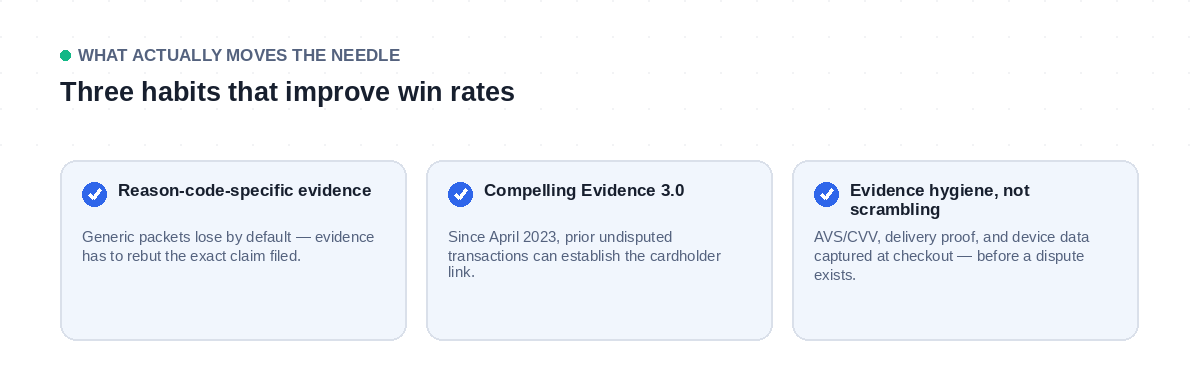
Visa's Compelling Evidence 3.0 framework, in place since April 2023, changed what counts as proof for a specific and common category of dispute: it lets merchants use a cardholder's own prior, undisputed transaction history to establish that the same person made the disputed purchase — a documented pattern of past behavior, not just evidence from the single transaction in question. Paired with device-level evidence captured at checkout — a stable device fingerprint, session timestamps, browser environment — merchants report meaningfully higher win rates on eligible disputes, with some sources citing 40% to 60% when that evidence is captured consistently.
The pattern underneath all of this is the same: the merchants who win are the ones who treat evidence collection as a standing operational habit, not a scramble that starts after a dispute lands. AVS and CVV match results, delivery or access confirmation, clear authorization records, and device data need to already exist by the time a chargeback notice arrives — representment is the moment you use that evidence, not the moment you go looking for it.
The Trap: Winning Doesn't Fix Your Ratio
Here's the part that changes how representment should actually be prioritized. A dispute is counted against a merchant's chargeback ratio on the day it's filed — not the day it's resolved, and not based on which side wins. Visa's VAMP calculation combines fraud reports and non-fraud disputes against settled card-not-present transactions, and a won representment does not remove that dispute from the numerator. The only things that do are disputes resolved through a pre-dispute solution before they're ever formally filed, and fraud that specifically qualifies for exclusion under Compelling Evidence 3.0. A representment win recovers the transaction's revenue. It does nothing to protect the ratio that determines whether an acquirer keeps the account.
That reframes the entire strategy. Representment is necessary — it's real money, and letting winnable disputes go unanswered is leaving revenue on the table for no reason. But it is fundamentally a damage-recovery tool, not a ratio-management one. The only levers that actually move a merchant's chargeback ratio are reducing how many disputes get filed in the first place — through clearer billing descriptors, proactive renewal reminders, and the kind of evidence hygiene that resolves confusion before a customer calls their bank — and enrolling in pre-dispute alert networks that intercept a transaction before it becomes a formal chargeback at all.
What This Means in Practice
A merchant serious about protecting their account needs two separate strategies running at once, not one. Fight the disputes worth fighting — reason-code-specific evidence, submitted inside the real deadline, backed by evidence collected as routine practice rather than assembled under pressure. But treat every win as a recovered transaction, not a solved problem, because the dispute already did its damage to the ratio the moment it was filed. The merchants who actually stay off VAMP's radar are the ones investing in prevention and pre-dispute resolution first, and treating representment as the backstop it's designed to be — not the primary defense.
MMG Corporation works with high-risk merchants across EU markets on exactly this kind of chargeback and dispute strategy. If your representment win rate looks fine but your ratio keeps climbing anyway, that's usually the sign the strategy needs to shift upstream — and that's a conversation worth having before an acquirer has it for you.
Get in touchThis article was researched and written with the help of AI tools as part of our content process, and reviewed and fact-checked by the MMG team before publication.