
Our piece on Black Friday chargebacks covered the risk that shows up late — disputes that lag orders by four to eight weeks, landing on a ratio nobody's watching by the time they arrive. There's a second risk that does the opposite: it shows up immediately, in real time, at the exact moment a legitimate customer tries to pay. And by most current measurements, it costs merchants more than the fraud it's meant to prevent.
The Instinct to Tighten Is Exactly the Problem
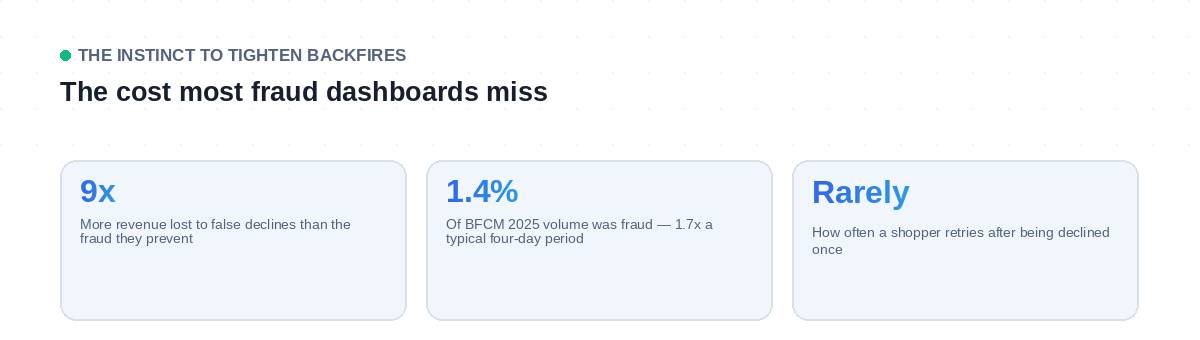
Fraud genuinely does spike during peak season — one analysis of BFCM 2025 found fraud reaching roughly 1.4% of total payment volume during the four-day window, 1.7 times the rate of a typical four-day period. The natural response is to tighten fraud rules going into the weekend. That response is also, by a wide margin, the more expensive mistake. False declines — legitimate transactions blocked by an overly cautious fraud model — cost retailers roughly nine times more revenue than the fraud those same rules actually prevent.
The mechanism is straightforward once you see it: fraud losses are visible and get immediate attention, because a chargeback shows up on a statement with a dollar amount attached. False declines are invisible by comparison — a blocked transaction doesn't generate a report, it just generates a customer who quietly doesn't buy. Most shoppers don't retry after a decline; they assume something's wrong with their card, or with the merchant, and move on. The revenue never gets recorded as lost, because from the system's perspective, the transaction simply never happened.
Customers Don't Separate Your Fraud System From Your Brand
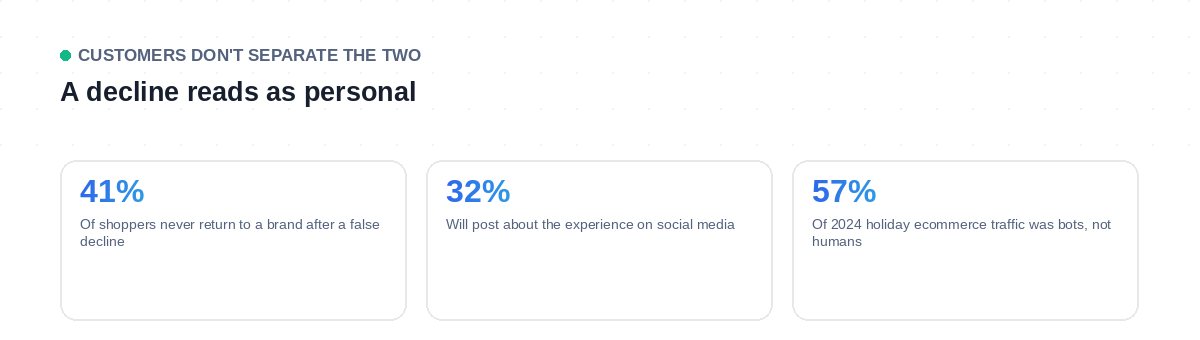
The consumer research on this is specific and worth sitting with. 41% of shoppers say they'll never shop with a brand again after experiencing a false decline, and 32% will post about the experience on social media. A declined card reads as personal to the person holding it — it feels like the business doesn't trust them, not like a fraud model made a probabilistic call. That reaction doesn't distinguish between a merchant that got it wrong once during a traffic surge and a merchant with a genuinely bad product; the customer just remembers being turned away.
This is also happening against a backdrop of dramatically higher bot traffic than most fraud teams are used to accounting for. During the 2024 holiday season, bot traffic exceeded human shoppers on ecommerce sites for the first time — 57% of traffic, with bad bots alone accounting for 31% of total internet traffic during that window. Fraud models tightened in response to that noise can end up treating unusual-but-legitimate human behavior — a shopper buying from a new device, in a hurry, during a spike — as indistinguishable from the automated traffic actually driving the fraud numbers up.
You Can't Fix What You're Not Measuring
Part of why false declines stay invisible is structural: most merchants track chargebacks closely, because chargebacks come with a fee and a formal dispute process attached, but far fewer track their decline rate with the same rigor, let alone break that rate down by reason code to distinguish a hard decline from a false positive. A meaningful first step is simply establishing what a normal decline rate looks like for the business outside of peak season, so a spike during Black Friday week is visible as a spike rather than absorbed into "that's just how the holidays are." Without that baseline, a fraud team tightening rules in November has no real way to tell whether they're blocking more fraud or just blocking more customers — the aggregate approval rate moves either way, and only a closer look at decline reasons actually distinguishes the two.
The Risk Window Is Wider Than the Weekend
There's a timing misconception here that mirrors the one on the chargeback side, just running in the opposite direction. Fraud activity doesn't concentrate neatly into the Black Friday weekend itself — in 2025, fraud activity started trending upward on November 8, well over two weeks before the holiday, and stayed elevated through December rather than spiking and receding. Attackers are stretching activity across the whole season rather than concentrating it, using automation to test stolen cards and probe for weaknesses continuously. A fraud strategy that only tightens for the weekend itself is defending the wrong window on both ends — arriving late to the actual start of elevated risk, and often staying tightened well past the point where it's still doing more good than harm.
What Actually Works: Invisible Defenses, Not Heavier Gates
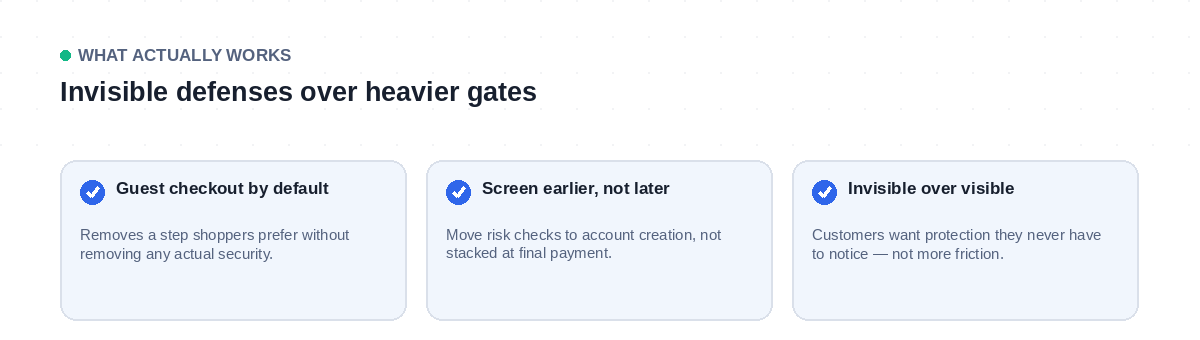
The merchants managing this well are moving fraud screening earlier and making it less visible to the customer, rather than adding more friction at the moment of payment. Guest checkout as the default — rather than forcing account creation — removes a step most shoppers actively prefer without removing any actual security, since background fraud detection can run against a guest checkout just as effectively as against a registered account. Moving risk screening to account creation or earlier in the funnel, instead of stacking it at the final payment step, catches the same signals without making a legitimate, slightly-unusual transaction feel like an interrogation.
The through-line across all of this is that customers consistently say they want protection they never have to notice — security and privacy both rank as high priorities, but only when they're invisible. A fraud strategy built entirely around visible friction at checkout is optimizing for the wrong signal: it makes the merchant feel more protected without necessarily blocking more actual fraud, while reliably costing real, measurable revenue from the legitimate customers caught in the same net.
Two Risks, One Season
Between this piece and the dispute-timing article, the full shape of Black Friday's actual risk profile comes into view: chargebacks that arrive too late for most teams to still be watching, and false declines that strike too early and too visibly for most teams to notice the revenue they're quietly costing. Both point to the same underlying lesson — the weekend itself is the part everyone already prepares for. The weeks on either side of it are where the real damage, and the real opportunity to prevent it, actually sit.
MMG Corporation works with high-risk merchants across EU markets on exactly this kind of peak-season fraud and authorization strategy. If your approval rates dip every November without a clear read on how much of that is actually fraud prevention versus lost legitimate revenue, that's worth a closer look before the next peak season arrives.
Get in touchThis article was researched and written with the help of AI tools as part of our content process, and reviewed and fact-checked by the MMG team before publication.