
Why Euro Stablecoins Are Gaining Ground
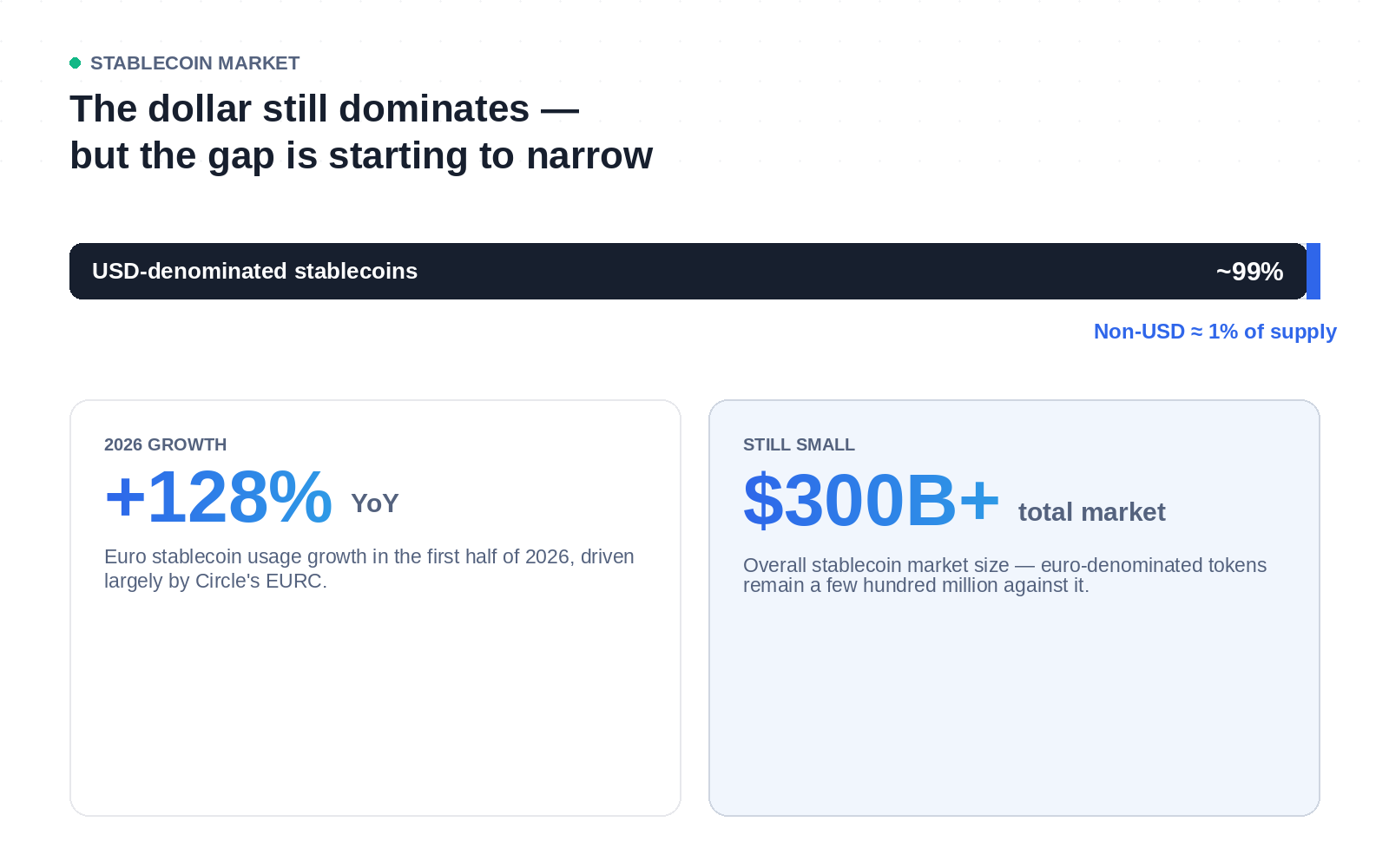
For as long as stablecoins have mattered to payments, they've meant dollars. Tether and Circle's USDC built the rails, the liquidity, and the habits — and by early 2026, the European Central Bank put a number on just how lopsided that had become: roughly 99% of all stablecoin supply in circulation is still denominated in US dollars. Out of a market that had climbed past $300 billion, everything else was rounding error.
That's still true today. But the shape of the "everything else" is starting to change, and the reason is more interesting than crypto speculation — it's regulation.
What actually moved: MiCA, not hype
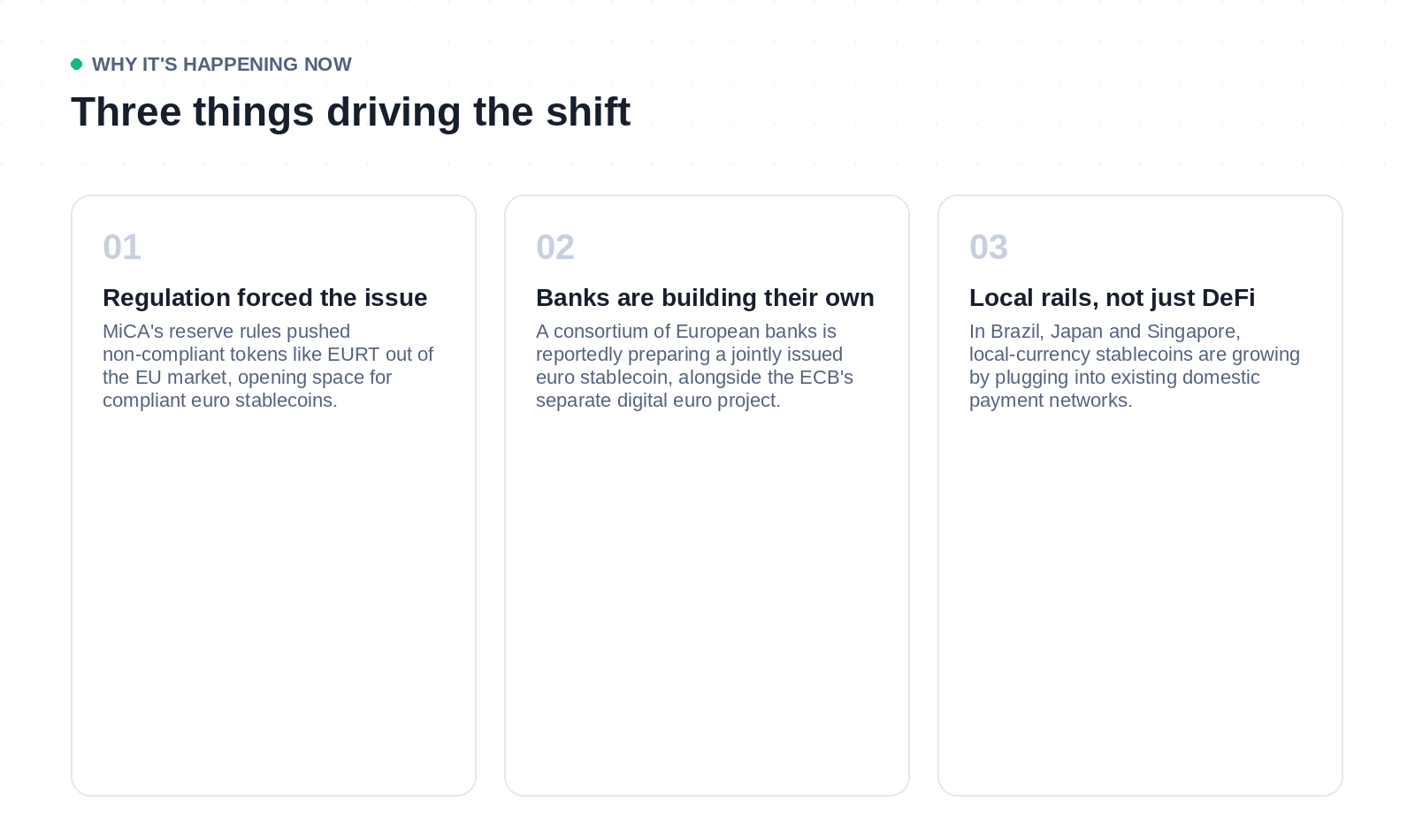
The EU's Markets in Crypto-Assets regulation (MiCA) has been phasing in since 2024, but its stablecoin provisions are what forced the issue. Issuers of "e-money tokens" — the MiCA category that covers euro-pegged stablecoins — are required to hold a substantial share of reserves with European credit institutions rather than parking them wherever is most convenient globally.
Tether didn't comply. Rather than restructure EURT's reserves to meet the requirement, Tether pulled it from the EU market. Major exchanges serving European customers responded by delisting USDT for EU users entirely. That left a gap in a market that still needed euro-denominated stablecoins for on-chain settlement — and compliant alternatives, led by Circle's EURC, moved in to fill it.
The growth since has been fast, even if it's growth from a small base. Euro stablecoin usage climbed by over 100% in the first half of 2026 alone, and EURC now accounts for the large majority of non-dollar stablecoin transfer volume tracked on-chain. It's worth being precise about scale here: euro-denominated stablecoins are still measured in the hundreds of millions, not the tens of billions — a rounding error next to the dollar-denominated market. But the growth rate, and the reason behind it, are what make this worth watching.
It's not just Europe
The same pattern — regulatory clarity plus local payment-rail integration — is showing up in currencies well beyond the euro. In Japan, a trust bank has already issued the country's first yen-backed stablecoin, and the three largest Japanese banks are reportedly planning a joint yen coin of their own. Singapore has a regulated Singapore-dollar stablecoin trading on public infrastructure. In Brazil, a real-backed stablecoin has grown from near zero to meaningful monthly volume by integrating directly with the country's instant payments network, and much of that activity is domestic rather than cross-border — a reminder that stablecoins are increasingly being used as everyday payment infrastructure, not just a way to move dollars around the world.
A consortium of European banks is also reportedly working on a jointly issued euro stablecoin expected later in 2026, alongside the European Central Bank's own parallel track: a digital euro central bank digital currency it has described as strengthening the euro's international role. Whether bank-issued tokens, central bank digital currency, or private issuers like Circle end up leading the European market is still an open question. What's not in question is that "euro-denominated, on-chain, MiCA-compliant" is now a real category, where two years ago it barely existed.
Why this matters if you accept crypto payments
For a merchant or PSP that added crypto as a payment method built around dollar-pegged tokens, this shift raises two practical questions rather than a philosophical one.
The first is settlement currency risk. A euro-based business accepting USDT or USDC is carrying dollar exposure on every transaction until it converts back to euros — a small but real FX risk that a euro-denominated stablecoin removes entirely, since the token is already in your settlement currency.
The second is compliance risk. MiCA enforcement has continued to tighten through 2026, and the EURT delisting showed that a token's compliance status in the EU can change abruptly, with real consequences for anyone whose payment flow depended on it. Building around MiCA-compliant, euro-denominated stablecoins isn't just a currency preference at this point — it's a way to avoid being caught out the next time a token's regulatory standing shifts.
None of this displaces the dollar's dominance in the near term. Network effects, deep liquidity, and simple habit are powerful, and USD stablecoins aren't going anywhere. But for European merchants weighing whether to accept stablecoins at all, the practical answer has quietly gotten more interesting: it no longer has to mean choosing dollars by default.
If crypto and stablecoin acceptance is something you're evaluating, it's worth having that conversation with a payments partner who can walk through the settlement and compliance side alongside the rest of your payment mix — rather than adding it as an afterthought.