
The Feature That Quietly Costs You Customers (or Money)
"Would you like to pay in your own currency instead?" It shows up at checkout as a small, friendly-looking popup — a courtesy for the international customer, sparing them the guesswork of what their bank will charge later. It's also a markup, typically 3% to 7% above the real exchange rate, quietly split between the merchant, the acquirer, and whoever provides the conversion technology. Handled well, it's a legitimate revenue line. Handled badly, it's one of the more specific, well-documented ways a merchant ends up fighting chargebacks over something that looked like a convenience feature.
This is dynamic currency conversion, or DCC — and it's worth understanding properly, because it sits in an unusual spot: genuinely useful when done right, genuinely risky when it isn't, and the difference between the two comes down to details most merchants never look at closely.
How It Actually Works
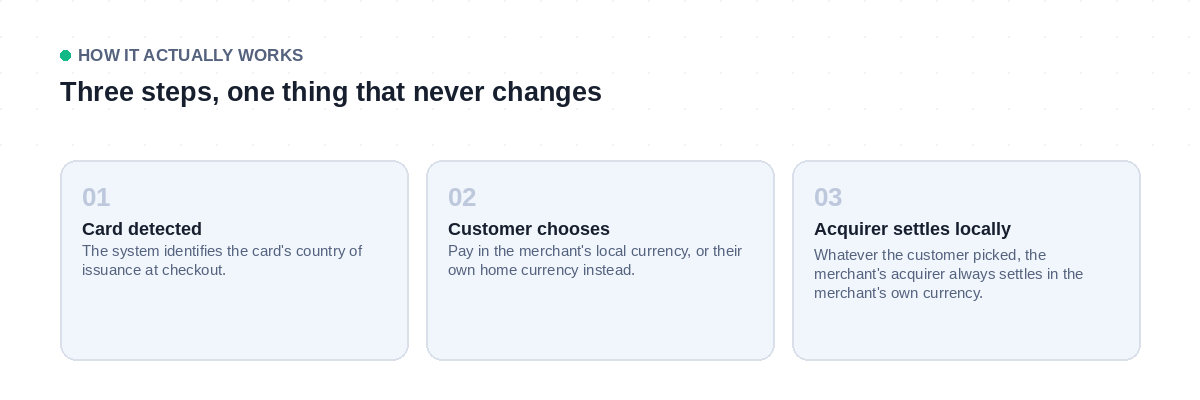
When an international card is used at checkout, DCC-enabled systems detect the card's country of issuance and offer the cardholder a choice: pay in the merchant's local currency, or pay in their own home currency instead. If they choose the home-currency option, the conversion happens immediately, at a rate calculated by the merchant's DCC provider — not by the cardholder's bank, which is what would normally handle the conversion after the fact. The customer sees one number, in a currency they recognize, before they approve anything.
The rate used to get there includes a markup over the wholesale interbank rate — the real rate banks trade currency at among themselves. That markup is the whole business model: it's a combination of a conversion fee and a margin, and it gets shared out between the merchant, the acquirer, and the DCC technology provider as commission. One detail that surprises a lot of merchants: no matter which currency the customer chooses to pay in, the merchant's own acquirer always settles the transaction in the merchant's local currency, for the full amount. DCC changes what the customer sees and pays. It doesn't change what lands in the merchant's account.
The Markup Is Real, and It's Not Small
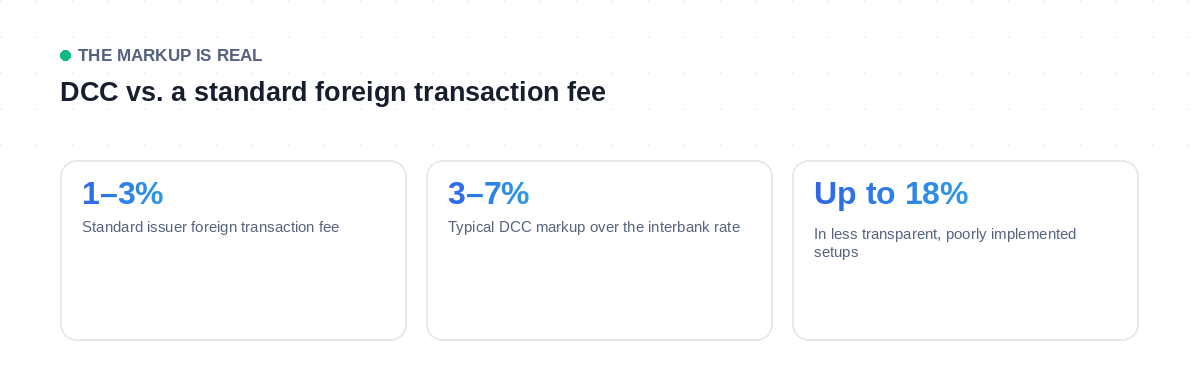
Across independent sources tracking this, the typical DCC markup lands at 3% to 7% above the interbank rate — and in less transparent or poorly regulated implementations, some studies have found markups reaching 12% to 18%. For comparison, a standard foreign transaction fee charged by a card issuer for ordinary cross-border purchases usually runs 1% to 3%. DCC, done at the aggressive end, can cost a customer several times more than simply letting their own bank handle the conversion — and because the number is presented as a single, all-in total, most customers have no easy way to spot that markup unless they think to compare it against the real exchange rate themselves.
That's not automatically a problem. Card network rules are built around the idea that a fully informed customer can choose to accept that cost in exchange for certainty — knowing exactly what they'll pay, in a currency they understand, with no surprise on their statement later. The problem shows up when the choice isn't real, or the disclosure isn't clear. That's where DCC stops being a revenue feature and starts being a compliance exposure.
The Line Between Revenue and a Chargeback
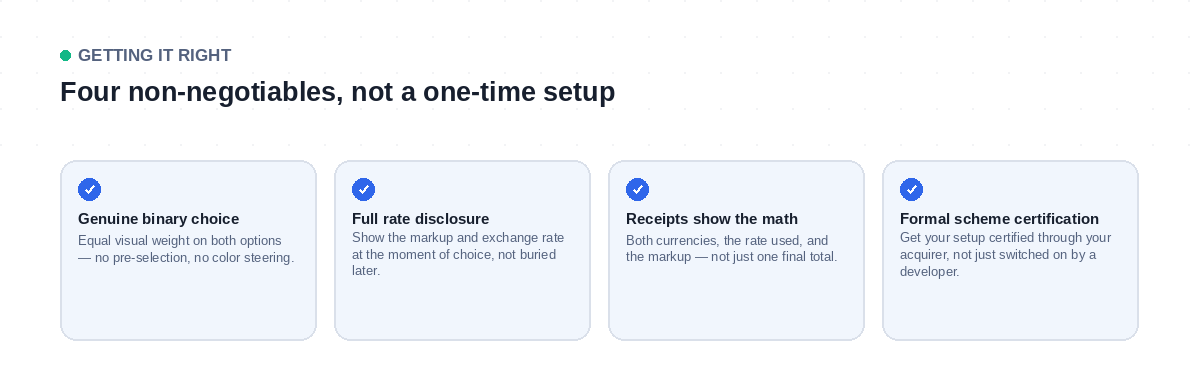
Visa and Mastercard's rules on DCC are specific, and they exist because this exact feature generates a predictable pattern of disputes when it's implemented carelessly. The customer must be given a genuine, unforced choice between DCC and the local-currency price — DCC can never be the default, and it can never be opt-out. The interface has to be neutral: no color-coding one option as "recommended," no pre-selected radio button, no visual steering toward the higher-revenue choice. Both the receipt and the eventual card statement need to show the transaction amount in both currencies, the exchange rate actually used, and the markup applied — not just a single final total.
Visa takes this seriously enough to maintain a dedicated chargeback reason code — code 76 — specifically for transactions where a cardholder wasn't properly offered a choice, or wasn't clearly told DCC was being applied. That's not a generic "customer is unhappy" dispute code; it's a mechanism built around this one feature, which tells you how common the underlying problem has been across the industry. In the EU specifically, disclosure rules go a step further, requiring the markup to be shown clearly against the European Central Bank's reference rate — not just against whatever number the DCC provider chooses to display.
The practical risk isn't limited to losing the chargeback itself. Even when a merchant can show they followed the rules and wins the dispute, DCC-related complaints tend to arrive wrapped in genuine customer frustration — the "I didn't realize I was paying that much" reaction — which is exactly the kind of friction that erodes trust with a customer regardless of who technically wins the argument.
What This Looks Like in Real Numbers
The abstract percentages are easier to weigh with an actual example attached. Take a €500 purchase from a customer whose card was issued in the US. Under standard conversion, the customer's own bank converts €500 to dollars using something close to the real interbank rate, typically adding a foreign transaction fee in the 1% to 3% range — landing somewhere around $535 to $545, depending on the day's rate and the issuer's specific fee. Under DCC at a middle-of-the-road 5% markup, that same €500 purchase might show up as roughly $560 to $570 at the moment of sale — a fixed, known number, but a noticeably higher one. At the aggressive end of the range some studies have documented, an 18% markup on the same purchase could push the total past $620: the same €500 item, nearly $80 to $90 more expensive than letting the customer's own bank handle it.
None of that is necessarily improper — a customer who understood the trade-off and chose certainty over the lowest possible price made a real choice. The risk is entirely in whether that choice was genuinely offered, clearly disclosed, and free of the kind of interface nudging card networks explicitly prohibit. The same markup that's a legitimate commission when disclosed properly is the exact same markup a customer disputes as deceptive when it isn't.
Getting It Right
The merchants who use DCC well treat every one of the compliance details above as non-negotiable, not as a checklist to satisfy once and forget. That means a genuinely binary choice presented with equal visual weight on both options, full disclosure of the rate and markup at the moment of choice — not buried in a footnote — and receipts and statements that show the math rather than a single number. It also means getting the setup formally certified through your acquirer or payment processor under the relevant card scheme rules before turning it on, rather than treating it as a checkout-page toggle that only needs a developer, not a compliance review.
It's also worth thinking about whether DCC fits a given business at all. For merchants already managing tight chargeback ratios — which describes a lot of high-risk verticals — adding a feature with its own dedicated chargeback reason code is worth weighing carefully against the incremental revenue it generates. A subscription business already fighting to keep its dispute ratio under a VAMP threshold may get more value from leaving DCC off entirely than from the commission it would add, especially if the customer base skews toward exactly the kind of impulsive or emotionally driven purchases that produce confusion-driven disputes in the first place.
A Feature Worth Understanding Before You Flip It On
DCC isn't a trick, and it isn't automatically bad for either side of the transaction — plenty of international customers genuinely prefer knowing their exact cost upfront, and plenty of merchants run it cleanly as a legitimate revenue line for years without a single dispute. The businesses that get burned by it are almost always the ones that treated it as a simple checkout toggle rather than a feature with its own specific rulebook, its own dedicated chargeback code, and its own compliance certification requirement sitting behind the friendly popup.
MMG Corporation works with high-risk and cross-border merchants across EU markets on exactly this kind of payment configuration decision. If you're weighing whether DCC makes sense for your business — or trying to figure out whether your current setup is actually compliant — that's a conversation worth having before a chargeback pattern forces it.
Get in touchThis article was researched and written with the help of AI tools as part of our content process, and reviewed and fact-checked by the MMG team before publication.