
AI Is About to Change How Your Customers Pay – Here's What It Means for You
MMGCorporation Team · March 2026 · 7 min read
Visa just made a move that could quietly reshape how online payments work — and it's already happening in Europe. No overnight changes, no sudden disruption. But if you're a merchant, this is one of those moments where understanding what's coming early puts you in a very different position to those who find out late.
So, What Actually Happened?
On 17 March 2026, Visa officially launched a programme called Visa Agentic Ready, starting in Europe, including the UK. The programme is designed to prepare banks, merchants, and the broader payments ecosystem for a world where AI handles purchases on behalf of consumers — autonomously, without a human clicking "pay" at each step.
This isn't a concept paper or a future roadmap. It's live, structured testing with real banks in real payment environments. And the list of institutions already involved reads like a who's who of European banking.
To understand why this matters, it helps to take a step back and look at what's actually being described — because "agentic commerce" is one of those terms that sounds like jargon until you see it in action.
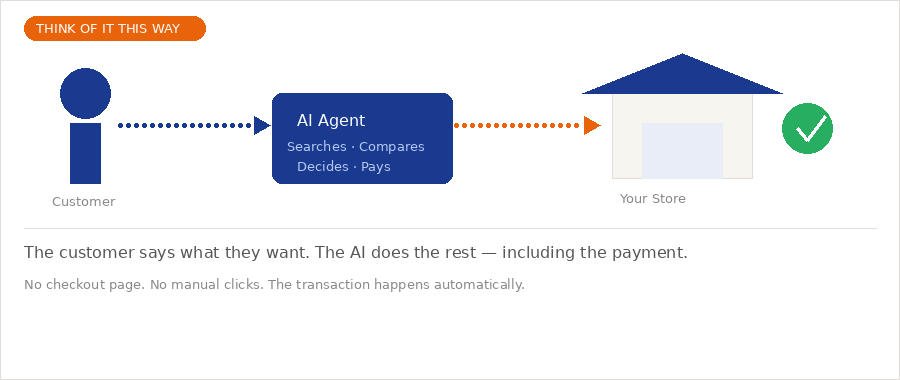
Think of it this way:
Imagine a customer tells their AI assistant: "Order me the best running shoes under €80 in size 43." The AI searches across dozens of stores, compares prices, checks reviews, picks the best match — and completes the purchase. No browser tabs, no checkout page, no clicking "Pay Now." The transaction just happens, entirely on the customer's behalf.
That's agentic commerce. AI agents act as personal shoppers, making decisions and payments autonomously based on what a consumer has told them they want. It's a fundamental shift from how shopping works today — and Visa is now building the infrastructure to make it safe and scalable across Europe.
The Programme in Plain English
Visa's Agentic Ready programme is, at its core, a structured testing environment. In this first phase, the focus is squarely on getting banks ready — giving them a safe, controlled space to understand how AI-initiated payments behave before they go live for consumers at scale.
The programme builds on Visa's broader Intelligent Commerce framework, which the company has been developing as its strategic approach to AI-driven payments. Agentic Ready is the practical, European-first rollout of that thinking — moving from strategy into real-world testing.
Some of Europe's biggest financial institutions have already signed up for the first phase, including Barclays, HSBC UK, Commerzbank, Revolut, DZ Bank, Banco Santander, Nationwide, Nexi Group, Raiffeisen Bank International, Erste Bank, Piraeus Bank, and more.
These banks are working directly with Visa and selected merchants to test how AI-triggered payments behave in the real world. The goal of this phase isn't yet to roll out agentic payments to consumers — it's to understand what needs to be in place technically, operationally, and from a compliance perspective to make that happen safely.
Europe was chosen as the starting point deliberately. The region already has high adoption of tokenisation, passkeys, and advanced biometric authentication — exactly the infrastructure that agentic payments rely on. It's a natural testing ground.
How Does Visa Keep This Secure?
This is the question every merchant — and every consumer — will reasonably ask. If an AI is making purchases on someone's behalf, how do we know it's legitimate? How do we prevent fraud? Who's accountable if something goes wrong?
Visa's answer centres on what they call a trust layer — a combination of existing security technologies, extended into this new AI-driven context. Two technologies sit at the heart of it:
Tokenisation replaces a customer's real card number with a unique, secure digital code. When an AI agent initiates a purchase, it uses that token — never the actual account details. Sensitive financial data is never exposed in the process. Biometric authentication then ties every AI-initiated transaction back to a verified, real person — through fingerprint or face scan — ensuring there's always a human being accountable behind each payment.
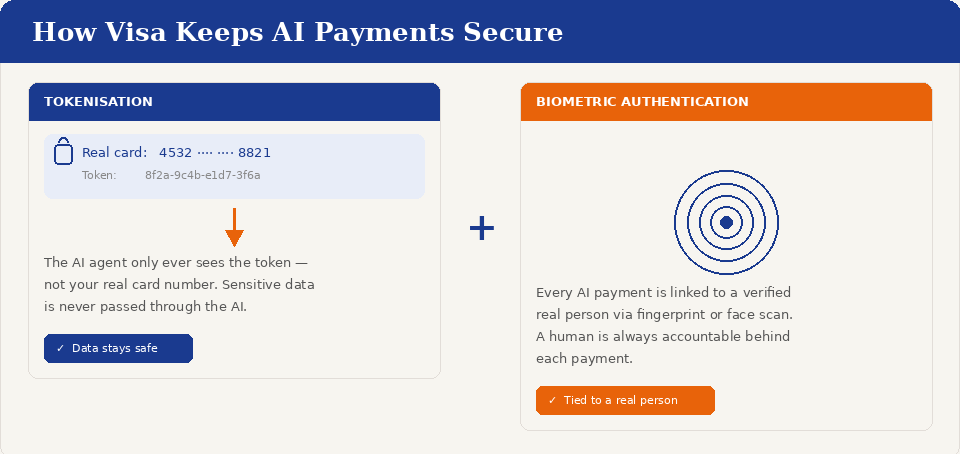
The important thing to note here is that Visa isn't building something entirely new. They're taking the security infrastructure that already underpins hundreds of millions of everyday card transactions and extending it carefully into AI-driven territory. The rails are familiar — the trains are just becoming autonomous.
Consent is also built into the framework. Consumers will need to grant AI agents the right to make purchases on their behalf, with controls they can set and adjust. It's not a free pass for AI to spend freely — it's a delegated, permissioned system.
Why Should You Care as a Merchant?
Here's the honest answer: nothing changes for you this week, or probably this year. Visa hasn't announced a firm timeline for when agentic payments will be available to consumers at scale — this is still a testing and preparation phase. But the direction is clear, and the pace across the industry is accelerating. Understanding what's coming now is the difference between being ready and scrambling to catch up.
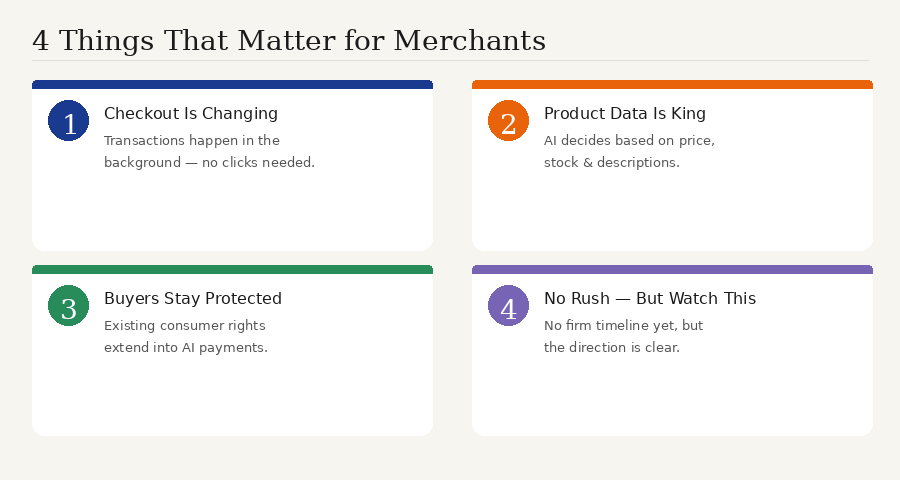
1 — The Checkout Experience Is Changing When AI agents shop for consumers, nobody is clicking through your checkout flow anymore. Transactions will happen programmatically, in the background, without a human navigating your pages. This shifts the emphasis from great UX design to great technical integration. Your payment infrastructure needs to be clean, reliable, well-documented, and built on modern standards — exactly what working with a payment gateway like MMG is designed to ensure.
2 — Your Product Data Matters More Than Ever AI doesn't browse the way humans do. It doesn't get drawn in by beautiful imagery or persuasive copywriting — it makes decisions based on structured, machine-readable data: price, availability, descriptions, categories, ratings. If your product feed is incomplete, inconsistent, or out of date, an AI agent will simply skip past you and land on a competitor whose data is cleaner. Investing in data quality now isn't just good practice — it will become a genuine commercial advantage.
3 — Consumer Protections Stay in Place One thing that won't change: your customers remain protected. Visa is explicitly building Agentic Ready around existing consumer safeguards, and the whole framework is designed to ensure that buyer protections extend naturally into the AI-driven era. Refunds, disputes, and chargeback processes are expected to carry over. That's important for consumer trust — and for merchants who rely on that trust to run their businesses.
4 — No Hard Timeline — But Watch This Space Visa hasn't committed to a specific date for consumer rollout, and the current phase is focused entirely on bank readiness. But the programme has no stated end date, and with 21 major European banks already enrolled, momentum is building. The smart move isn't to act urgently right now — it's to stay informed and make sure your foundations are solid as this develops.
This Isn't Just a Visa Story
It's worth zooming out for a moment, because Visa's announcement doesn't exist in a vacuum. Earlier in March 2026, Mastercard and Santander made headlines by completing what they described as Europe's first end-to-end payment executed by an AI agent in a regulated banking environment. Santander's AI used a live Visa card to purchase a book from a merchant — a real transaction, completed autonomously, in a controlled but genuine environment.
Two of the world's largest payment networks making major AI announcements within weeks of each other isn't a coincidence. The race to define the standards, the infrastructure, and ultimately the market position for agentic payments is well and truly underway. Banks, payment networks, and technology platforms are all moving at once — and the merchants who understand this landscape will be better placed to benefit from it.
For you as a merchant, this means the question is no longer really if agentic payments will arrive — it's when, and whether your setup will be ready to handle them smoothly when they do.
The Bottom Line
Shopping is becoming more automated. AI will increasingly handle decisions that humans make today — searching, comparing, choosing, and paying. It won't happen overnight, but the infrastructure is being built right now, tested by major banks, and backed by the world's largest payment networks.
The merchants best positioned for this shift are those already operating on solid, modern payment infrastructure — with clean data, reliable integrations, and payment partners who are paying attention to where things are heading.
At MMGCorporation, we're watching this closely. We'll be tracking how Visa's programme evolves, what the testing phases reveal, and what it means practically for the merchants we work with. As things develop, we'll keep you in the loop — so you can focus on running your business, confident that your payments are ready for whatever comes next.
Questions About What's Coming?
Our team is happy to talk through what agentic payments might mean for your business — and how to make sure you're set up for whatever comes next.